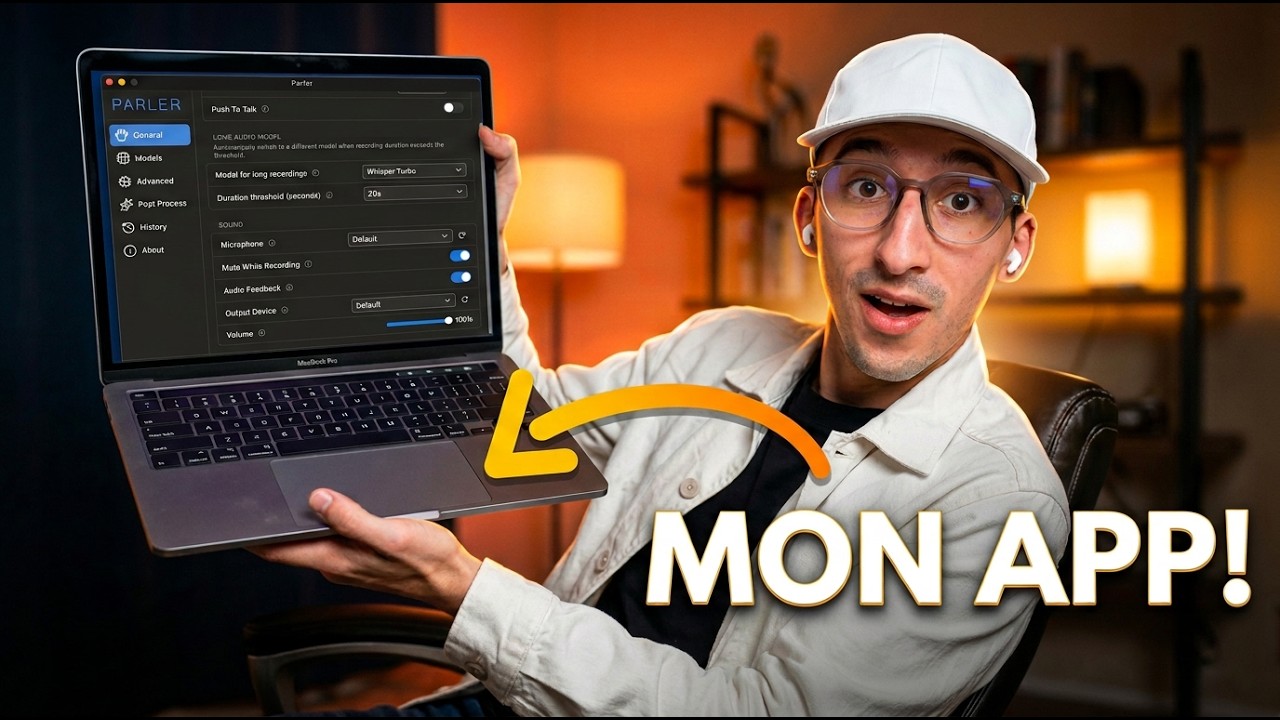
J'AI CRÉÉ L'APP PARFAITE "Speech to Text" en 1 HEURE avec Claude Code (et tu peux aussi le faire)
I CREATED THE PERFECT "Speech to Text" APP in 1 HOUR with Claude Code (and you can do it too)
Title history
- J'AI CRÉÉ L'APP PARFAITE "Speech to Text" en 1 HEURE avec Claude Code (et tu peux aussi le faire) — observed on 20261101-0139 UTC (YouTube)
Keywords
Summary
188 words
Critical Evaluation
Value of the Information & Strength of the Argument
The information is valuable for developers interested in AI-assisted coding and open-source customization. The creator presents a clear, step-by-step workflow that is directly applicable. His argumentation is pragmatic, contrasting the cost of commercial tools with the freedom of open-source projects and the power of AI to automate code changes. He demonstrates the actual output of the app, including post-processing results, which strengthens the credibility of his claims. However, the argumentation is based on personal experience and preferences rather than systematic comparisons or benchmarking. The video effectively conveys the idea that individuals can take control of software development, but it lacks a critical evaluation of limitations (e.g., error rates, configuration complexity) or alternative approaches.
Scientific Rigor, Source Quality, Title Accuracy
The video is not a scientific work but a practical tutorial. The creator cites specific open-source models and projects, and provides links to his fork and the original app in the description, which aids verifiability. The title accurately reflects the content, though the ‘1 hour’ claim might be an estimate rather than a strict measure. The video does not engage with any formal sources or peer-reviewed literature, relying instead on hands-on demonstration. The comments indicate some users found the app lacks Windows support and that security checks revealed vulnerabilities, which are not addressed in the video. Overall, the sources are limited to the mentioned open-source projects and the creator’s own repository.
239 words
Title / Content Match
The title matches the content: the creator demonstrates how to build and personalize a speech-to-text app in approximately one hour using Claude Code.
Quality & Reliability
7/10
The video offers a practical, working example of forking an open-source project and customizing it with Claude Code. The demonstrations are visual and reproducible, but there is no scientific rigor or external validation beyond the links in the description.
Chapters
- Introduction
- Comparaison des outils AI existants
- Avantages du projet open source
- Fork du projet avec GitHub
- Présentation de l'application Parler
- Test du speech to texte
- Feature de changement de modèle
- Configuration du Post Processing
- Démo des modes email et tweet
- Développer avec Claude Code
- Personnalisation des fonctionnalités
- Formation gratuite et conclusion
Cited Sources
- Parler (fork by Melvynx) — Fork of Handy with custom features demonstrated in the video.
- Handy - Speech to text app — Original open-source speech-to-text app that was forked.
- Formation Claude Code (mlv.sh/5Q0gRZy) — Training course referenced at the end of the video.
External References
Contribution & Novelties
The video demonstrates a practical, reproducible method for using Claude Code to fork and customize open-source applications, specifically a speech-to-text tool, without writing code from scratch. The novelty lies in the combination of AI-assisted coding, open-source licensing, and personal software ownership. The creator shows how to add features like model switching based on recording length, and post-processing modes, all through natural language prompts to Claude Code.
Pour aller plus loin :
- Whisper (speech recognition system) — Key open-source model used for transcription, pertinent to the video’s technical background.
- MIT License — The permissive license that enables forking and customization, central to the video’s approach.
- Tauri (software) — The framework used to build Handy and Parler, relevant for understanding the app’s architecture.
121 words
Radar Profile
The radar profile suggests a balanced assessment with strong technical detail and practical value, but moderate scientific reliability and source diversity. The video excels in hands-on demonstration and technical explanation, while lacking in formal sourcing or comparative analysis.
💬 Positive; the majority of the 30 comments are enthusiastic and grateful for the tip, with some users sharing practical feedback on installation issues or requesting features. A few note security concerns or platform limitations, but the overall climate is supportive.