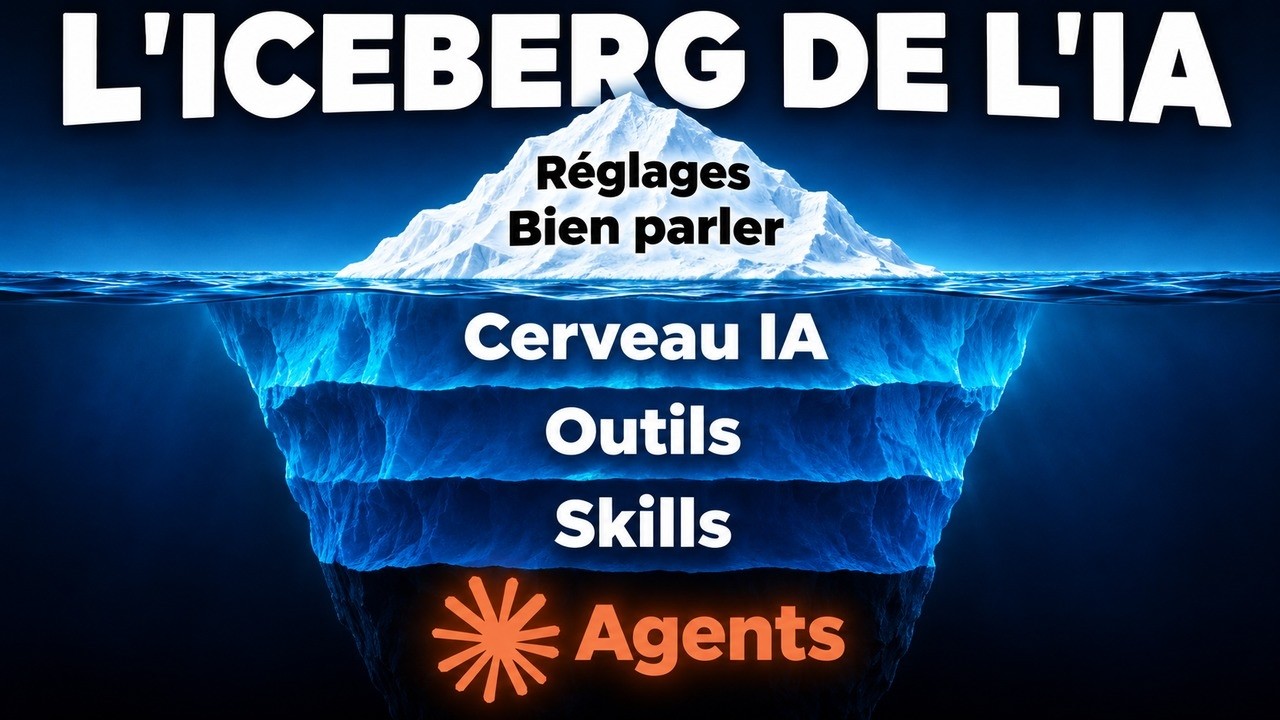
L'iceberg de l'IA : 6 niveaux, et la plupart s'arrêtent à la surface
The AI Iceberg: 6 Levels, and Most Stop at the Surface
Title history
- L'iceberg de l'IA : 6 niveaux, et la plupart s'arrêtent à la surface — observed on 20261106-1822 UTC (YouTube)
Keywords
Summary
201 words
Critical Evaluation
Value of the Information & Strength of the Argument
The core value lies in its clear, step-by-step progression from basic chat usage to sophisticated multi-agent orchestration. It provides actionable, concrete tips such as choosing ‘bypass permission’, segregating folders per project, and using a single conversation per task to avoid context overflow. The argumentation is based almost entirely on the creator’s personal workflow and success stories, such as generating posters via code or managing 10 parallel sessions. While this anecdotal approach makes the advice highly relatable and specific to the mentioned tools, it lacks empirical evidence or comparative benchmarks. The creator does not cite scientific literature or independent studies, relying instead on the persuasive power of his own initiatives and the linked resources. Consequently, the practical suggestions are plausible and useful for the targeted tool (Claude Code), but the reasoning is inductive and subjective.
Scientific Rigor, Source Quality, Title Accuracy
The scientific rigor is minimal; the video contains no citations of academic papers, engineering reports, or controlled experiments. The primary sources referenced are the creator’s own website links (mlv.sh) offering a free kit, training, and configuration guides, which serve as promotional material rather than objective verification. The only external mention is a skill created by ‘Mad Pocock’, but without a provided link. The title, ‘The AI Iceberg: 6 levels, and most people stop at the surface,’ is catchy and perfectly aligns with the content, which indeed outlines six escalating levels of competence, matching the metaphor of an iceberg where most users remain at the surface. No user comments were provided for analysis.
261 words
Title / Content Match
The title accurately reflects the content: the video presents a structured classification of six AI usage levels, from basic chat to advanced multi-agent orchestration, matching the 'iceberg' metaphor where most users remain at the surface.
Quality & Reliability
5/10
Content is highly practical and detailed but entirely based on personal anecdotes. No academic references are provided; the only sources are the creator's own promotional links and a passing mention of a community-created skill (Mad Pocock). The advice is tool-specific (Claude Code) and lacks generalizable scientific validation, though it offers actionable technical guidance.
Key Moments
Markers derived by PSI from the transcript: the creator did not define chapters.
- Introduction to the 6 levels of AI mastery.
- Level 0: Settings, using chat mode and its limitations.
- Level 1: Switching to Code mode and adjusting permissions (auto/bypass).
- Level 1: Speaking well to Claude, one task equals one conversation.
- Example: Generating a poster using code versus image generation.
- Level 2: Setting up an AI brain with AGENTS.md.
- Level 3: Branching tools (Connect Tool, Gmail, Notion).
- Level 4: Implementing and reusing skills (e.g., Grill Me, devis).
- Level 5: Launching sub-agents and parallel sessions.
- Summary of the 6 levels and call to action.
Cited Sources
- Free AI Brain Kit (6 levels) — Promoted at the beginning, middle, and end of the video as the main resource for installing the AI brain, connecting tools, and expanding workflows.
- AI Training — Cited as a general AI training resource for users.
- Agent Configuration — Cited as a configuration guide for agents (Claude Codex).
- Assistant Training — Cited as a formation for assistants.
- Blog — Creator's blog for further reading.
- One-on-One — Link to discuss directly with the creator.
- Twitter — Social media link.
- GitHub — Creator's GitHub profile.
- Discord — Community Discord server.
Contribution & Novelties
The original contribution is the proposition of a structured 6-level taxonomy for AI mastery, moving beyond simple prompting to system orchestration. Integrating AGENTS.md management, category-specific skills, and parallelized sub-agents into a single progressive framework is a useful mental model for intermediate users. However, this framework is tool-centric (Claude Code) and unvalidated.
Pour aller plus loin :
- Multi-agent system — Provides a theoretical background on how multiple agents interact, which is the technical foundation of the video’s Level 5.
- Prompt engineering — Explores the broader discipline of effectively communicating with AI models, which the video’s ‘Grill Me’ skill and ‘one task = one conversation’ rule address pragmatically.
- Software agent — Discusses the general concept of autonomous software entities acting on behalf of users, relevant to the creation of ‘AI brains’ and ‘skills’.
- Anthropic — Contextualizes the parent company of Claude, aiding understanding of the ecosystem in which these levels are applied.
150 words
Radar Profile
The profile shows high scores in information quantity and technical level, reflecting the dense, step-by-step nature of the tutorial. The quality of information is moderate, as it is practical but lacks independent evidence. The weakest axis is global reliability, which plummets due to the absence of validated sources and the promotional aspect of the content.