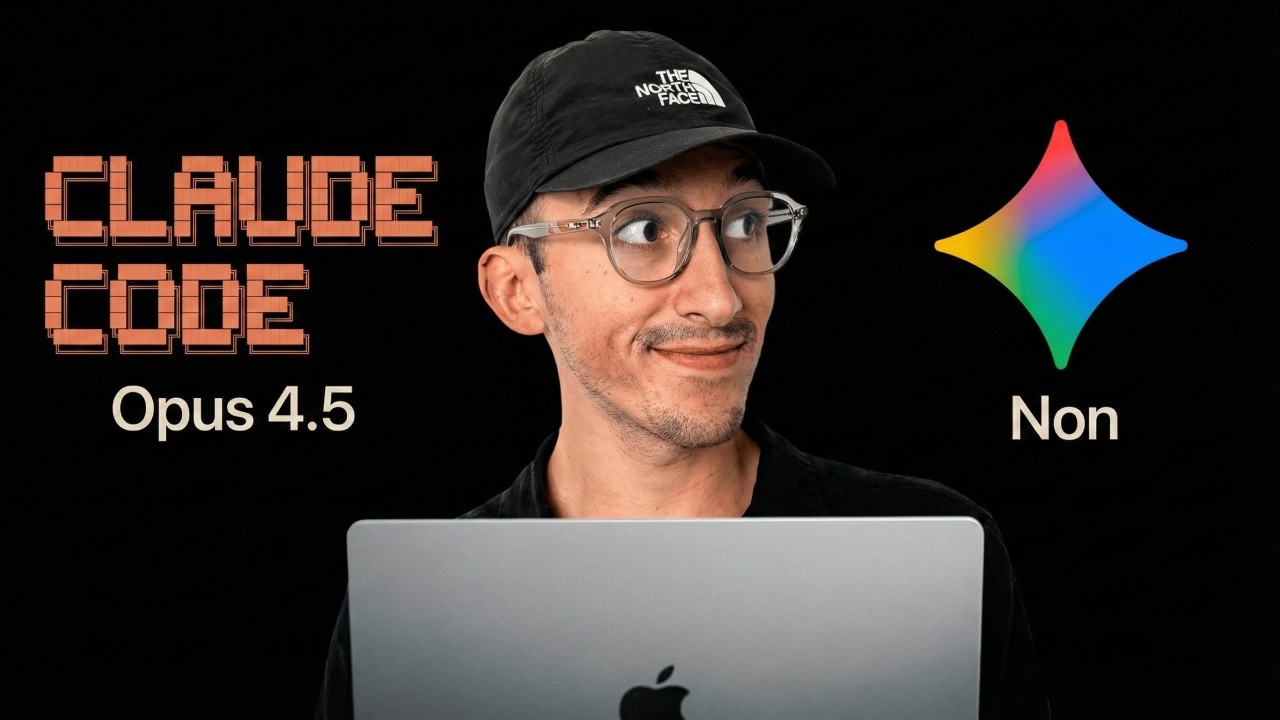
Opus 4.5: 10x meilleur que GEMINI (je n'ai jamais vu un aussi bon modèle)
Opus 4.5: 10x better than GEMINI (I have never seen such a good model)
Title history
- Opus 4.5: 10x meilleur que GEMINI (je n'ai jamais vu un aussi bon modèle) — observed on 20261101-0158 UTC (YouTube)
Keywords
Summary
181 words
Critical Evaluation
Value of the Information & Strength of the Argument
The video’s main value lies in its practical demonstration of model capabilities on realistic tasks, rather than relying solely on abstract benchmarks. Melvynx provides a clear methodology for fair comparison, tests multiple scenarios (feature creation, bug fixing, UI refactoring), and shows concrete results, including code snippets and screenshots. His argumentation is convincing when he highlights that Opus 4.5 consistently outperforms Gemini 3 on coding tasks, and that Claude Code leverages Opus 4.5’s strengths more effectively than Cursor. However, he occasionally overstates conclusions, such as dismissing Gemini entirely, and his comparison is limited to a narrow set of web development tasks, which may not reflect performance in other domains. The pricing discussion is insightful, suggesting that Opus 4.5 can be cost-effective despite higher rates due to lower token consumption. Overall, the argumentation is solid but biased towards Anthropic, as he openly admits his preference.
Scientific Rigor, Source Quality, Title Accuracy
The scientific rigor is moderate. Melvynx references external tweets and benchmark scores, but he does not provide direct links or detailed methodologies for these benchmarks. He relies heavily on his own tests, which are not reproducible without the exact project setup. The video lacks critical evaluation of the benchmarks’ limitations (e.g., SWE-bench’s focus on Python/Django). The title is arguably clickbait, as ‘10x better’ is an unquantified claim not supported by his limited tests; nevertheless, the tests do show notable superiority over Gemini in the specific tasks. The description links are primarily promotional (his own courses and social media), not scientific sources. No comments are provided for analysis, so public feedback is not assessed.
271 words
Title / Content Match
The title claims a 10x improvement over Gemini, which is hyperbolic, but the video does demonstrate Opus 4.5 outperforming Gemini 3 on the tested coding tasks.
Quality & Reliability
7/10
The video provides hands-on tests and comparative benchmarks, but the methodology is subjective and limited to two specific coding environments (Cursor and Claude Code), with some personal bias toward Anthropic models.
Chapters
- Introduction & objectif de la vidéo
- Préparation du test dans Cursor
- Choix des modèles et workflow
- Tweets, benchmarks et pricing Opus
- Lancement des agents et premiers résultats
- Résultats Sonnet vs Opus 4.5
- Échec et critique de Gemini 3
- Opus 4.5 testé sur ClaudeCode
- Worktrees, fixes de bug et bouton sender
- Conclusion et recommandations
Cited Sources
- Formation IA — Lien vers la formation gratuite de l'auteur mentionnée en fin de vidéo
- Blog — Blog personnel de l'auteur
- Discord — Serveur Discord communautaire
- GitHub — Compte GitHub de l'auteur
- Cours JavaScript — Cours gratuit JavaScript
- Cours NextJS — Cours gratuit NextJS
- Masterclass SaaS — Masterclass sur les SaaS
- Échange direct — Réservation de session en direct avec l'auteur
- Cours React — Cours gratuit React
- Twitter — Compte Twitter de l'auteur
Contribution & Novelties
The video provides an accessible, hands-on comparison of Claude Opus 4.5 with previous models, giving developers a practical sense of its strengths and weaknesses. It also highlights the importance of the coding environment (Cursor vs. Claude Code) in model performance, a nuance often overlooked in benchmark-driven discussions. The pricing analysis offers useful insight into cost optimization with the new model.
Pour aller plus loin :
- Claude (language model) — Overview of Anthropic’s Claude series, including context on Opus.
- Gemini (language model) — Overview of Google’s Gemini models, useful for comparison.
- SWE-bench — A widely cited benchmark for AI coding performance; consult the official repository or academic papers for details.
109 words
Radar Profile
The profile shows high scores in information quantity and technical level, reflecting the detailed hands-on tests and benchmark discussion. Quality and reliability are slightly lower due to subjective bias and limited sample size, while fiabilité is moderate because the conclusions are based on a small set of informal experiments.
💬 Équilibré — Sur les 30 commentaires analysés, plusieurs spectateurs valident la démonstration de Melvynx et apprécient la clarté du comparatif, tandis que d'autres défendent Gemini 3 sur des tâches complexes et pointent le coût élevé de Claude, parfois avec désaccord sur la méthodologie.