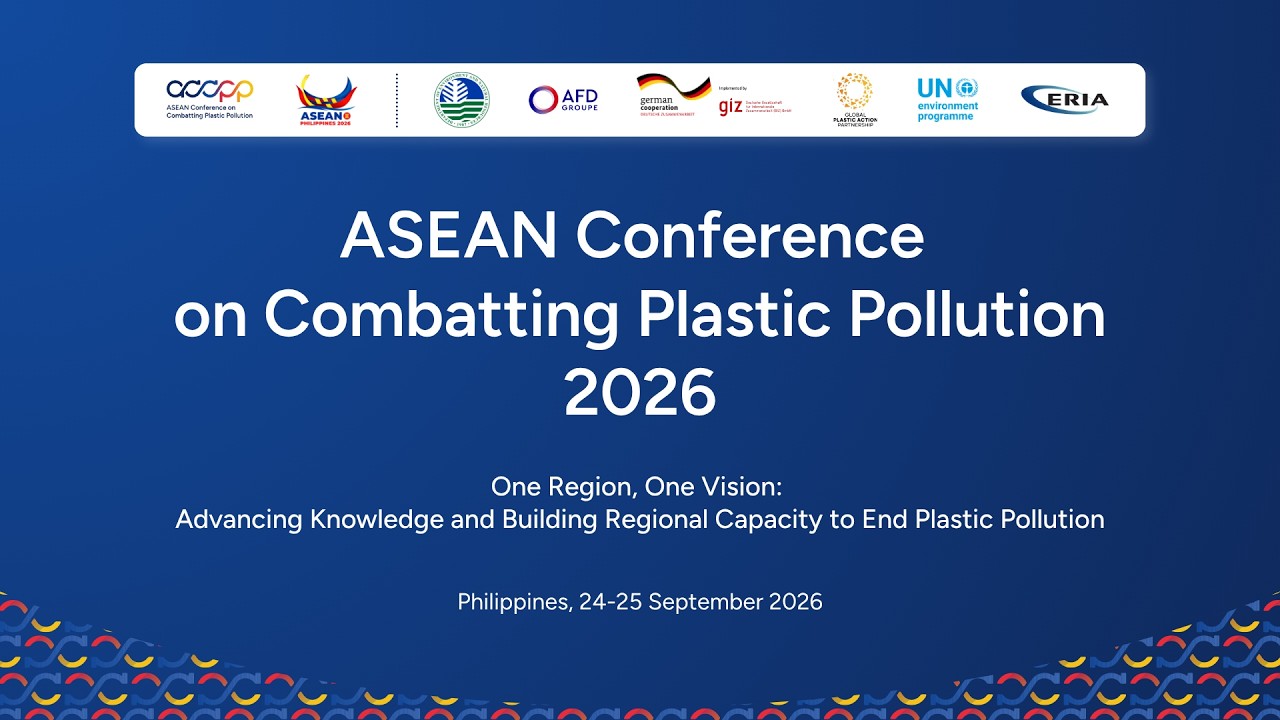
ERIA | ASEAN Conference on Combatting Plastic Pollution (ACCPP) 2026 – Manila, 24-25 September 2026
Keywords
Summary
164 words
Critical Evaluation
Value of the Information & Strength of the Argument
The conference provides valuable insights into the current state of plastic pollution governance in ASEAN, offering concrete data and case studies from around the region. The presentations on EPR highlight design challenges and the need for inclusive approaches. The argumentation is generally solid, drawing on reports from OECD, UNEP, and national roadmaps, and emphasizes systemic solutions. However, as a conference recording, it lacks the depth of a peer-reviewed study, and the discussion is often high-level. The strongest points are the emphasis on multi-stakeholder collaboration and the practical examples of national plastic action partnerships.
Scientific Rigor, Source Quality, Title Accuracy
The sources cited are authoritative, including OECD data, UNEP estimates, and official national roadmaps. The video is an official recording, ensuring authenticity. The title is perfectly aligned with the content, clearly indicating the nature and scope. The conference is well-structured, with clear session topics and expert moderators. The main limitation is that it is a conference recording, so statements are not subject to peer review, but they are based on institutional knowledge and data.
182 words
Title / Content Match
The title accurately describes the content: a full recording of the ASEAN Conference on Combatting Plastic Pollution. The description matches the video.
Quality & Reliability
8/10
The video is an official recording of a regional conference co-hosted by ERIA and the Philippine DENR, featuring high-level government officials, international organizations (WEF, UNEP, AFD, GIZ), and experts. The content is policy-oriented and provides credible data from OECD and UNEP. However, it is a conference recording, not peer-reviewed research, so it is reliable for policy and governance information but not for original scientific findings.
Key Moments
Markers derived by PSI from the transcript: the creator did not define chapters.
- Welcoming Remarks by Atty Juan Miguel T. Cuna
- Opening Remarks by Tetsuya Watanabe
- Opening Remarks by Roisin Greene
- Session 1: Governance as the Cornerstone of Effective EPR for Plastics
- OECD-ASEAN Regional Plastics Outlook by Dr Shardul Agrawala
- Session 2: Unlocking Capital for a Circular Plastics Economy
- Session 4: Measuring the Impact: Behaviour Change for Plastic Pollution
- Session 6: Advancing Circular Plastics in ASEAN
- Closing Remarks by Christophe Bahuet
Cited Sources
- Regional Knowledge Centre for Marine Plastic Debris — ERIA's Regional Knowledge Centre for Marine Plastic Debris is mentioned as the co-host and provides resources for plastic pollution research and capacity building.
Contribution & Novelties
The video provides a comprehensive record of the ACCPP 2026 conference, capturing the latest developments in ASEAN’s approach to plastic pollution. It offers insights into regional strategies, national roadmaps, and the role of extended producer responsibility. The presentations and discussions highlight the need for systemic change and the integration of finance, policy, and behavior. The conference serves as a platform for knowledge exchange and sets the agenda for future action.
Pour aller plus loin :
- OECD Plastic Work — Relevant OECD reports and data on plastic leakage and policy.
- Extended Producer Responsibility (Wikipedia) — Overview of EPR principles and implementation globally.
- UNEP Beat Plastic Pollution — UNEP’s global initiatives and solutions for plastic pollution.
114 words
Radar Profile
The scores indicate a high volume of information (10) with high quality (9) and reliability (9), and moderate technical depth (7). This profile suits a policy-oriented conference with strong institutional backing, but not highly technical research.