ERIA | KOBELCO Group Initiatives Aimed at Achieving Carbon Neutrality by Mr Noriaki Takamuku | AJSI
Keywords
Summary
181 words
Critical Evaluation
Value of the Information & Strength of the Argument
The value of the information lies in its detailed explanation of MIDREX technology and its role in reducing carbon emissions in steel production. The argumentation is coherent and follows a logical structure: from problem identification (global warming as a business risk) to proposed solutions (MIDREX, HBI in blast furnaces, and a technological roadmap). The speaker provides specific numbers (e.g., 30-40% reduction by 2030, 78 million tons avoided emissions by 2030) and cites a certification by DNV for a carbon-avoided steel product, adding credibility. However, the presentation is largely one-sided, showcasing the company’s own technology without addressing potential drawbacks or alternative approaches, which limits its critical value.
Scientific Rigor, Source Quality, Title Accuracy
The scientific rigor is moderate: the technical details of MIDREX are explained but without external references or peer-reviewed sources. The only named source is DNV, a certification body, but no specific standard or report is cited. The title accurately matches the content, so adequacy is good. The presentation is a corporate webinar, so the primary purpose is marketing and information dissemination rather than academic analysis.
186 words
Title / Content Match
The title accurately reflects the content: a KOBELCO executive presenting their carbon neutrality initiatives in a webinar.
Quality & Reliability
6/10
The presentation is a corporate webinar by a KOBELCO representative, providing a high-level overview of their carbon neutrality strategy and MIDREX technology. The technical details are plausible but not independently verified; the content is promotional in nature, with limited critical analysis or external references.
Key Moments
Markers derived by PSI from the transcript: the creator did not define chapters.
- Introduction to KOBELCO's business portfolio and history
- Declaration of carbon neutrality goal by 2050 and medium-term management plan
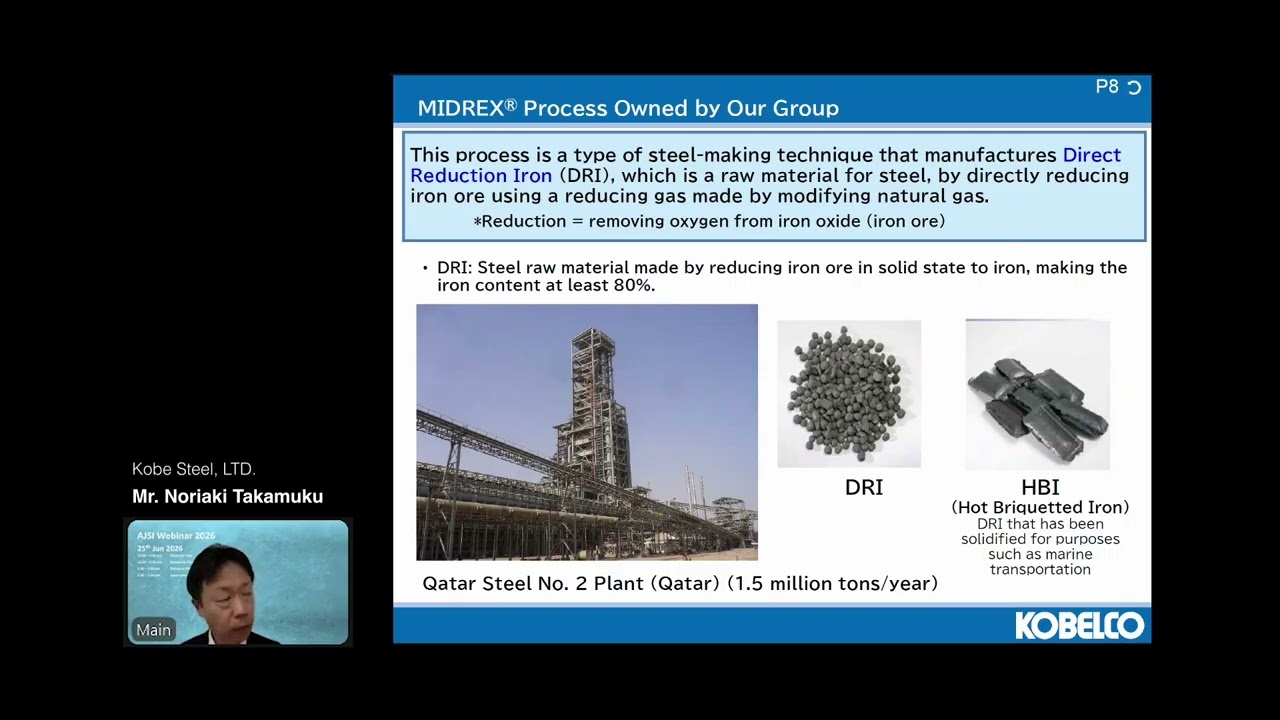
- Explanation of MIDREX process: direct reduction of iron ore with hydrogen-rich gas
- Features of MIDREX: hydrogen-rich reducing gas, CO2 recycling, and lower emissions
- Use of HBI in blast furnaces to reduce CO2 emissions by ~20%
- Certification of carbon-avoided steel by DNV
- Roadmap: integrating MIDREX, existing blast furnaces, biomass, AI, CCUS, and green hydrogen
Cited Sources
- DNV certification — Mentioned as a certification body verifying CO2 reduction from HBI charging at the Kakogawa Works.
Contribution & Novelties
The presentation offers a corporate perspective on decarbonization in the steel industry, specifically highlighting KOBELCO’s proprietary MIDREX technology as a practical near-term solution. It provides specific performance data (e.g., 20% CO2 reduction using HBI in blast furnaces) and mentions commercialization efforts. The novel aspect is the emphasis on integrating DRI with existing blast furnace operations as a transitional strategy.
Pour aller plus loin :
- MIDREX Technologies — Official website of MIDREX, the direct reduction process provider.
- Direct reduced iron — Overview of DRI production and its role in steelmaking.
- Carbon neutrality — General concept and policies related to achieving net-zero emissions.
101 words
Radar Profile
The radar profile shows a moderate quantitative and qualitative score, with a higher technical level reflecting the specific process details. Reliability is moderate due to the promotional nature and lack of external verification.