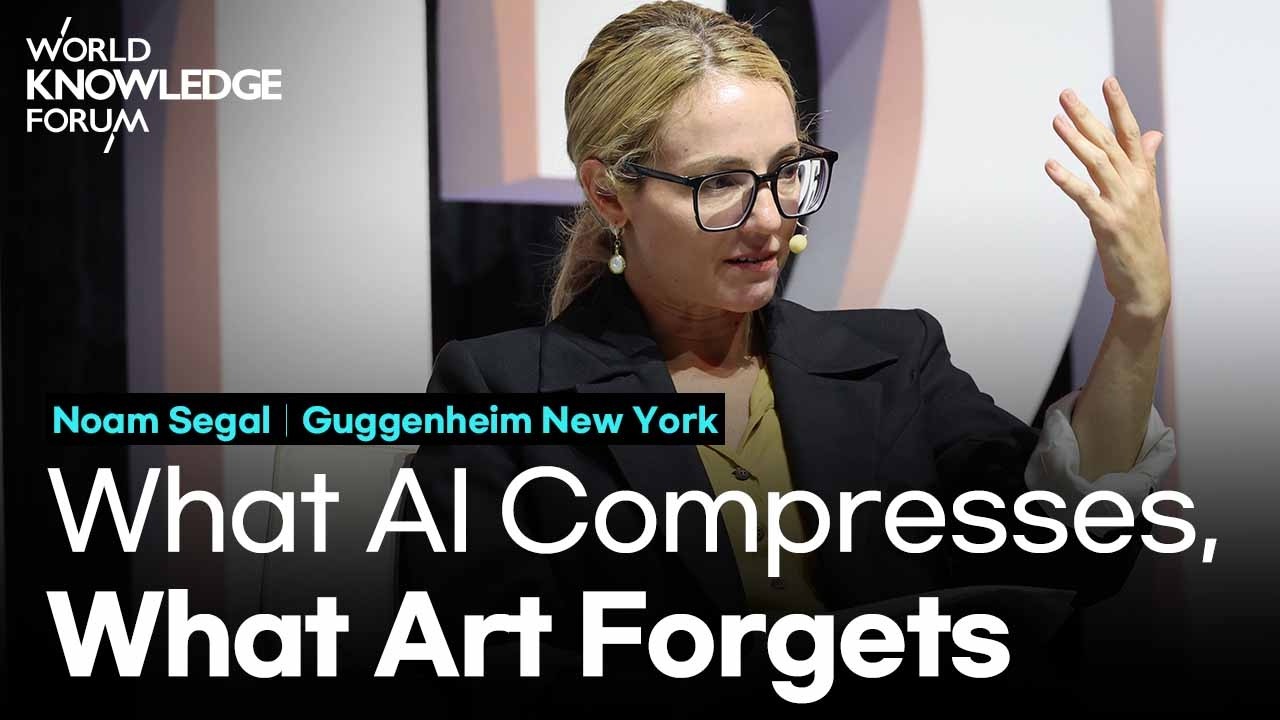
AI, Art, and the Future of Creativity
Keywords
Summary
183 words
Critical Evaluation
Value of the Information & Strength of the Argument
The value of the information is high: it provides a sophisticated theoretical framework linking information theory, AI compression, and art history, supported by concrete examples from contemporary artists. The argumentation is well-structured, moving from historical precedents (Jacquard, JPEG) through technical distinctions (three forms of compression in AI) to a philosophical discussion of cultural loss and artistic response. The speaker’s use of Duchamp as a counterexample to pattern-based AI is compelling, and the case studies effectively illustrate the proposed strategies. However, the presentation is opinion-driven and lacks empirical data or quantitative evidence to back claims about cultural loss, making the argumentation more persuasive than rigorously scientific.
Scientific Rigor, Source Quality, Title Accuracy
The speaker references well-known concepts (lossy compression, latent representation) and artists (Duchamp, Dinkins, Kang, Kulendran Thomas) but does not cite specific academic sources or publications. The provenance of claims is largely anecdotal and institutional (Guggenheim/LG award recipients). The title accurately matches the content, though it is broad; the talk focuses more on the tension between compression and context than on creativity in general. No comment data was provided, so public reception cannot be assessed.
194 words
Title / Content Match
The title accurately reflects the content: the talk explores how AI transformations affect creativity and cultural heritage, with deep philosophical and practical implications.
Quality & Reliability
9/10
The presentation offers a nuanced, expert-led analysis of AI's impact on art and cultural memory, drawing on specific technical concepts (lossy compression, latent spaces) and concrete artist examples. The argumentation is coherent, though it reflects a particular institutional perspective (Guggenheim) and lacks external verification of claims.
Key Moments
Markers derived by PSI from the transcript: the creator did not define chapters.
- Opening thanks and introduction to the topic of knowledge preservation.
- Discussion of Jacquard loom as early cultural compression.
- Explanation of lossy compression in JPEG and AI training.
- Distinguishing three types of loss: pixel, representational, contextual.
- Marcel Duchamp and the unpatterning of art.
- Artist strategies: Stephanie Dinkins, Yiyun Kang, and Kulendran Thomas.
- Conclusion on co-evolution and returning provenance to circulation.
Contribution & Novelties
The talk brings a fresh interdisciplinary perspective by framing AI generative models as ’lossy compression’ of cultural memory, a metaphor that bridges engineering and art history. It offers a clear typology of compression (pixel, representational, contextual) and argues that artists can deliberately counteract this loss by reinserting provenance, intimacy, and physicality. The case studies of Dinkins, Kang, and Kulendran Thomas provide concrete examples of such practices.
Pour aller plus loin :
- Lossy compression — Core technical concept underlying the talk’s central metaphor.
- Generative adversarial network — The AI architecture type used by many artists discussed, though not explicitly named.
- Provenance — Key concept for understanding the loss of historical context in AI training data.
- Marcel Duchamp — Reference point for the critique of ‘retinal art’ and the separation of image from meaning.
132 words
Radar Profile
The radar profile shows a strong performance across quantity, quality, and technical depth, with a slightly lower score for reliability, reflecting the opinion-based nature of the talk. The high quantity and quality scores indicate a rich, well-argued presentation, while the moderate technical score aligns with its accessibility to a general audience. Overall, the profile suggests a valuable discourse with room for more empirical grounding.