The Future of Work
Title history
- The Future of Work — observed on 20261110-1509 UTC (YouTube)
Keywords
Summary
182 words
Critical Evaluation
Value of the Information & Strength of the Argument
The video provides a well-structured and balanced overview of the debate on AI and work. The host effectively frames the topic with historical context and a clear conceptual model, while the panelists offer diverse expert perspectives. Joel Blit’s discussion of tacit knowledge offers an original lens, and the arguments are generally logically presented. The value lies in its synthesis of known research and the articulation of policy considerations. However, some claims could benefit from deeper empirical support, and the discussion occasionally remains at a high level without concrete data.
Scientific Rigor, Source Quality, Title Accuracy
The video references several credible sources, including academic papers (Frey and Osborne, Bloom), reports from McKinsey, the OECD, and the IMF, as well as IBM surveys. These are cited in the description, enhancing the scientific rigor. The title accurately reflects the content, which explores the future of work from multiple angles. The panelists are knowledgeable and provide informed opinions, though the format primarily relies on their expertise rather than presenting new research. Overall, the sources are reliable and the title matches the substance.
187 words
Title / Content Match
The title accurately reflects the content, which explores technological impacts on employment and society.
Quality & Reliability
8/10
The video features a panel of experts with relevant backgrounds and references numerous credible sources, including academic papers and institutional reports. However, the discussion is largely expository and not all claims are formally verified.
Key Moments
Markers derived by PSI from the transcript: the creator did not define chapters.
- Introduction: Host Rohinton Medhora sets up the topic and introduces the conceptual framework of technology and employment.
- Discussion of AI quadrants and the speed of AI change compared to previous technological revolutions.
- Impact of AI on various industries and the role of generative AI in different occupations.
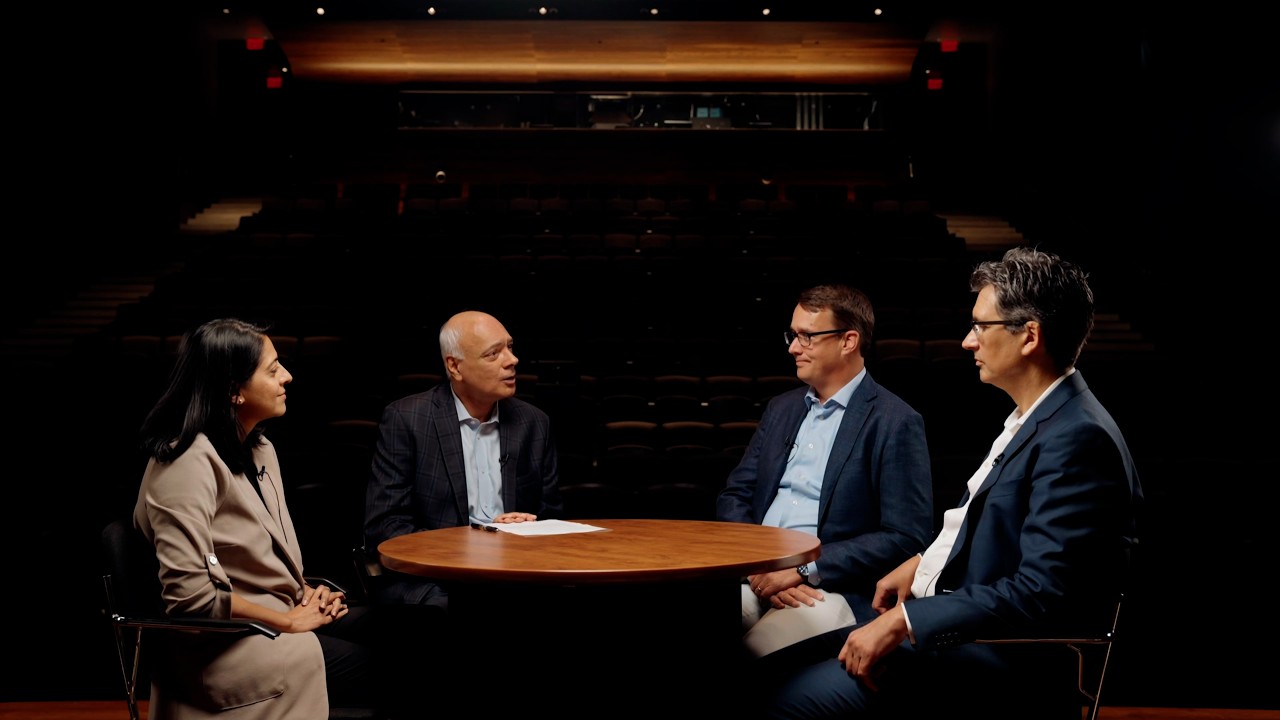
- Panel introduction: Joel Blit, Mai Mavinkurve, and Monte McNaughton join to discuss the issues.
- Joel Blit explains how AI captures tacit knowledge and its implications for labor markets.
- Mai Mavinkurve discusses the human skills that remain valuable, such as accountability and care.
- Monte McNaughton talks about the need for education reform to adapt to the changing world of work.
- Concluding remarks on policy responses and the importance of human qualities.
Cited Sources
- The Future of Employment (Frey and Osborne, 2013) — Cited as predicting 47% of US jobs at risk of automation.
- The 2 Sigma Problem (Bloom, 1984) — Referenced in the context of educational methods and tutoring.
- The State of Science, Technology, and Innovation in Canada 2025 — Likely mentioned in relation to Canadian innovation and policy.
- Caveman cartoon (Dan Collins) — Used to illustrate the technology-employment nexus.
- Augmented work for an automated, AI-driven world (IBM Institute for Business Value, 2023) — Referenced for insights on skills and workforce changes.
Contribution & Novelties
The video synthesizes existing research and expert opinion, offering a balanced perspective on AI’s impact on work. Its original contribution includes the framing of AI as a capturer of tacit knowledge, which provides a nuanced lens for understanding which jobs may be affected. The discussion also highlights the importance of non-technical skills, aligning with recent shifts in employer priorities.
Pour aller plus loin :
- Universal basic income — relevant to the discussion of social safety nets.
- Tacit knowledge — central to Joel Blit’s argument.
- The Future of Employment — background on Frey and Osborne’s prediction.
95 words
Radar Profile
The profile shows high scores in information quantity and quality, moderate technical level, and solid reliability. The video is informative and credible but not overly technical, making it accessible to a broad audience.