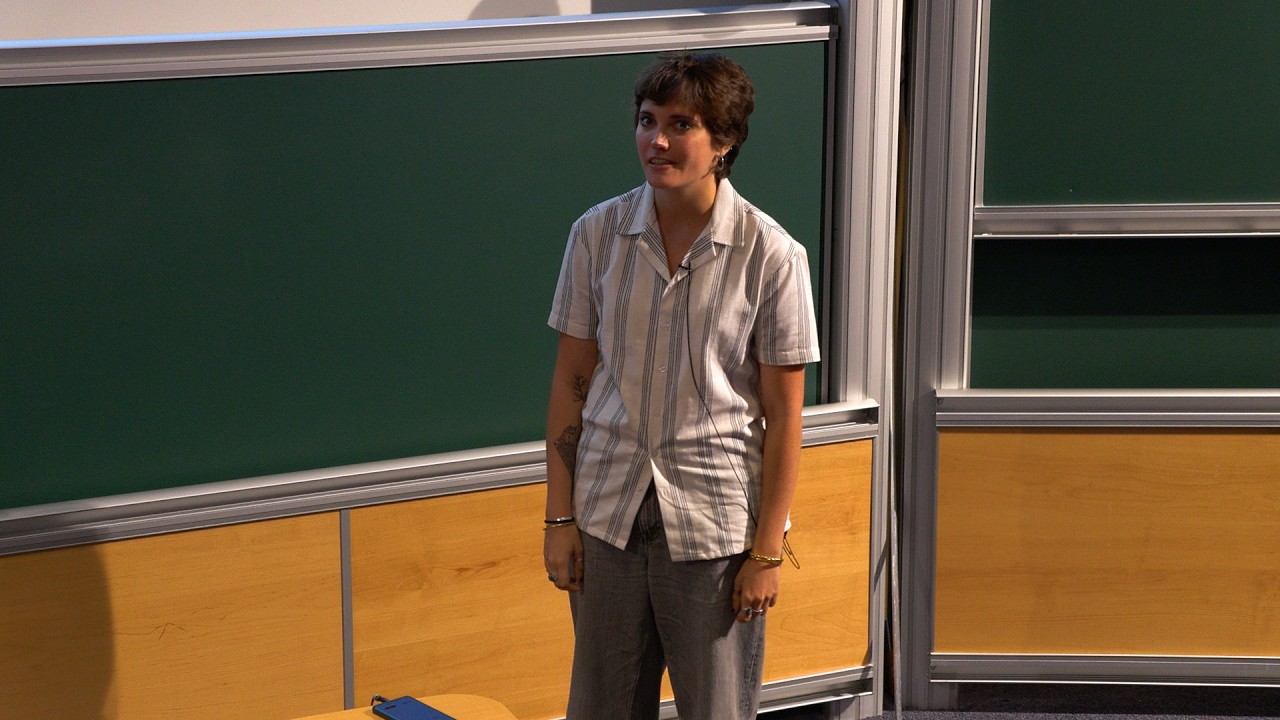
Matilda Delgado - Anomalies and the structure of String Theory
Keywords
Summary
226 words
Critical Evaluation
Value of the Information & Strength of the Argument
The value of the information is high for researchers in theoretical high-energy physics, as it addresses a relatively underexplored area (non-supersymmetric strings) using modern mathematical tools (bordism groups). The argumentation is rigorous: the speaker careful defines anomalies, uses the modern approach via bordism groups, and clearly separates local vs global anomalies. The argument for using anomalies as consistency conditions is well-motivated, and the technical details (e.g., spectral sequences) are presented at a level appropriate for a specialist audience. The novelty lies in the first computation of global anomalies for non-supersymmetric strings and in the worldsheet anomaly analysis for type II orbifolds. The speaker also acknowledges open questions (e.g., the status of one of the 10D strings) and discusses limitations. The logical flow is clear, and the inclusion of Q&A strengthens the presentation.
Scientific Rigor, Source Quality, Title Accuracy
The scientific rigor is strong: the talk is based on two arXiv preprints (2606.18380 and 2310.06895), which are recent and likely to be peer-reviewed in the near future. The speaker uses well-defined mathematical concepts (bordism, twisted string structures) and explicitly states assumptions. However, as a conference talk, no detailed proofs are given, relying on the audience’s background. The title is perfectly aligned with the content, as both spacetime and worldsheet anomalies are discussed. No public comments were provided, so no validation from the community is available. The speaker mentions a personal communication about a K-theoretic anomaly, but does not provide a reference, which slightly reduces the reproducibility.
254 words
Title / Content Match
The title accurately reflects the content: the talk indeed covers anomalies in string theory, focusing on both spacetime and worldsheet anomalies.
Quality & Reliability
7/10
The talk presents recent research based on arXiv preprints [2606.18380] and [2310.06895], with rigorous mathematical methods (bordism groups, spectral sequences). However, the results are not peer-reviewed and some open questions remain (e.g. the 10D SO(16) string global anomaly status). Overall reliable but not fully settled.
Key Moments
Markers derived by PSI from the transcript: the creator did not define chapters.
- Introduction and motivation for non-supersymmetric string theory
- Crash course on anomalies and bordism groups
- Discussion of the three 10D non-supersymmetric strings and their gauge groups
- Computation of 11D twisted string bordism groups and results for Sugimoto and SO(16)×SO(16)
- Transition to worldsheet anomalies and the inverse question of allowed spacetimes
- Review of type II worldsheet and GSO projection
- Orbifold construction and mixed anomalies between fermionic parity and orbifold group
- General analysis of flat space orbifolds and conditions for consistency
- Summary, open questions, and Q&A about compactifications
Cited Sources
- arXiv:2606.18380 — Main reference for the talk's results on spacetime and worldsheet anomalies
- arXiv:2310.06895 — Related previous work on worldsheet anomalies in string theory
- CARMEN.TV - IHES video platform — Platform hosting the video and related scientific content
Contribution & Novelties
The talk presents original results on anomaly cancellation in non-supersymmetric string theories and on worldsheet anomaly constraints for type II orbifolds. The key novelty is the first systematic computation of global anomalies using bordism groups for the Sugimoto and SO(16)×SO(16) strings, showing they are anomaly-free, while leaving one case open. The worldsheet anomaly analysis is also original, linking the consistency of orbifold backgrounds to a mixed anomaly between fermionic parity and the orbifold group.
Pour aller plus loin :
- Bordism group (Wikipedia) — Background on bordism, a central mathematical tool used in the talk.
- Anomaly cancellation in string theory (nLab) — Overview of anomaly cancellation mechanisms in string theory.
- GSO projection (Wikipedia) — Explanation of the Gliozzi-Scherk-Olive projection, reinterpreted in the talk as gauging fermionic parity.
126 words
Radar Profile
The radar profile shows high technical level (9) and good information quality (8), while quantity (7) and reliability (7) are moderate. This reflects a specialized seminar with deep mathematical content but limited scope (focused on anomalies). The profile is typical for a cutting-edge research talk.