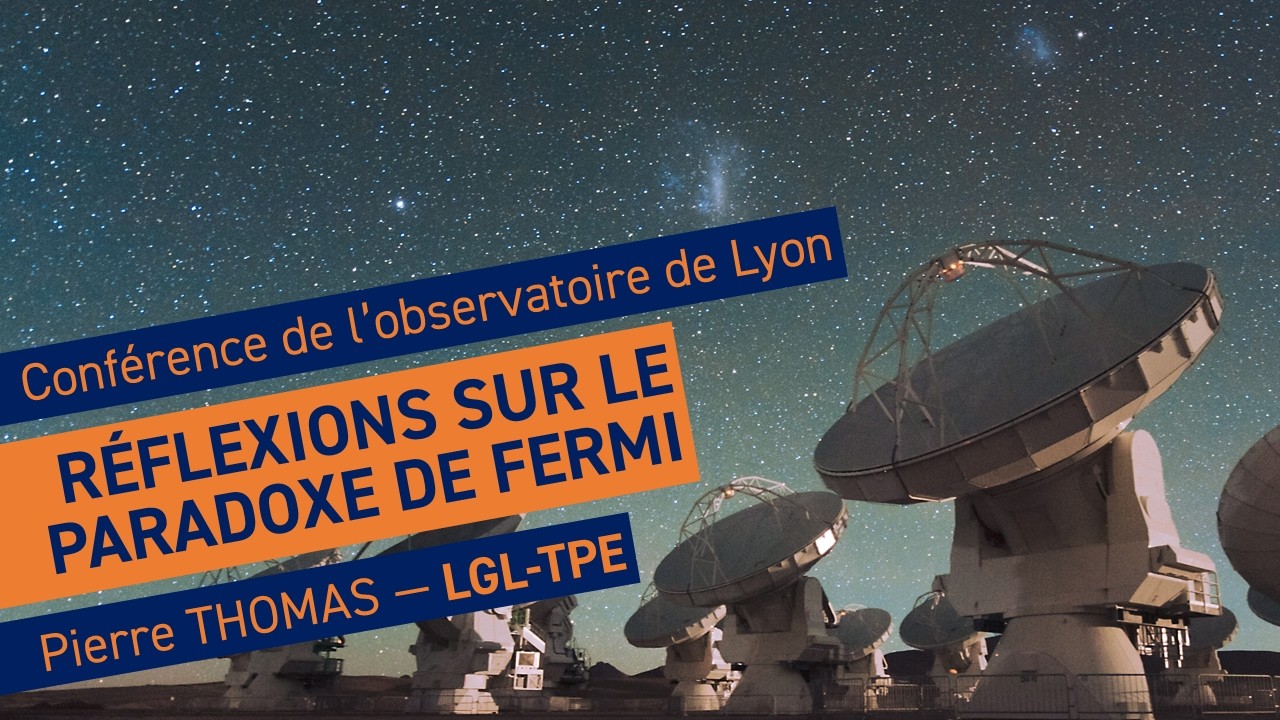
Le paradoxe de Fermi | Conférence de l'observatoire de Lyon
The Fermi Paradox | Lyon Observatory Lecture
Keywords
Summary
213 words
Critical Evaluation
Value of the Information & Strength of the Argument
The value of the talk is its synthesis of astronomical, geological and biological evidence around a single question. It gives concrete examples that are often missing from short treatments: the fossil record as a negative detector of crashed probes, the GEIPAN statistics on unexplained sightings, the distinction between rocky and gaseous exoplanets, and the range of extremophile habitats that widen the plausible envelope for life. The argument is structured and cumulative: the speaker first tests the claim that aliens are already here, then examines how exoplanet discoveries change the terms of the paradox, and finally asks whether the paradox is really paradoxical. Its main weakness is that the quantitative parts are rough and rhetorical. The estimate that 10^13 to 10^14 UFOs should have crossed Earth over three billion years depends on strong assumptions about sighting rates, detection probability and the representativeness of French airspace; it is illustrative rather than a formal calculation. The claim that an intelligent alien would not resemble a humanoid is well argued from evolutionary contingency, but it is presented through anecdote and museum images rather than a systematic review. The talk also moves between UFO sightings, interstellar visitation and radio signals without always separating their different evidentiary standards. Overall, the argumentation is clear and thought-provoking, but it should be read as an expert synthesis rather than a definitive analysis.
Scientific Rigor, Source Quality, Title Accuracy
The scientific rigour is good for a lecture: the speaker is an academic geologist, the setting is a university observatory, and most factual claims—exoplanet detection since 1995, high-temperature and high-pressure microbial life, the distinction between rocky and gaseous planets—are broadly consistent with established science. The treatment is also appropriately cautious in places: the speaker notes that the solar system is a single known case, that intelligence does not fossilise directly, and that inferences from fossils to intelligence are indirect. However, the lecture has no bibliography or explicit references. The exoplanet count of 8,306 is given without a catalogue or date source, and the GEIPAN figures are summarised without linking to the official reports. Several claims are simplified for rhetorical effect: the statement that no geologist has ever found a fossil flying saucer is a vivid absence-of-evidence argument, not a statistical test of visitation. Source quality is therefore limited to the institutional link in the description and the named bodies mentioned in the talk, with no peer-reviewed literature cited on screen. The title is accurate: it announces a lecture on the Fermi paradox at the Lyon Observatory, and the content delivers that subject without misleading clickbait, even though the treatment is more geological and biological than the title alone might suggest.
448 words
Title / Content Match
The title accurately announces a lecture on the Fermi paradox given at the Lyon Observatory. The content follows that theme, although the evidence base is mainly geological and biological rather than purely astronomical.
Quality & Reliability
7/10
Academic lecture by a geologist at a university observatory; the content is broadly consistent with established astronomy, geology and biology and is appropriately caveated in places, but it is a synthesis without bibliography and includes rough illustrative estimates.
Chapters
Cited Sources
- Observatoire de Lyon — Official observatory page and programme link provided in the video description.
- GEIPAN – Groupe d'études et d'informations sur les phénomènes aérospatiaux non identifiés — Named in the lecture as the French official body that receives and investigates UFO reports; its annual statistics are discussed.
Contribution & Novelties
The originality of the lecture lies in applying a geologist’s evidence standard to the Fermi paradox: instead of asking only whether radio signals are detected, it asks whether repeated physical visitation should have left fossils, craters or debris in the geological record. It also combines exoplanet demographics with extremophile biology to argue that the habitable envelope may be broader than classical definitions suggest, while the absence of any trace of visitation over billions of years remains a strong negative observation. The talk is a synthesis rather than a new empirical contribution, but its fossil-record framing and its critique of the humanoid Roswell image are memorable pedagogical moves.
Further reading:
- Fermi paradox — Background on the 1950 question and the main proposed resolutions.
- Extremophile — Context for the examples of life at high temperature, pressure, salinity and under ice.
- Exoplanet — Overview of detection methods and the growing catalogue discussed in the lecture.
- Habitable zone — Conceptual background for the argument that habitable zones may not be as narrow as often assumed.
171 words
Radar Profile
The profile is information-rich but not highly technical: many concrete examples and empirical anchors are supplied, while the treatment remains an accessible synthesis. Reliability is supported by the academic setting and the speaker's expertise, but limited by the absence of formal citations and by rough illustrative estimates.