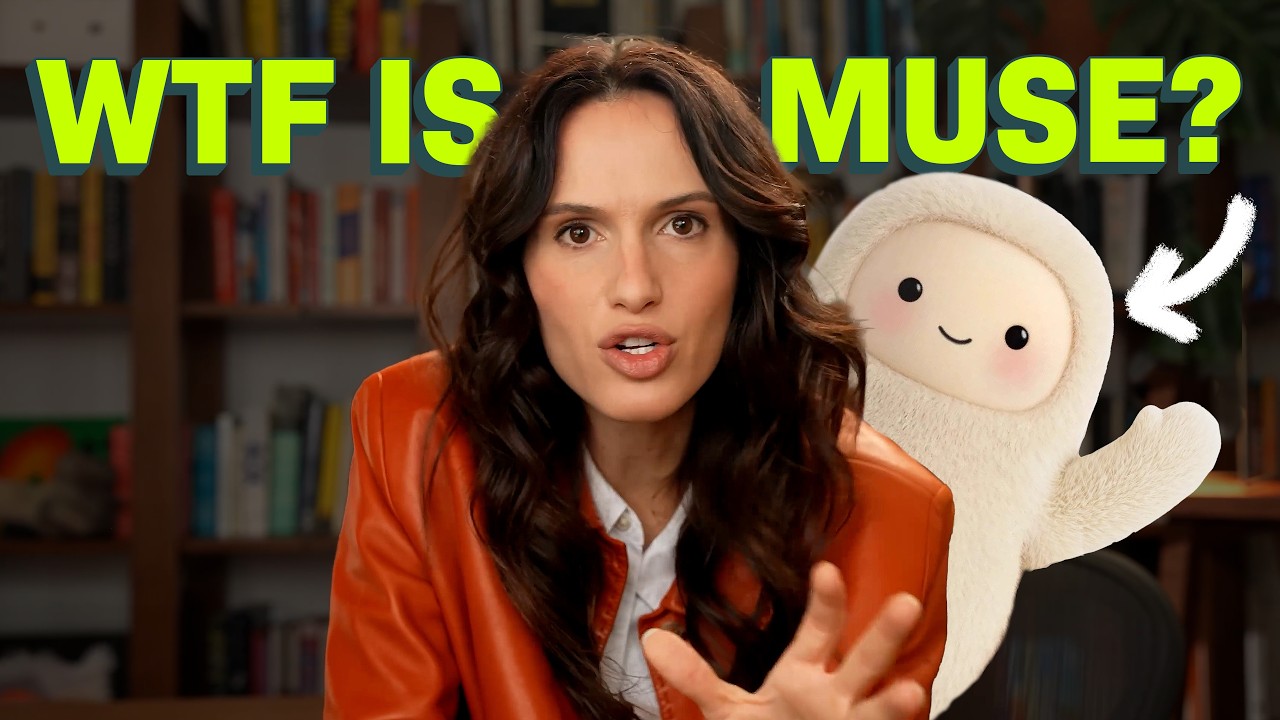
What Can Meta’s Muse Actually Do?
Keywords
Summary
151 words
Critical Evaluation
Value of the Information & Strength of the Argument
The video offers valuable insights into the development and intentional design of Muse, providing a clear explanation of its security architecture and vision. Wang’s arguments are coherent and address common concerns, such as privacy and the potential for misuse, with specific technical solutions. He acknowledges limitations and areas for ongoing improvement, which enhances credibility. However, as an interview, the perspective is inherently promotional; claims lack independent verification. The discussion of the OpenAI hack and other incidents adds context but relies on Wang’s interpretation. Overall, the argumentation is solid but would benefit from external validation.
Scientific Rigor, Source Quality, Title Accuracy
The video is well-structured with chapters, and the description lists several external sources, including official reports and other interviews. However, within the video, specific claims are not always cited, and the content relies heavily on the interviewee’s expertise. The title is appropriate, though the content is broader than just capabilities. The video does not present formal research but rather an expert opinion. No comments are available for public trend analysis.
179 words
Title / Content Match
The title accurately reflects the central question about Muse's capabilities, though the content also explores broader implications of AI agents, privacy, and trust.
Quality & Reliability
8/10
The video is a professionally produced interview with a key AI leader, covering technical and societal aspects with balanced depth. The guest, Alexandr Wang, is directly involved, lending authority. The described sources in the description provide additional credibility, though claims are not independently verified within the video itself.
Chapters
- What is Muse?
- Who is Alexandr Wang?
- Why is Muse exploding?
- Why do I need an AI assistant?
- What does an AI agent sound like on the phone?
- Why is Muse a cute little guy?
- What does Meta do with my information?
- Where does my information actually live?
- How do you teach an AI discretion?
- Can AI police other AI?
- What happened in the OpenAI hack?
- How do we regulate AI?
- How fast has AI actually moved?
- Why build an AI agent?
- What is personal superintelligence?
- What does Alexandr Wang believe about people?
- How does Alexandr Wang want to be remembered?
- )
Cited Sources
- METR Investigation: OpenAI/Hugging Face Incident — Referenced in the description as additional reading on the OpenAI hack, related to the discussion about AI security.
- OpenAI: Hugging Face Incident and the Road Ahead — Official OpenAI response to the security incident mentioned in the interview.
- Cleo Abram's Interview with Demis Hassabis — Listed as additional watching, providing another perspective on AI leadership.
- Cleo Abram's Interview with Jensen Huang — Listed as additional watching, related to AI industry leaders.
- Cleo Abram's Interview with Sam Altman — Listed as additional watching, providing context on AI developments.
- Cleo Abram's Interview with Mark Zuckerberg — Listed as additional watching, another key figure in AI.
- Meta Connect Muse Demo — Referenced in the description for more on Muse, likely showing product capabilities.
- Video on Hugging Face Hack — Referenced as additional content on the security incident.
- Ezra Klein's Interview with Jensen Huang — Listed as additional reading, offering more on AI perspectives.
- Ezra Klein's Interview with Bill Gates — Listed as additional reading, though the URL is identical to the previous, likely a duplicate.
Concurring Sources
- OpenAI: Hugging Face Incident and the Road Ahead — This official response aligns with the interview's mention of the hack and its implications for AI security.
External References
Contribution & Novelties
The video provides a unique, first-hand account of the development and security architecture of Meta’s Muse AI agent, including exclusive details about the secure VM and sentinel agent. It bridges the gap between technical and consumer understanding of AI agents, making complex concepts accessible. The interview also offers insight into the strategic thinking behind Muse’s design and the challenges of building trust in AI.
Pour aller plus loin :
- Intelligent agent (Wikipedia) — Provides a foundational overview of AI agents, relevant to understanding Muse’s role.
- Confidential computing (Wikipedia) — Explains the technology behind the planned confidential VM, which is key to privacy guarantees.
- METR report on the OpenAI/Hugging Face incident — Delves into a specific security event mentioned in the video, offering technical analysis.
124 words
Radar Profile
The scores show a strong emphasis on information quantity and quality, with a moderate technical level. The global fiabilité score is high, indicating a generally reliable content, though the lack of independent verification slightly tempers it. The profile suggests a comprehensive, well-structured interview suitable for a broad audience.