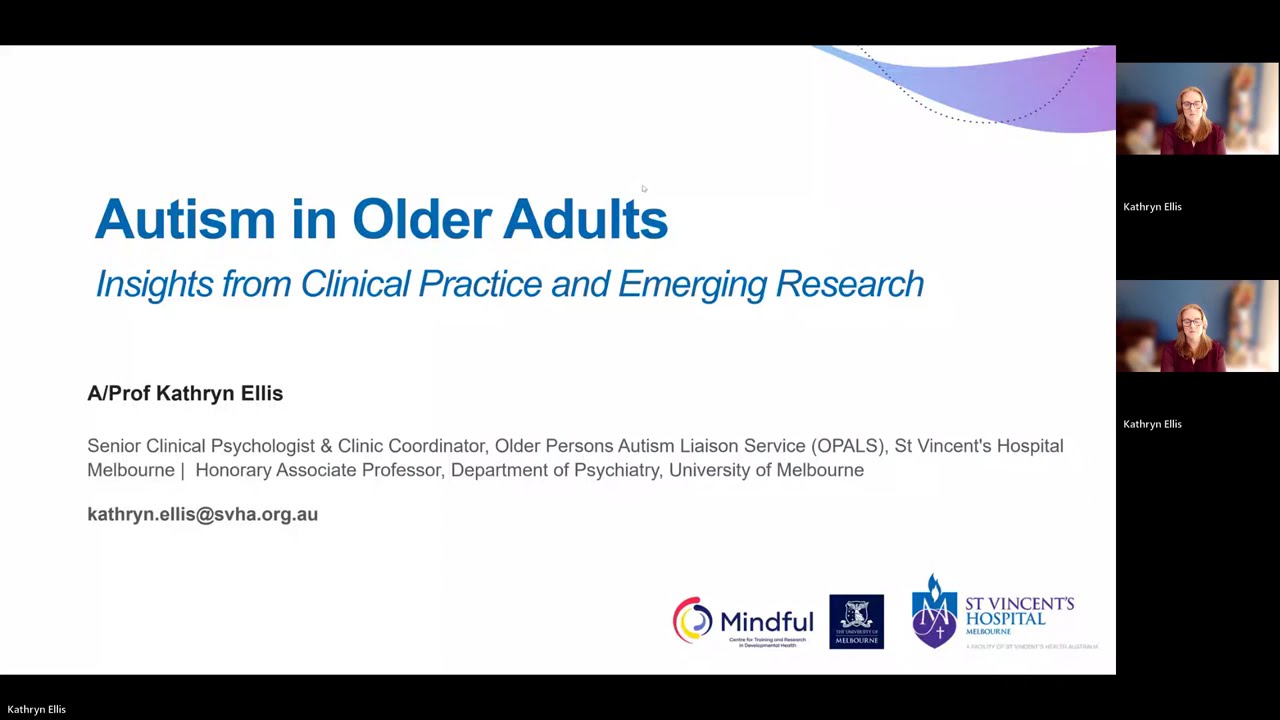
NARI Seminars in Ageing: Autism in Older Adults - Clinical Practice and Emerging Research
Title history
- NARI Seminars in Ageing: Autism in Older Adults - Clinical Practice and Emerging Research — observed on 20261116-0857 UTC (YouTube)
Keywords
Summary
184 words
Critical Evaluation
Value of the Information & Strength of the Argument
The presentation offers substantial value by addressing a neglected population and synthesizing clinical experience with emerging research. It provides clear, practical information for clinicians, such as common signs of undiagnosed autism in later life and the benefits of late diagnosis. The argumentation is solid, grounded in both the speaker’s clinical work and a review of available literature. Ellis appropriately caveats findings where evidence is preliminary (e.g., the link between autism and dementia) and avoids overstating conclusions. She also emphasizes the importance of individualized assessment and neuro-affirming care, making the argument persuasive and clinically applicable.
Scientific Rigor, Source Quality, Title Accuracy
The speaker demonstrates high scientific rigor by referencing peer-reviewed literature and clinical data, though specific citations are not listed. The description mentions her 175+ publications, adding credibility. The title accurately reflects the content, which covers clinical practice and research. The talk is well-structured, with a clear introduction, body, and conclusion. No external sources are cited in the description, but the speaker refers to the Australian Bureau of Statistics and the Royal Commission, indicating engagement with institutional data. Overall, the content is reliable, and the title-con tent alignment is strong.
198 words
Title / Content Match
The title accurately reflects the content, which focuses on autism in older adults from both clinical practice and research perspectives.
Quality & Reliability
9/10
Presentation by a senior clinical psychologist with over 175 peer-reviewed papers, drawing on clinical experience and current research. The talk is well-structured, uses identity-first language, and avoids overgeneralizations, reflecting a high level of expertise and evidence-based practice.
Key Moments
Markers derived by PSI from the transcript: the creator did not define chapters.
- Introduction and acknowledgments of country.
- Explanation of identity-first language and avoidance of functioning labels.
- Historical overview of autism diagnosis and the 'missing generation'.
- Prevalence by age statistics from the Australian Bureau of Statistics.
- Discussion of mental health, cognition, and physical health in older autistic adults.
- Introduction of the OPALS service and its assessment process.
- Key factors prompting late autism diagnosis, including family cascades and masking.
- Clinical implications and recommendations for neuro-affirming care.
Contribution & Novelties
This presentation adds valuable insight into autism in older adults, a significantly under-researched area. It highlights the importance of recognizing and diagnosing autism in later life for improving mental health outcomes and quality of life. The description of the OPALS service offers a practical model for specialist assessment. The speaker also emphasizes the need for neuro-affirming, person-centred care, which is a forward-looking perspective.
Pour aller plus loin :
- Autism Spectrum Disorder - Wikipedia — Provides foundational knowledge on autism, including historical and diagnostic aspects.
- Older Adults and Autism - National Autistic Society — Offers guidance on autism in older adults, complementing the seminar’s themes.
- Neurodiversity - Wikipedia — Discusses the neurodiversity movement central to the presentation’s language and perspective.
- The Relationship Between Autism and Dementia - PubMed — Provides access to research on the overlap between autism and dementia, as discussed in the seminar.
144 words
Radar Profile
The radar profile shows high scores in quantity, quality, technical level, and reliability, indicating a comprehensive, well-supported, and technically sound presentation. The low number of citations in the description slightly contrasts with the high internal reliability, but the speaker's expertise and use of institutional data compensate.