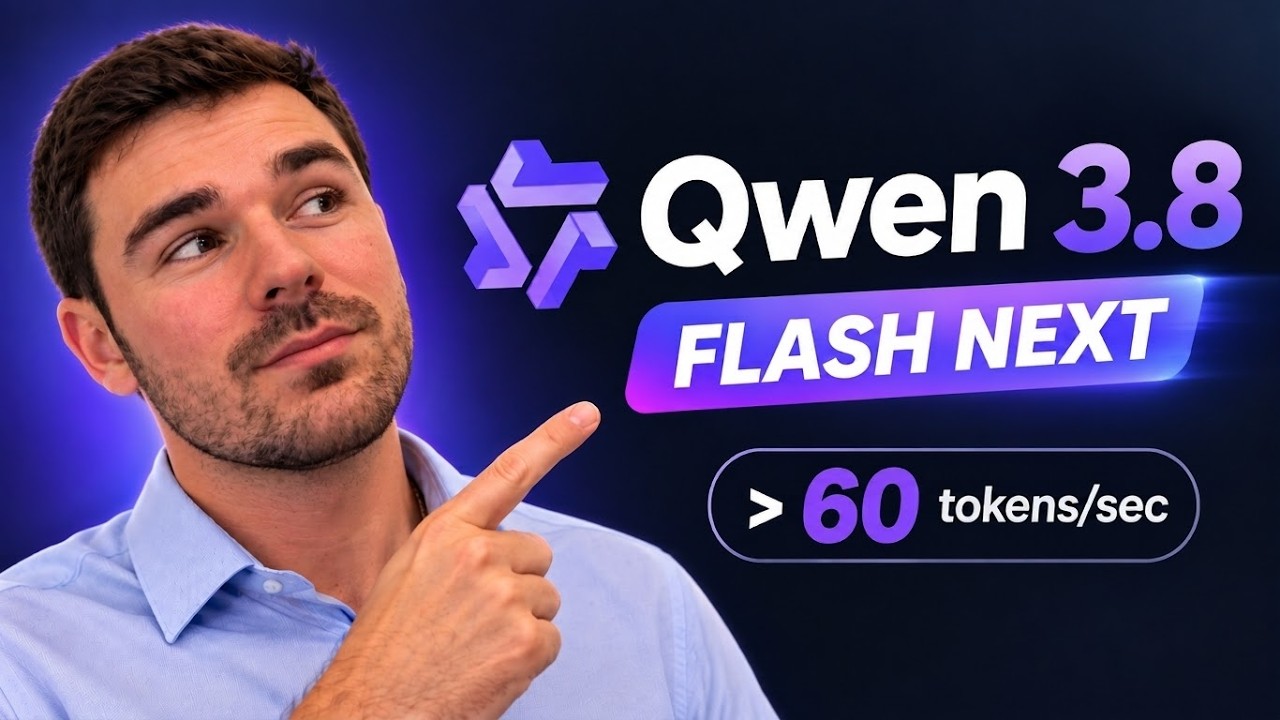
QWEN 3.8 FLASH NEXT : Enfin utilisable sur 16GB VRAM !
QWEN 3.8 FLASH NEXT: Finally usable on 16GB VRAM!
Title history
- QWEN 3.8 FLASH NEXT : Enfin utilisable sur 16GB VRAM ! — observed on 20261031-2315 UTC (YouTube)
Keywords
Summary
180 words
Critical Evaluation
Value of the Information & Strength of the Argument
The video provides high practical value for AI enthusiasts and developers seeking to run capable LLMs locally on modest hardware. It presents a concrete, reproducible method that dramatically improves inference speed, backed by visible demonstrations and specific benchmarks (e.g., 60 t/s generation, 900 t/s prefill). The argumentation is coherent: Nathan explains the technical bottlenecks (DDR4 RAM, limited VRAM) and shows how he overcomes them by leveraging a second GPU as RAM extension and optimizing the Strata engine. He transparently discusses hardware requirements and trade-offs between quantization levels (IQ2, IQ3) and model versions (classic vs Swift). The reasoning is logical, and the performance gains are attributed to the custom engine rather than magic. However, the video is also promotional, as Ajean is the creator’s own software, and he repeatedly encourages viewers to download it. The claims are based on personal testing, and while plausible, independent validation is not provided. Nonetheless, the argumentation is solid within its scope, and the presented results are internally consistent.
Scientific Rigor, Source Quality, Title Accuracy
The video demonstrates good technical rigor by providing detailed configuration options, benchmark numbers, and a clear explanation of the modifications made to the Strata engine. The creator acknowledges his testing is limited to his own hardware (Linux with NVIDIA GPUs) and invites community testing for other setups. The main source cited is his own Ajean website (https://ajean.nathaninline.com ), which serves as the primary reference for downloading the software. No external scientific papers or third-party tests are mentioned, which limits the independent verifiability. The title accurately reflects the content, and the video’s claims are directly supported by the demonstrations. The community comments show a highly positive reception, with many users confirming successful results after following the instructions, which lends some credibility to the reproducibility. Overall, the lack of external sources and reliance on self-promotion slightly reduce the overall scientific rigor, but the transparency about limitations and the detailed methodology partially compensate.
328 words
Title / Content Match
The title accurately reflects the content: the video demonstrates the Qwen 3.8 Flash Next model running at high speed on consumer GPUs with as little as 12GB VRAM, achieving 60+ tokens per second – indeed making it 'finally usable'.
Quality & Reliability
7/10
The video offers detailed technical instructions, benchmarks, and reproducible steps, but it heavily promotes the creator's own tools (Ajean, Jean). While the performance gains are plausible and demonstrated, independent verification is lacking, and the claims are based on a single user's setup.
Key Moments
Markers derived by PSI from the transcript: the creator did not define chapters.
- Introduction: presents Qwen 3.8 Flash Next as the best local model and shows a live demo with 60 t/s generation speed.
- Reveals how the speed boost was achieved: Nico1221's Strata engine, and discusses VRAM and RAM requirements.
- Explains the modification: using a secondary GPU as RAM extension, integrating Strata into Ajean as 'Ajean MoE'.
- Details the Ajean configuration menu: model selection, quantization, context length, MTP, and vision options.
- Introduces Jean, the persistent memory assistant that can browse the web and update its knowledge, showing a live demonstration.
- Summary and call to action: encourages viewers to test on their own and contribute to GitHub for Windows/AMD support.
Cited Sources
- Ajean - Nathan Inline — Official website for downloading the Ajean application, which includes the modified Strata engine and Jean assistant.
Contribution & Novelties
The video presents a significant practical advancement in running large language models on consumer hardware. The key innovation is the adaptation of the Strata engine to utilize a secondary GPU as a memory extension, effectively increasing available RAM and enabling the IQ3 XXS quantization of the Qwen 3.8 Flash Next model on systems with limited VRAM and slower DDR4 RAM. This approach achieves substantial speed improvements (from 5 t/s to 60+ t/s) and is integrated into the user-friendly Ajean application, making it accessible to non-experts. Additionally, the introduction of ‘Jean’ as a persistent memory assistant within Ajean adds a novel feature for local AI agents. The video is valuable for researchers and practitioners interested in efficient local inference.
Pour aller plus loin :
- Mixture of Experts — Core architecture behind Qwen 3.8, relevant to understanding how expert routing and acceleration work.
- Quantization (neural networks) — Explains the method used to reduce model size and memory footprint, crucial for fitting models into limited RAM.
- Large language model — Provides broader context on the capabilities and challenges of local LLM inference.
179 words
Radar Profile
The radar profile shows high scores across quantity of information, technical level, and global reliability, with slightly lower quality of information due to the promotional nature. The strong performance in technical depth reflects the video's detailed benchmarks and configuration explanations, while the reliability score benefits from reproducible demonstrations, despite the lack of third-party validation.
💬 Très positif. Sur les 30 commentaires analysés, la quasi-totalité exprime un enthousiasme marqué pour les performances démontrées, remercie le créateur, et attend avec impatience la version Windows. Plusieurs utilisateurs confirment avoir obtenu des résultats concluants avec leurs propres configurations, renforçant la crédibilité de la démo.