Doświadczenie Rutherforda
Rutherford's experiment
Keywords
Summary
182 words
Critical Evaluation
Value of the Information & Strength of the Argument
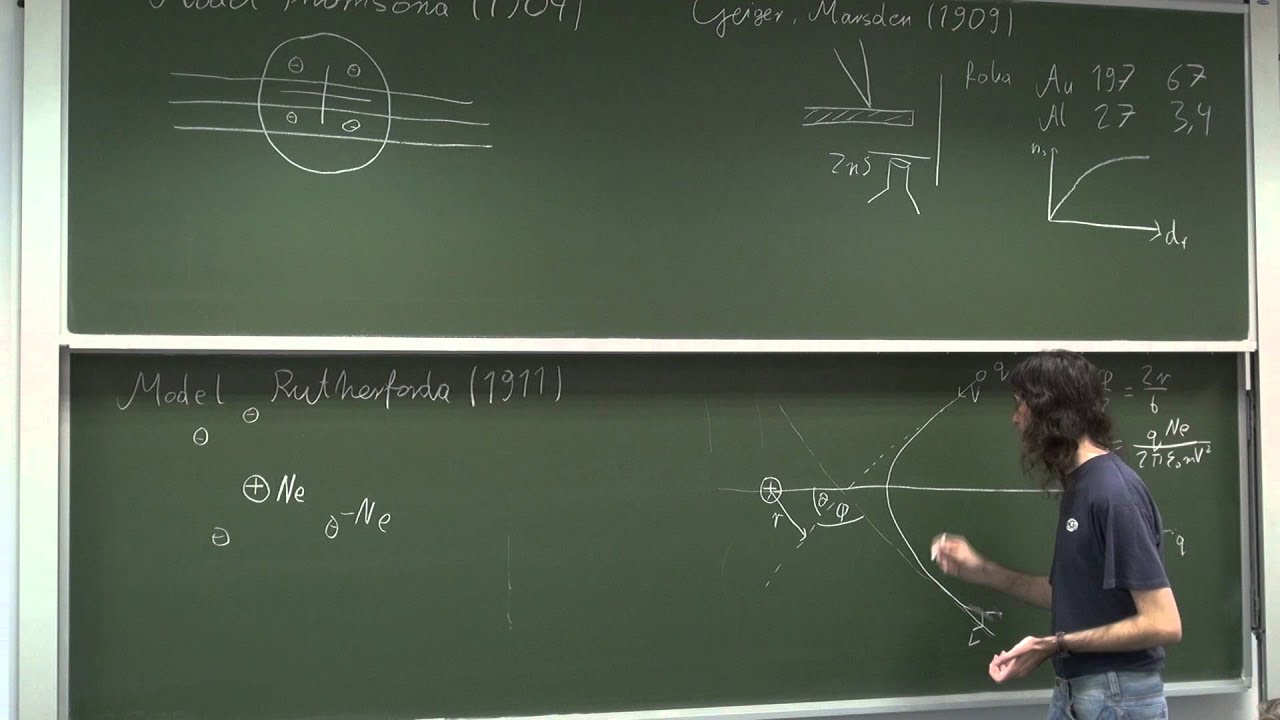
The value of the information is high, as it offers a thorough, step-by-step explanation of the Rutherford experiment, from historical context to quantitative derivation. The argumentation is solid: the lecturer systematically refutes the Thomson model based on experimental evidence, then logically constructs the nuclear model and supports it with a mathematical treatment of Coulomb scattering. The derivation of the cross-section formula from conservation laws is rigorous and connects well with the observed results. The lecture also critically discusses assumptions, such as single scattering and point-like nucleus, which enhances its scientific credibility.
Scientific Rigor, Source Quality, Title Accuracy
The scientific rigor is evident from the detailed derivation and the careful logical progression. The lecture references Rutherford’s 1911 paper implicitly, though no explicit citations are given in the transcript. The description provides no external links, so no specific sources are cited. The title is perfectly aligned with the content, which is exclusively about the Rutherford experiment. The lecture is presented at an advanced level, likely aimed at physics students or researchers, which is consistent with the venue of the Institute of Physics seminar.
190 words
Title / Content Match
The title accurately reflects the content: the entire lecture is devoted to the Rutherford gold foil experiment, its historical context, and resulting atomic model.
Quality & Reliability
8/10
The lecture is delivered by a lecturer at the Institute of Physics of the Polish Academy of Sciences, providing a technically accurate explanation of the Rutherford experiment and its theoretical derivation. The transcript reveals a coherent and detailed presentation, though some audio artifacts may affect clarity.
Key Moments
Markers derived by PSI from the transcript: the creator did not define chapters.
- Introduction of Thomson's plum pudding model and expected behavior of alpha particles
- Description of the experimental setup with gold foil and zinc sulfide screen
- Presentation of surprising results: some particles deflected at angles greater than 90°
- Conclusion that the Thomson model is invalid and Rutherford's proposal of a nuclear atom
- Derivation of the Rutherford scattering formula using conservation of energy and angular momentum
- Discussion of multiple scattering, limitations, and summary
Concurring Sources
- Geiger–Marsden experiment — The experiment and its results, which are the central subject of the lecture
- Rutherford model — The nuclear atomic model proposed by Rutherford to explain the scattering results
- Rutherford scattering — The derivation and formula discussed in the lecture
Contribution & Novelties
The lecture provides a clear and detailed pedagogical exposition of a classic experiment, emphasizing both historical context and quantitative derivation. It does not present new research but offers an accessible explanation of the Rutherford scattering formula and its implications. The contribution lies in its didactic clarity and the thorough treatment of the physics involved.
Pour aller plus loin :
- Geiger–Marsden experiment — Context and details of the landmark experiment.
- Rutherford model — The proposed atomic model and its limitations.
- Rutherford scattering — Mathematical formalism and cross-section formula.
87 words
Radar Profile
The radar profile shows high scores across all dimensions, particularly in information quality and reliability, reflecting the lecture's technical depth and authoritative source. The quantity of information and technical level are also strong, indicating a dense and rigorous content. The overall balance suggests a highly trustworthy educational resource.