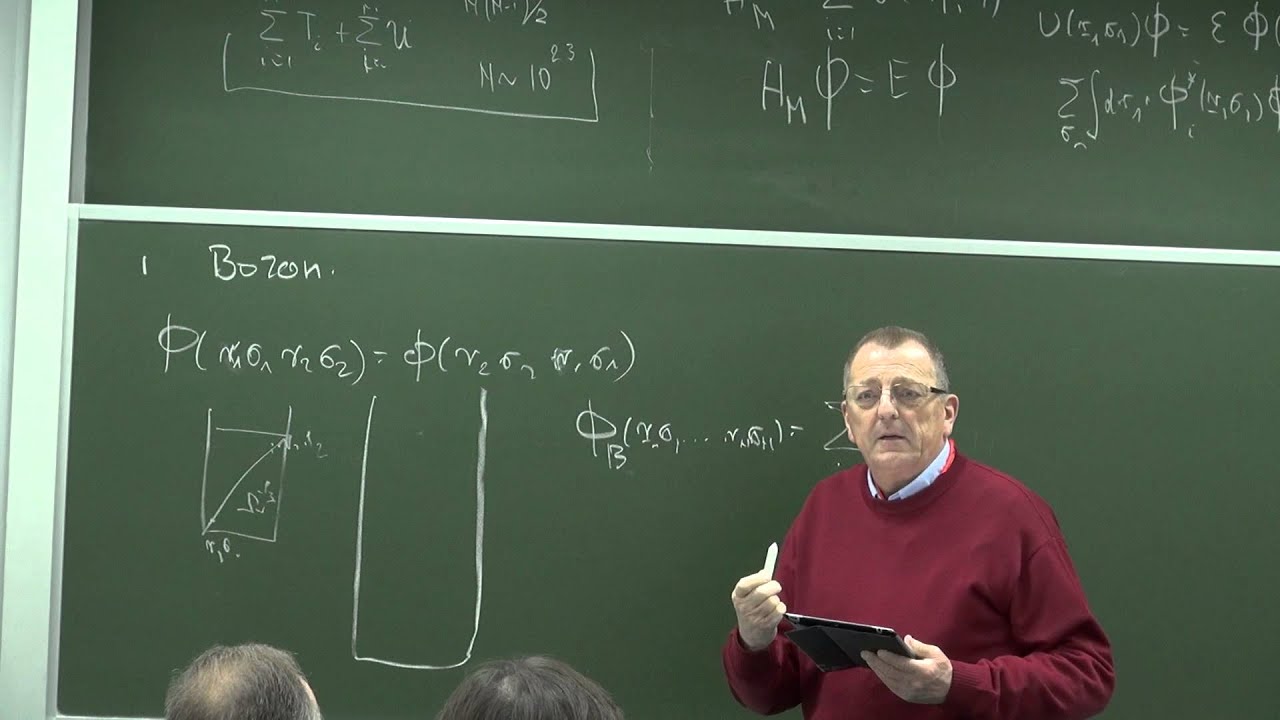
Wstęp do mechaniki kwantowej układów wielu ciał
Introduction to quantum mechanics of many-body systems
Keywords
Summary
144 words
Critical Evaluation
Value of the Information & Strength of the Argument
The lecture provides a deep insight into the conceptual foundations of many-body quantum mechanics. The argumentation is logical, moving from the Hamiltonian to symmetry constraints, to density matrices, and finally to approximation schemes. The speaker emphasizes the assumptions and their physical consequences, such as the long-range correlations induced by indistinguishability. He also points out common textbook omissions, like the dimension-dependence of density of states, thereby adding value beyond standard presentations. The effectiveness of the argumentation is enhanced by its pedagogical clarity, though some derivations are sketched rather than fully explicit.
Scientific Rigor, Source Quality, Title Accuracy
The scientific rigor is generally high: the mathematical steps are clearly motivated, and the speaker acknowledges the limits of the model assumptions. However, no formal citations are given; the lecture relies on established knowledge and the speaker’s own framework. The title accurately matches the content, as it is a genuine introduction to the subject, neither misrepresenting nor overclaiming. No external sources are referenced, so the reliability rests on the speaker’s authority and the logical coherence of the presentation.
183 words
Title / Content Match
The title accurately reflects the lecture's content, which covers fundamental concepts of quantum many-body physics, including the Hamiltonian, indistinguishability, density matrices, and approximations.
Quality & Reliability
7/10
The lecture is delivered by a senior physicist at a national academy, with clear derivations and logical progression. However, it lacks explicit citations of sources, and some statements are presented as accepted truths without discussion of alternative proofs.
Key Moments
Markers derived by PSI from the transcript: the creator did not define chapters.
- Discussion of the many-body Hamiltonian and limitations of two-body interactions.
- Introduction of indistinguishability and its consequences for wavefunction symmetry and statistics.
- Definition of reduced density matrices and their relation to energy and information loss.
- Slater determinant for fermions and the resulting expression for density matrices.
- Preview of Thomas-Fermi and Kohn-Sham approximations derived from the density matrix formalism.
Contribution & Novelties
The lecture’s original contribution lies in its pedagogical approach, linking the formal machinery of many-body quantum mechanics to physical insights and approximation schemes. It effectively demonstrates how density matrices and the Slater determinant naturally lead to functional theories like Thomas-Fermi and Kohn-Sham, which are central to modern electronic structure calculations. The emphasis on the role of long-range correlations from indistinguishability is particularly illuminating.
Pour aller plus loin :
- Density functional theory — Covers the fundamental framework that the lecture alludes to.
- Slater determinant — Provides the mathematical construction used in the Hartree-Fock ansatz.
- Second quantization — An alternative formalism often used in many-body theory, though not covered in this lecture.
110 words
Radar Profile
The radar profile indicates a high level of technical depth and quantitative information, with slightly lower reliability due to the lack of external citations. The balance between the scores suggests a lecture that is content-rich but not fully referenced, typical of a seminar presentation.