Keywords
Summary
148 words
Critical Evaluation
Value of the Information & Strength of the Argument
The value of this talk lies in its pedagogical and philosophical reflections. Turski provides a compelling argument that physics is a unique science that combines qualitative and quantitative understanding, and that mastery of this integration is essential for scientific progress. He supports his claims with historical anecdotes and quotations from renowned physicists, which adds authority. However, the argumentation is largely anecdotal and lacks systematic evidence or rigorous philosophical analysis. The distinction between ’talking physics’ and ’talking about physics’ is presented as self-evident but is not deeply operationalized. The call for physicists to engage with broader societal issues is valuable, but the reasoning remains at a general level, without concrete methodologies or examples of how to achieve this integration.
Scientific Rigor, Source Quality, Title Accuracy
The talk’s scientific rigor is moderate. It relies on personal experience and historical narratives rather than citable references. The sources mentioned (von Neumann, Bohr, Wigner) are authoritative, but no specific publications are cited except for von Neumann’s book on mathematical foundations of quantum mechanics, which is referenced without details. The title ‘Talking Physics’ is highly appropriate as it encapsulates the core message. The talk is not a research presentation but a reflective seminar, so the absence of a rigorous source list is acceptable, yet it limits the reproducibility of the claims. The speaker encourages participants to cite sources, which is a positive methodological point, but the seminar itself does not systematically provide them.
246 words
Title / Content Match
The title 'Talking Physics' directly matches the central theme of the seminar, which distinguishes between 'talking physics' and 'talking about physics'.
Quality & Reliability
7/10
The content is a reflective seminar by a senior physicist, presenting historical reflections on physics education and the nature of scientific understanding. The speaker cites well-known figures (von Neumann, Bohr, Wigner) and makes coherent arguments about the necessity of deep understanding in physics. However, the talk is not peer-reviewed and relies heavily on personal experience and opinions, limiting its factual rigor.
Key Moments
Markers derived by PSI from the transcript: the creator did not define chapters.
- Introduction: greeting and setting the theme of 'Talking Physics' vs 'talking about physics'.
- Historical context of physics seminars in Warsaw and the tradition of training students to talk physics.
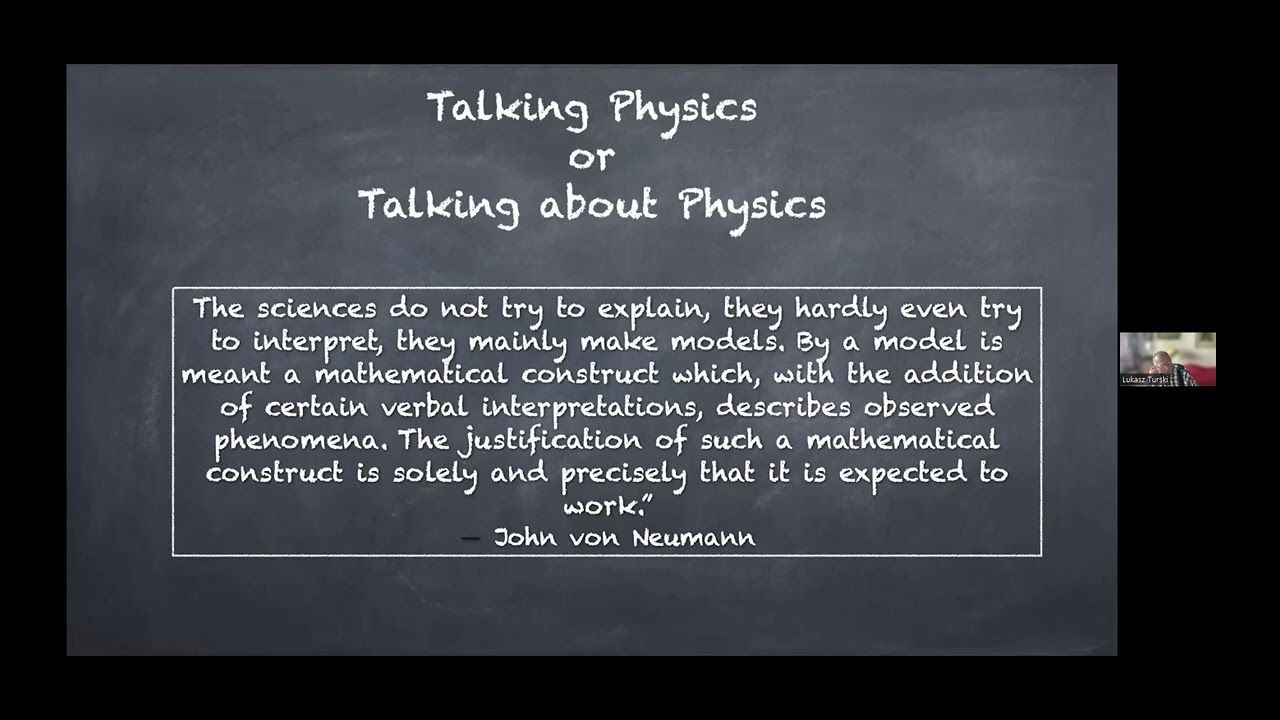
- Quotation from John von Neumann on the nature of science as model-building; discussion of his contributions.
- List of quantum mechanics seminar topics and critique of students' focus on technical polish rather than sources.
- Bohr's quote 'Never express yourself more clearly than you are able to think' and its application to seminar preparation.
- Discussion of energy crisis and the necessity of physics for societal solutions; concluding remarks on the future of physics.
Contribution & Novelties
The talk provides a personal perspective on physics education, emphasizing the need for deep understanding over superficial knowledge. While not novel in terms of original research, it synthesizes historical lessons with contemporary challenges. The speaker’s experience and authority add value to the discussion.
Pour aller plus loin :
- Quantum mechanics — Provides foundational knowledge on the subject central to the seminar.
- John von Neumann — His life and contributions to mathematics and physics, including the mathematical foundations of quantum mechanics.
- Eugene Wigner — His thoughts on the unreasonable effectiveness of mathematics in physics, relevant to the speaker’s emphasis on understanding.
- Niels Bohr — His work on quantum theory and his famous statements on clarity of expression.
116 words
Radar Profile
The radar profile shows moderate scores across qualitative and quantitative information, with a relatively lower level of technical depth. This reflects the talk's nature as a reflective seminar rather than a technical lecture. The strong point is the quality of information, supported by authoritative references to historical physicists, while the quantity of technical detail and the level of technical expertise presented are modest.