Druga zasada termodynamiki cz. I
The Second Law of Thermodynamics Part I
Keywords
Summary
205 words
Critical Evaluation
Value of the Information & Strength of the Argument
The value of the information is high for a physics audience, as it provides a clean derivation of the canonical ensemble from first principles, emphasizing the operational meaning of temperature. Turski’s argumentation is logically tight: he starts from the density operator in quantum mechanics, assumes energy conservation, and via the microcanonical ensemble and the concept of a large reservoir, he derives the Boltzmann factor without invoking any thermodynamic axioms. He explicitly avoids philosophical speculations and shows that the zeroth law is a consequence of the weak coupling to a reservoir. The critique of the Jarzynski equality, while concise, is based on his assertion that the original paper is flawed, though he doesn’t elaborate. Overall, the argumentation is rigorous and pedagogically effective, though it requires a solid background in quantum mechanics and statistical mechanics.
Scientific Rigor, Source Quality, Title Accuracy
The lecture demonstrates scientific rigor through careful mathematical derivations and correct references to historical figures (Boltzmann, Clausius) and their contributions. However, no external sources are explicitly cited in the video description, and the presenter does not provide literature references during the talk. The title ‘Druga zasada termodynamiki cz. I’ (Second law of thermodynamics part I) is appropriate, as the lecture sets the groundwork for understanding the second law, focusing on statistical ensembles rather than the law itself. The content is consistent with established physics, though the presenter’s claim about the Jarzynski equality being erroneous is controversial and not substantiated. No audience comments were provided for analysis.
254 words
Title / Content Match
The title accurately reflects the focus on the second law of thermodynamics, here as the first part building the foundation using statistical ensembles.
Quality & Reliability
8/10
Rigorous derivation of statistical mechanics from quantum mechanical density operator, clear exposition, but some transcription errors and occasional informal tone. The content is correct and well-structured.
Key Moments
Markers derived by PSI from the transcript: the creator did not define chapters.
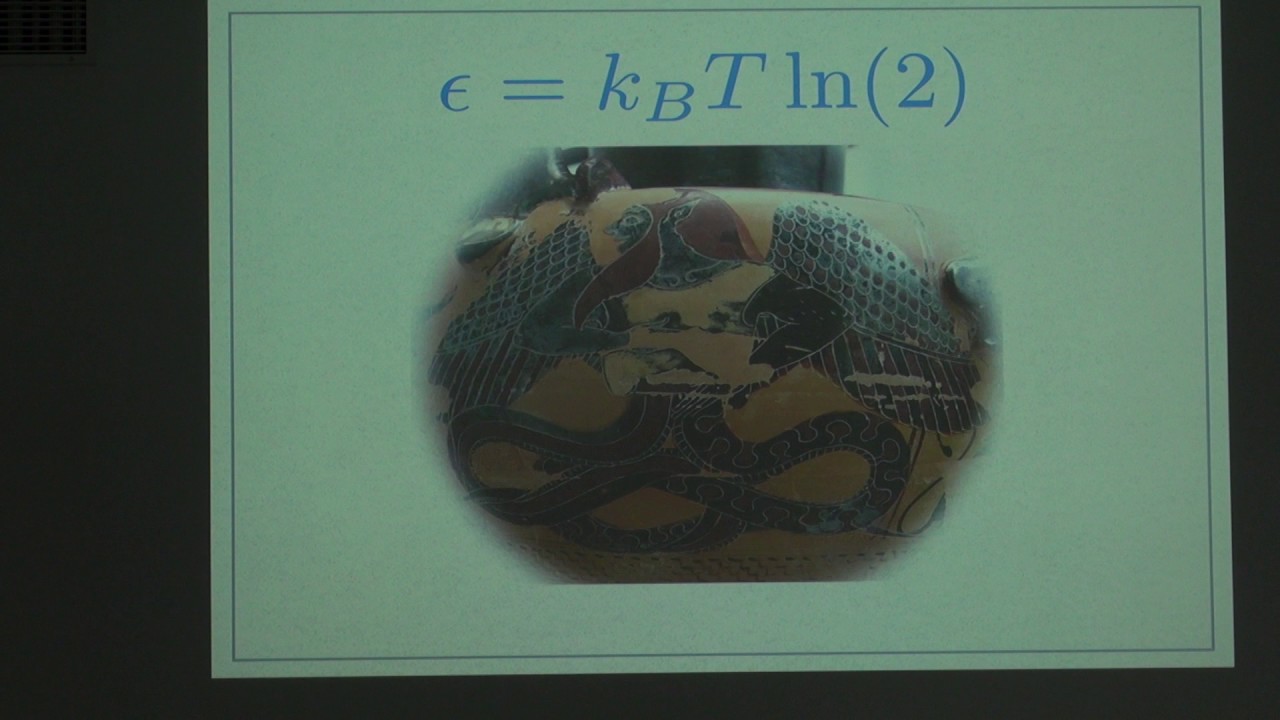
- Introduction and tribute to Boltzmann's tombstone; critique of historical inaccuracies about Boltzmann's suicide.
- Statement of the three laws of thermodynamics in humorous terms; introduction of the slot machine analogy.
- Introduction of the density operator and statistical ensembles; definition of the microcanonical ensemble.
- Detailed calculation for a paramagnet: counting microstates and applying Stirling's approximation to obtain the density of states.
- Partition of the system into a small system and a large reservoir; tracing out reservoir degrees to derive the canonical distribution.
- Interpretation of β as inverse temperature; discussion of zeroth law and role of the reservoir; mention of grand canonical ensemble.
- Conclusion and summary, emphasizing that the second law emerges from simple counting without mysticism.
Cited Sources
- Video lecture: Druga zasada termodynamiki cz. I — The lecture itself, by prof. Łukasz Turski at the Institute of Physics of the Polish Academy of Sciences.
Contribution & Novelties
The lecture offers a clear, first-principles derivation of the canonical ensemble and the concept of temperature, showing that the second law is not a separate axiom but a consequence of counting microscopic states. Turski also provides a critical remark on the widely used Jarzynski equality, questioning its validity, although the claim is not detailed. The pedagogical style makes advanced statistical mechanics accessible to graduate-level physicists.
Pour aller plus loin :
- Boltzmann entropy formula — Directly related to the microscopic definition of entropy in the lecture.
- Canonical ensemble — The main statistical ensemble derived from the reservoir argument.
- Jarzynski equality — Mentioned and criticized by the speaker; source for further investigation.
110 words
Radar Profile
The radar profile is heavily biased toward quantity and technical level (10/10), with slightly lower quality (9) and reliability (8). This indicates a very dense, advanced lecture with precise derivations, but with minor imperfections in presentation and transcription that slightly affect overall reliability.