On the relations between physics and mathematics
Keywords
Summary
185 words
Critical Evaluation
Value of the Information & Strength of the Argument
The value of the information lies in its clear conceptual mapping of a classic problem in the philosophy of science. The speaker does not present new empirical findings but synthesizes well-established ideas, making the lecture useful as an introduction for graduate students. The argumentation is structured around three questions: what is physics, what is mathematics, and why is mathematics important to physics. The speaker supports his claims with historical quotations (Maxwell, Aristotle, Heytesbury, Leonardo, Wigner) and with a taxonomy of philosophical positions. The reasoning is generally sound, though it remains at a high level of generality and does not engage with contemporary debates in the philosophy of mathematics or with specific technical examples from modern theoretical physics. The argument that mathematics is indispensable to physics is convincingly illustrated, but the deeper question of why it works is left open, which the speaker acknowledges.
Scientific Rigor, Source Quality, Title Accuracy
The lecture demonstrates scientific rigor in its historical citations, accurately quoting Maxwell’s ‘Matter and Motion’ (1878), Aristotle’s ‘Physics’, William Heytesbury’s mean speed theorem, and Leonardo da Vinci’s notebooks. The discussion of Wigner’s 1960 paper ‘The Unreasonable Effectiveness of Mathematics in the Natural Sciences’ is faithful to the original. However, the talk does not provide a formal bibliography or precise references in the transcript, and the sources are mentioned in passing rather than systematically. The title ‘On the relations between physics and mathematics’ is fully adequate to the content, which is a general introduction to the topic. No comments were provided for analysis.
260 words
Title / Content Match
The title accurately reflects the content: the talk is a broad introduction to the relationship between physics and mathematics, covering definitions, historical examples, and philosophical positions. It does not promise a narrow technical result, and it delivers exactly what it announces.
Quality & Reliability
7/10
The lecture is delivered by a recognized theoretical physicist (Professor Marek Kuś, Center for Theoretical Physics, Polish Academy of Sciences) in an academic seminar setting. The content is a conceptual and historical reflection rather than a presentation of new empirical results, and it relies on well-known references (Maxwell, Aristotle, Wigner, Klein, Brouwer, Hilbert, Frege, Russell). No primary data or original experiments are presented, but the reasoning is coherent and the historical citations are accurate. The absence of a formal bibliography and the informal spoken style slightly reduce the score.
Key Moments
Markers derived by PSI from the transcript: the creator did not define chapters.
- Introduction by the seminar organizer, outlining the series on fundamental problems of theoretical physics.
- Professor Kuś begins his talk, stating the topic: relations between physics and mathematics.
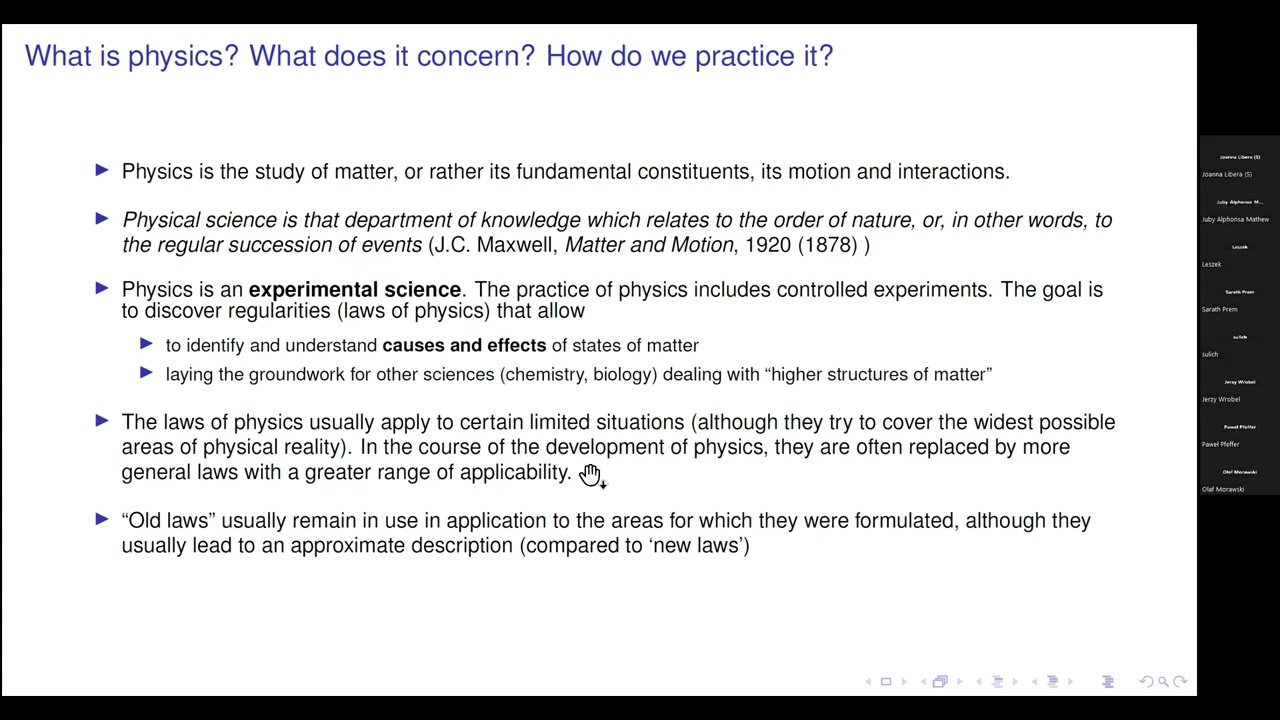
- Definition of physics as the study of matter, motion, and interaction, with a quote from Maxwell's 'Matter and Motion' (1878).
- Discussion of what mathematics is: objects, methods, and the character of mathematical statements.
- Three philosophical approaches to mathematical objects: Platonism, intuitionism, and logicism/formalism.
- Historical examples: Aristotle's law of motion and the Oxford Calculators' mean speed theorem.
- Renaissance and modern science: Copernicus, Galileo, Kepler, Newton, Leibniz, and Leonardo's quote on mathematics.
- Eugene Wigner's 'unreasonable effectiveness of mathematics' and its two central problems.
Cited Sources
- Matter and Motion (James Clerk Maxwell, 1878) — Quoted for the definition of physical science as the department of knowledge relating to the order of nature.
- Physics (Aristotle) — Quoted for an early example of mathematical reasoning applied to motion.
- William Heytesbury and the Oxford Calculators — Cited for the mean speed theorem, an early mathematical formulation of uniformly accelerated motion.
- The Unreasonable Effectiveness of Mathematics in the Natural Sciences (Eugene Wigner, 1960) — Central reference for the discussion of why mathematics applies so well to physics.
- Morris Klein — Quoted for the statement that mathematics is a body of knowledge but contains no truth about the physical world.
- Leonardo da Vinci — Quoted from his treatise on painting: 'There is no certainty in sciences where one of the mathematical sciences cannot be applied.'
Concurring Sources
- The Unreasonable Effectiveness of Mathematics in the Natural Sciences — Confirms Wigner's two problems and the general framing of the lecture.
- Philosophy of mathematics — Supports the description of Platonism, intuitionism, and logicism as presented by the speaker.
- History of physics — Corroborates the historical examples from Aristotle to Newton.
Contribution & Novelties
The lecture does not present original research but offers a pedagogical synthesis of a classic philosophical problem. Its originality lies in the clear organization of the material: it moves from definitions of physics and mathematics, through three philosophical stances on mathematical objects, to historical examples and finally to Wigner’s puzzle. The speaker’s contribution is to frame the discussion for a graduate seminar, emphasizing that the relationship between physics and mathematics remains mysterious despite its success. He also highlights the connection between the effectiveness of mathematics and the uniqueness of physical theories, a point often overlooked in introductory treatments.
Pour aller plus loin :
- The Unreasonable Effectiveness of Mathematics in the Natural Sciences — Wikipedia article on Wigner’s famous essay, providing context and subsequent debates.
- Philosophy of mathematics — Overview of Platonism, intuitionism, logicism, and other schools discussed in the lecture.
- History of physics — Background on Aristotle, the Oxford Calculators, Galileo, Newton, and the mathematization of physics.
- Mathematical physics — Article on the discipline that applies mathematics to physical problems.
170 words
Radar Profile
The radar profile shows moderate to high scores in information quality and reliability, reflecting the academic nature of the lecture. The technical level is relatively low, as the talk is conceptual and historical rather than mathematically detailed. The quantity of information is moderate, given the broad scope and introductory intent.