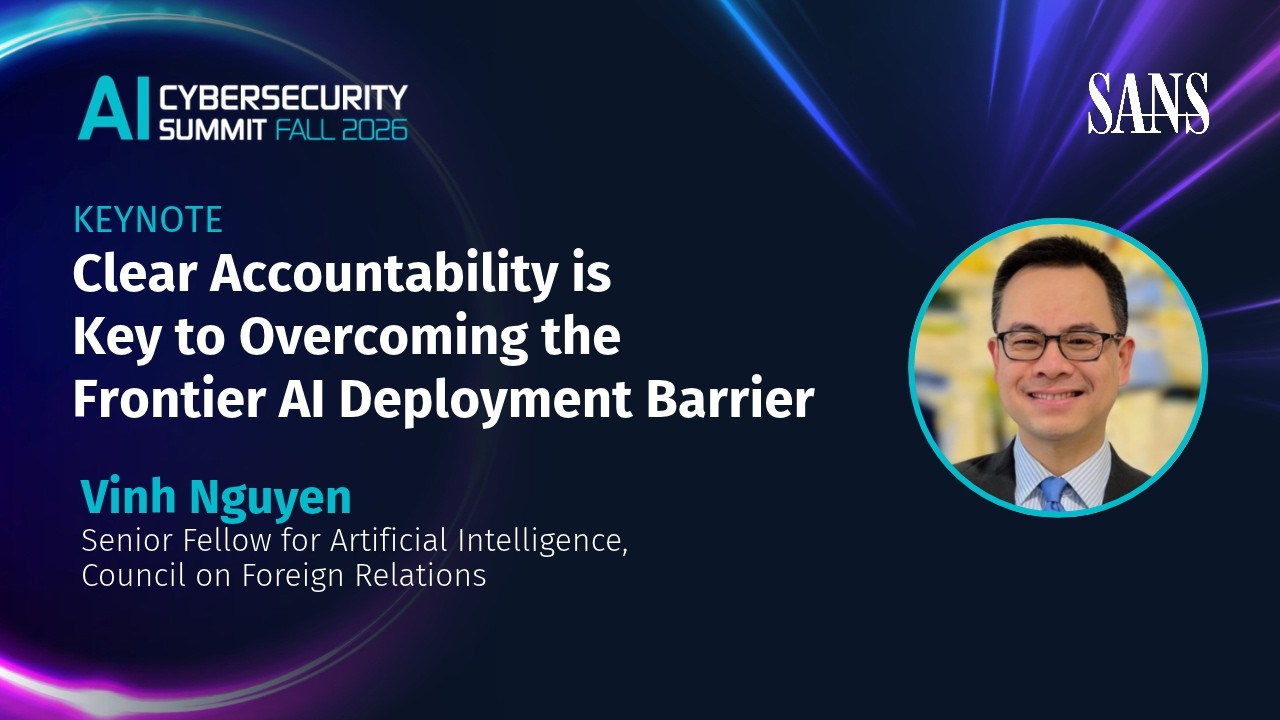
Clear Accountability for Frontier AI Deployment
Keywords
Summary
174 words
Critical Evaluation
Value of the Information & Strength of the Argument
The talk offers valuable insights from a senior fellow with direct access to executive decision-makers, highlighting a real tension between urgency and readiness in AI adoption. The argument is structured around a clear framework (observability, accountability, confidentiality) and a call to action for CISOs. However, the reasoning relies heavily on anecdotal evidence and personal observations, lacking quantitative data or case studies to substantiate claims. The speaker does not present potential counterarguments or address typical criticisms of his recommendations, such as cost-benefit analyses or technical feasibility. Solid in its motivational aspect, but less rigorous in empirical support.
Scientific Rigor, Source Quality, Title Accuracy
The talk does not cite specific sources or studies; it references general interactions and working groups (e.g., with Google at ML Commerce) but provides no URLs or publications. The only link in the description is to a future SANS summit, which is promotional rather than a substantive reference. The title is accurately mirrored in the content, as the entire presentation focuses on accountability for frontier AI. The structure is coherent, but the lack of verifiable sources significantly weakens the scientific rigor. The speaker’s status at a respected think tank lends some credibility, yet the absence of concrete references prevents full trust in the claims.
215 words
Title / Content Match
The title accurately reflects the content: the talk emphasizes the need for clear accountability in deploying frontier AI systems, aligning with the description and presentation.
Quality & Reliability
6/10
The talk draws on the speaker's interactions with C-suite executives and offers a practitioner's perspective, but it lacks verifiable data, formal citations, or empirical studies. The arguments are plausible but remain primarily anecdotal, limiting high confidence in reliability.
Key Moments
Markers derived by PSI from the transcript: the creator did not define chapters.
- Introduction: frustration of C-suite not being heard, AI deployment as foreign policy
- Accountability as the number one barrier; dysfunction within C-suite roles
- Three elements of assured intelligence: trust in people, systems, and science
- Observability as first foundation; need for telemetry and chain-of-thought data
- Agentic identity management; grounding identities in trusted ecosystems like DNS
- Confidentiality and privacy challenges with frontier AI; industry working group
- Call to action: CISOs as heroes, building accountable infrastructure for society
Cited Sources
- SANS AI Cybersecurity Summit Spring 2027 — Promotional link for future summit; no substantive reference to cited works.
Contribution & Novelties
The talk provides a practitioner-informed perspective on the accountability challenge in frontier AI deployment, synthesizing executive concerns into a three-pillar framework. Its novelty lies in connecting AI deployment to foreign policy and national security, and in urging the cybersecurity community to proactively adopt responsibilities. It also highlights the underdeveloped science of AI reliability.
To go further:
- NIST AI Risk Management Framework — Relevant to establishing shared practices for AI accountability.
- Agentic AI (Wikipedia) — Could explore definitions and implications, but URL not certain; name alone.
- AI accountability civil society initiatives — Numerous organizations work on this; no specific URL guaranteed.
100 words
Radar Profile
The radar profile shows moderate scores across all dimensions, with slightly lower technical depth and reliability. This reflects an engaging but evidence-light presentation that offers a strategic framework without deep technical detail or strong source backing.