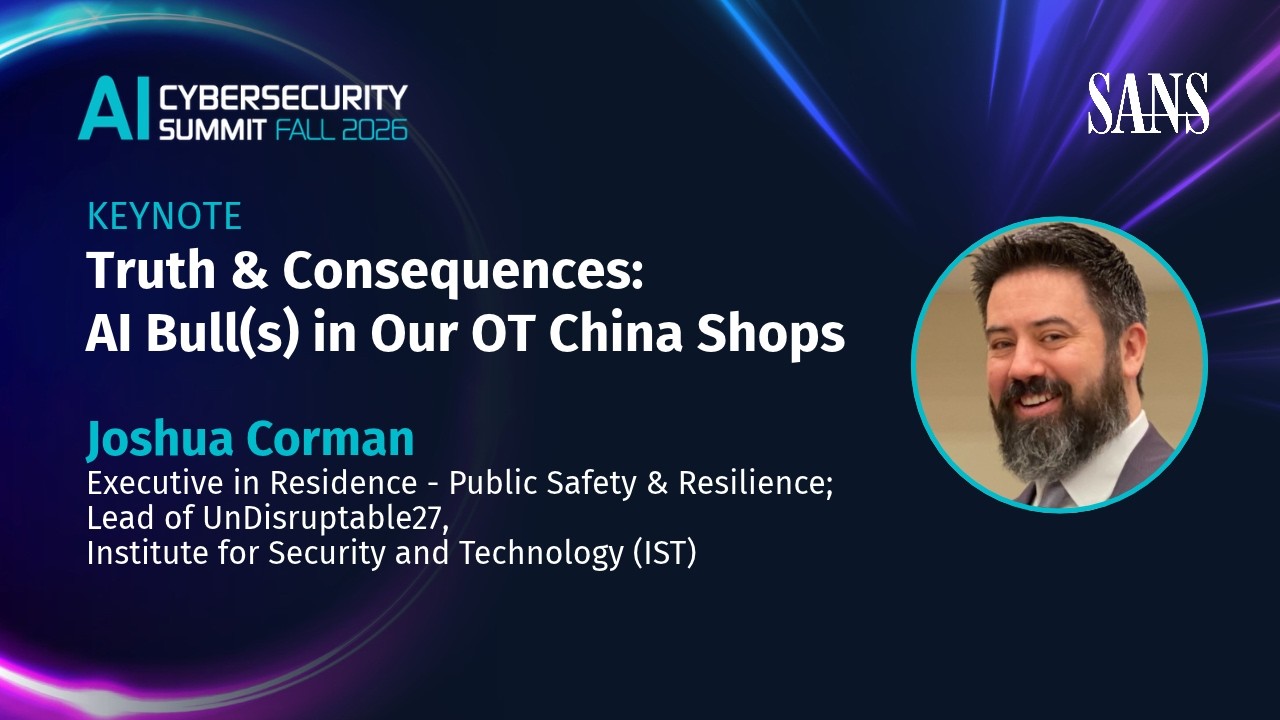
Truth and Consequences: AI Bull(s) in Our OT China Shops
Title history
- Truth and Consequences: AI Bull(s) in Our OT China Shops — observed on 20261110-2022 UTC (YouTube)
Keywords
Summary
235 words
Critical Evaluation
Value of the Information & Strength of the Argument
The video’s primary value lies in its shift of perspective from IT-centric cybersecurity to the often-overlooked OT and critical infrastructure sector. Corman presents concrete, declassified examples (Volt Typhoon, Iranian reconnaissance) and draws on his personal experience in government and industry, which lends authenticity to his warnings. His argumentation is forceful and coherent, leveraging analogies (water hammer, Jenga towers) to make technical risks accessible. However, his claims are largely anecdotal and rely on his own authority rather than documented citations; he does not provide data or footnotes for many assertions, such as the number of OT incident responders (120) or the details of the insurer exercise. The argument about AI being an additional risk rather than a solution is well reasoned, but it is an opinion piece rather than a systematic evaluation.
Scientific Rigor, Source Quality, Title Accuracy
Corman references several concrete sources, including declassified intelligence reports on Volt Typhoon, his own publications (Rugged Software Manifesto, Fragile Foundations), and his exercise with insurers. He also quotes a 9/11 commission moment to emphasize accountability. However, he does not provide direct citations or links to these sources during the talk; the only link in the description is to the SANS summit registration. This limits the verifiability of his claims. The title is highly appropriate and memorable, distinctly capturing the tension between AI and OT fragility. No comments were provided for analysis.
237 words
Title / Content Match
The title precisely captures the video's core argument: AI introduced into OT environments acts like a bull in a china shop, causing potentially catastrophic consequences. The presentation directly addresses this metaphor.
Quality & Reliability
7/10
The speaker is a recognized expert in critical infrastructure security with direct experience in government and industry. He references declassified incidents (e.g., Volt Typhoon) and describes his own studies and exercises, but the presentation is an opinion keynote rather than a peer-reviewed analysis. Specific claims about adversary capabilities are based on declassified information but not independently verified in this talk.
Key Moments
Markers derived by PSI from the transcript: the creator did not define chapters.
- Corman asks the audience to think about the dependability of steel and concrete versus software, introducing the theme of overdependence on undependable systems.
- Introduction to OT/ICS: what a PLC is, its age, and its vulnerability to internet exposure, setting the stage for why OT is a critical blind spot.
- Corman discusses Volt Typhoon, the Chinese military unit inside US water facilities, emphasizing that it's not theoretical but an active threat.
- Introduction of the water hammer analogy and the physical consequences of disrupting OT, including cascading failures to healthcare.
- Presentation of the 55 National Critical Functions and the need for ruthless prioritization; most OT-dependent functions have low downtime tolerance.
- Description of the insurer exercise that simulated attacks on 6,000 water plants, revealing a critical shortage of OT incident responders (~120).
- Corman critiques the AI community for ignoring OT in discussions like the 'Glasswing' paper and argues against simply adding AI to fight AI.
- Presentation of four hypotheses for securing OT: AI-to-AI, shields up, engineering, or offline/manual, with his bet on removing complexity.
- Call to action: the need for humility, engagement, and support for initiatives like UnDisruptable27 and the upcoming Fragile Foundations report.
Cited Sources
- SANS AI Cybersecurity Summit Spring 2027 — Mentioned as the next summit event where the speaker will participate; provides registration details.
Contribution & Novelties
Corman brings a fresh and urgent perspective by highlighting that AI discussions in cybersecurity are overwhelmingly focused on IT, while OT and critical infrastructure—the systems that sustain life—are critically underserved. He proposes a nuanced evaluation framework for existing cybersecurity controls, urging professionals to discard beliefs that are no longer valid, and argues for a pragmatic approach that goes beyond adding AI. His experiences (e.g., the insurer simulation, Operation Warp Speed) offer real-world insights that are rarely discussed in mainstream AI conferences.
Pour aller plus loin :
- Operational Technology (Wikipedia) — Defines the domain and its distinction from IT, essential for understanding the video’s core subject.
- ICS (Industrial Control System) Security (Wikipedia) — Provides background on ICS architectures and their vulnerabilities.
- Volt Typhoon (CISA advisory) — Official alert about the Chinese state-sponsored activity that Corman discusses.
- Water Hammer (Wikipedia) — Explains the physics analogy used to describe cascading failures.
- Critical Infrastructure Protection (Wikipedia) — Overview of the field and national programs.
160 words
Radar Profile
The radar profile shows high scores in information quantity and technical depth but moderate reliability, reflecting a talk rich in expert insights but lacking formal citations. The emphasis on practical experience over peer-reviewed evidence is evident.