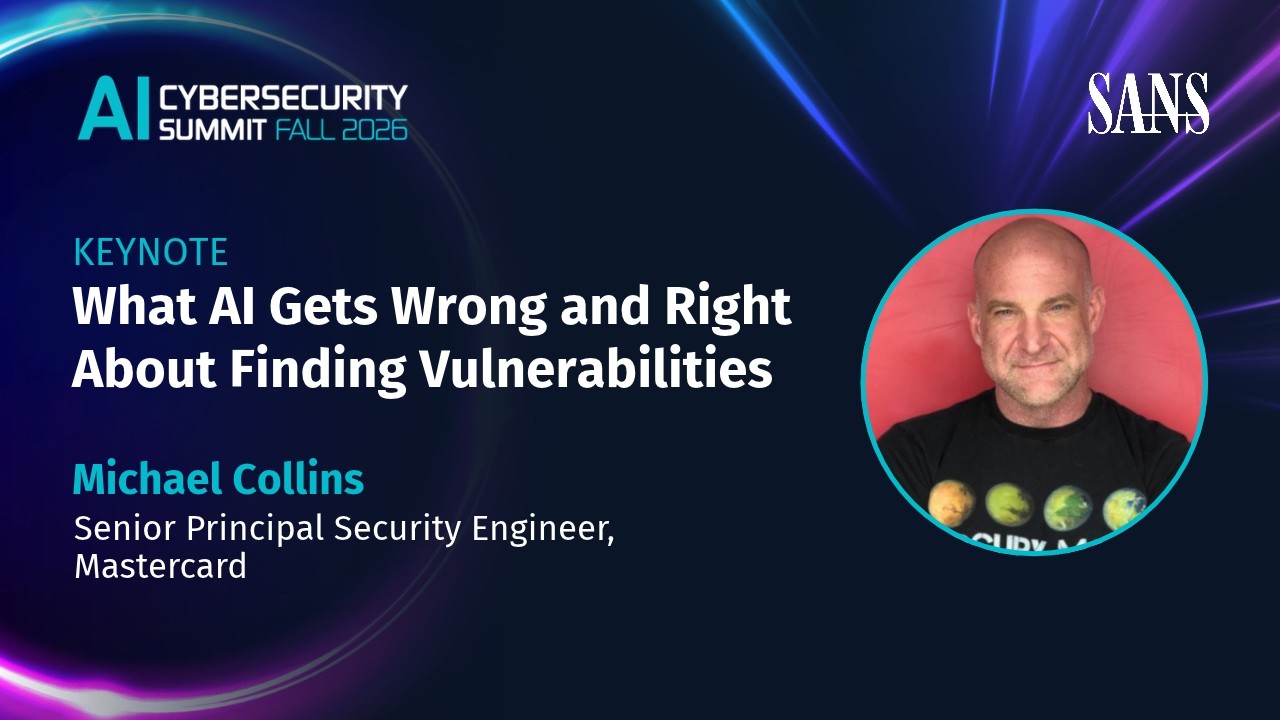
What AI Gets Wrong and Right About Finding Vulnerabilities
Keywords
Summary
204 words
Critical Evaluation
Value of the Information & Strength of the Argument
The value of this talk lies in its grounded, practitioner-oriented perspective, offering concrete operational advice that is often missing from vendor hype. Collins argues that the capability of frontier models is profound, demonstrated by a live example of reversing a binary with minimal prompting. He carefully balances enthusiasm with caution, noting the risks of democratized exploit development and the operational overhead of fixing findings. His argumentation is solid, based on his own experience and that of partner organizations, and he supports claims with specific examples like the OpenBSD bug and the speed of finding vulnerabilities. However, the evidence is largely anecdotal, and he does not provide quantitative metrics or systematic analysis, which limits the strength of his conclusions from a rigorous scientific standpoint. The reasoning is coherent, and he anticipates counterpoints, such as the need for context to improve risk ranking, which strengthens his credibility.
Scientific Rigor, Source Quality, Title Accuracy
The talk is a keynote, and while the speaker does not cite formal academic sources, he references the Glasswing project (likely an Anthropic initiative) and mentions numbers pulled from Anthropic, though without a specific link. The only explicit source provided is a link to the SANS AI Cybersecurity Summit for future events, which is not directly a citation for the talk’s claims. The scientific rigor is moderate: the content is based on experience rather than a structured study, and there is no external verification of the described capabilities. The title is appropriate and accurately foreshadows the balanced discussion of AI’s strengths and weaknesses in vulnerability discovery. The speaker’s credibility as a senior security engineer with 30 years of experience adds weight to the anecdotal evidence, but the lack of verifiable data (e.g., detection rates, false positive rates) prevents a higher reliability score. Overall, the talk is informative and trustworthy in its domain, but it should be viewed as a practitioner’s perspective rather than a rigorous scientific evaluation.
327 words
Title / Content Match
The title accurately reflects the content: the speaker discusses both the successes (e.g., finding hard bugs, reversing binaries) and the limitations (false positives, fixing bottlenecks, risk of operational changes) of using AI for vulnerability discovery.
Quality & Reliability
7/10
The talk is a first-hand account from a senior security engineer with decades of experience, sharing practical lessons from Mastercard's AI vulnerability operations. The reliability is high for experiential insights, but the presentation is anecdotal and not peer-reviewed, with no detailed metrics or external validation.
Key Moments
Markers derived by PSI from the transcript: the creator did not define chapters.
- Introduction: Michael Collins introduces himself, his 30-year hacking background, and the new AI Vulnerability Operations group at Mastercard.
- Reference to Arthur C. Clarke's 1964 predictions about computers and AI, highlighting their foresight.
- Discussion on the democratization of exploit development and the impact of frontier models on the security landscape.
- Personal anecdote: feeding a crypto reversing challenge to the model, which solved it autonomously and even fixed the wine configuration on the speaker's Mac.
- Importance of sandboxing: using the Mastercard Cyber Range to isolate testing and avoid triggering internal security controls.
- Development of a sophisticated harness: cost tracking, co-work functionality, de-duplication, and support for multiple model providers.
- Bottlenecks and fixes: packaging code, scaling operations, and the ongoing challenge of fixing vulnerabilities quickly.
- Key lessons learned: sandbox from day one, treat everything as code, stay model-agnostic, and plan for fixing ahead of time.
- Q&A session: questions about chain-of-thought access and information sharing between companies, addressing transparency and open-source collaboration.
Cited Sources
- SANS AI Cybersecurity Summit Future Events — Link provided in the video description for upcoming SANS AI Cybersecurity Summits, which is the context for the talk.
Contribution & Novelties
This talk provides a rare, detailed look into the operational realities of using frontier AI for vulnerability discovery in a large enterprise (Mastercard). It contributes practical lessons on building a harness, sandboxing, and integrating AI into security workflows, which are not typically found in academic literature. The speaker’s candid discussion of failures and surprises, such as the model fixing its own environment, adds a unique perspective.
Pour aller plus loin :
- Digital twin — A relevant concept for creating safe production-like environments for AI testing.
- Fuzzing — The speaker compares AI-driven vulnerability hunting to a sophisticated fuzzer; understanding fuzzing helps contextualize the approach.
- Cyber range — Sandboxed environments for cybersecurity training and testing, which the speaker used to enable safe AI operations.
122 words
Radar Profile
The scores indicate a talk that is strong in qualitative information and reliability, with a slightly lower score in technical depth and quantity of data. This reflects a practitioner's narrative that is rich in experiential detail but lacks systematic quantitative analysis. The profile suggests a balanced but not technically exhaustive overview, suitable for a professional audience seeking practical insights.