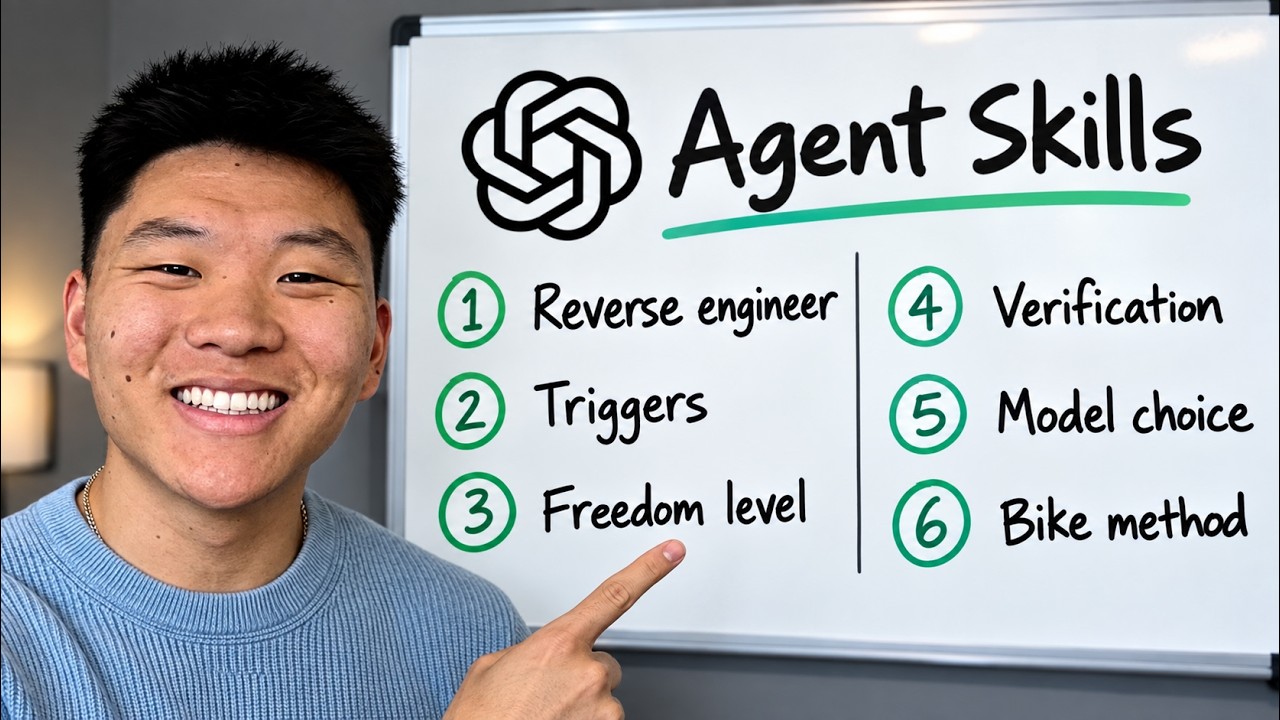
How to Build Codex Skills Better than 99% of People
Keywords
Summary
117 words
Critical Evaluation
Value of the Information & Strength of the Argument
The information provided is highly valuable for practitioners seeking to optimize AI agent performance through structured skill design. The argumentation is logically sound, moving from conceptual explanations to concrete demonstrations. The six-step framework is coherent and each step is justified with practical reasoning, such as explaining why one should start with an output and work backward, or why verification loops reduce manual oversight. The live comparison of models adds empirical weight to the claim that simpler models can often deliver equivalent results, though this is based on a single trial and not statistically validated. The reasoning is consistent and avoids overclaiming, acknowledging that skill quality depends on iteration and context.
Scientific Rigor, Source Quality, Title Accuracy
The video does not cite scientific sources, relying instead on personal experience and practical tests. The description includes links to the creator’s own resources and affiliate tools, which are commercial rather than authoritative. The title accurately describes the content, promising a better-than-average skill-building technique, which aligns with the detailed walkthrough. The presence of a promotional segment is noted and does not distort the core technical content. The lack of external references limits the ability to independently verify claims, but the empirical demonstration provides a degree of credibility.
212 words
Title / Content Match
The title accurately reflects the content, which focuses on a systematic approach to building and refining Codex skills.
Quality & Reliability
6/10
The video offers a practical framework based on personal experience, but lacks external validation or scientific references. The methodology is coherent and clearly explained, though the reliance on anecdotal evidence and the promotional nature of some content limit its reliability.
Chapters
Cited Sources
- Playbook for growing a $1M AI agency — Mentioned in the description as a free playbook for AI agency growth.
- FREE First Client SOP — Promoted within the video as a free resource for acquiring first clients.
- Glaido - voice to text tool — Affiliate tool mentioned in the description as a tool used by the creator.
- Hostinger VPS for Claude Code hosting — Affiliate link for VPS hosting, mentioned in the description.
- LinkedIn profile of Nate Herk — Creator's professional profile provided for connectivity.
Contribution & Novelties
94 words
Radar Profile
The radar profile suggests a balanced video with strong information quantity and quality, slightly lower technical depth, and moderate global reliability. The high scores in information metrics indicate a dense, useful tutorial, while the reliability score is dragged down by the lack of external sources and anecdotal evidence.