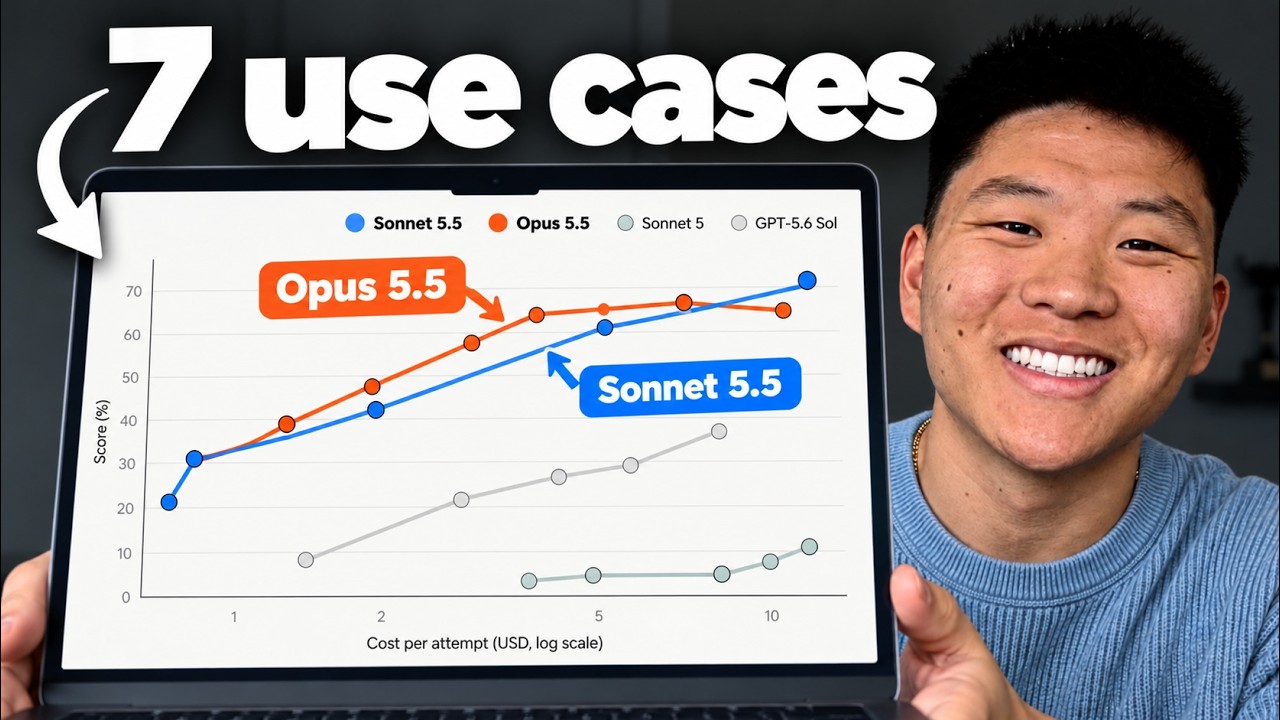
I Tested Sonnet 5.5 vs Opus 5.5. What You Need to Know.
Keywords
Summary
114 words
Critical Evaluation
Value of the Information & Strength of the Argument
The video delivers substantial value by showcasing real, reproducible workflows with actual outputs and cost data. The argumentation is structured around practical tests, with clear criteria for evaluating each output. The author acknowledges subjectivity but supports conclusions with quantitative metrics (token usage, runtime, cost). The reasoning for choosing one model over another is logically tied to the nature of the task, reinforcing the idea that model selection depends on task specification clarity. However, the argumentation could be strengthened by including blind tests or independent verification, and the promotional content (free skill, agency course) slightly undermines objectivity.
Scientific Rigor, Source Quality, Title Accuracy
The video cites no external scientific sources, but it references Anthropic’s own guidance on model selection, which adds credibility. The sources provided in the description are primarily promotional and tools, not academic references. The title accurately reflects the content, and the video does not overpromise. The scientific rigor is moderate: the testing methodology is transparent, but the evaluation is subjective and not peer-reviewed. The author does not discuss potential biases or limitations of the tests. The presence of sponsored links is disclosed, but they are not integrated into the content analysis.
202 words
Title / Content Match
The title accurately describes the video's content, which is a direct comparison of Sonnet 5.5 and Opus 5.5.
Quality & Reliability
7/10
The video is a hands-on comparison with detailed cost and speed analysis, but it is subjective and promotional in parts, lacking external validation.
Chapters
Cited Sources
- Scrollcraft Website Design Skill — Free website design skill mentioned and used in the video.
- Glaido — Voice-to-text tool promoted by the author.
- Hostinger VPS for Claude Code — Recommended hosting solution for Claude Code.
- Nate Herk LinkedIn — Author's professional LinkedIn profile.
- AI Automation Society Plus — Paid community for AI automation learning.
- AI Automation Society Free — Free resources community linked in description.
Concurring Sources
- Anthropic's Model Selection Guide — Referenced in the video but no direct URL provided.
Contribution & Novelties
The video systematically compares the two latest Claude models across diverse tasks, providing real-world cost and speed data. It highlights the trade-offs between creativity and cost, and demonstrates that with clear specifications, Sonnet can often match Opus at half the price. The author also introduces the concept of ‘skills’ and how they can be reused with different models.
Pour aller plus loin :
- Large language model — Background on LLMs and their capabilities.
- Prompt engineering — Techniques relevant to model choice and output quality.
- Anthropic — Company behind Claude, context on model development.
93 words
Radar Profile
The radar shows balanced strengths across information quantity, quality, technical level, and reliability, with slightly higher scores in quantity and technical detail. This indicates a content that is rich in examples and practical data but relies on subjective evaluation, making fiabilité moderate.