AI News in 10 mins: 10% chance AI kills all humans
Keywords
Summary
178 words
Critical Evaluation
Value of the Information & Strength of the Argument
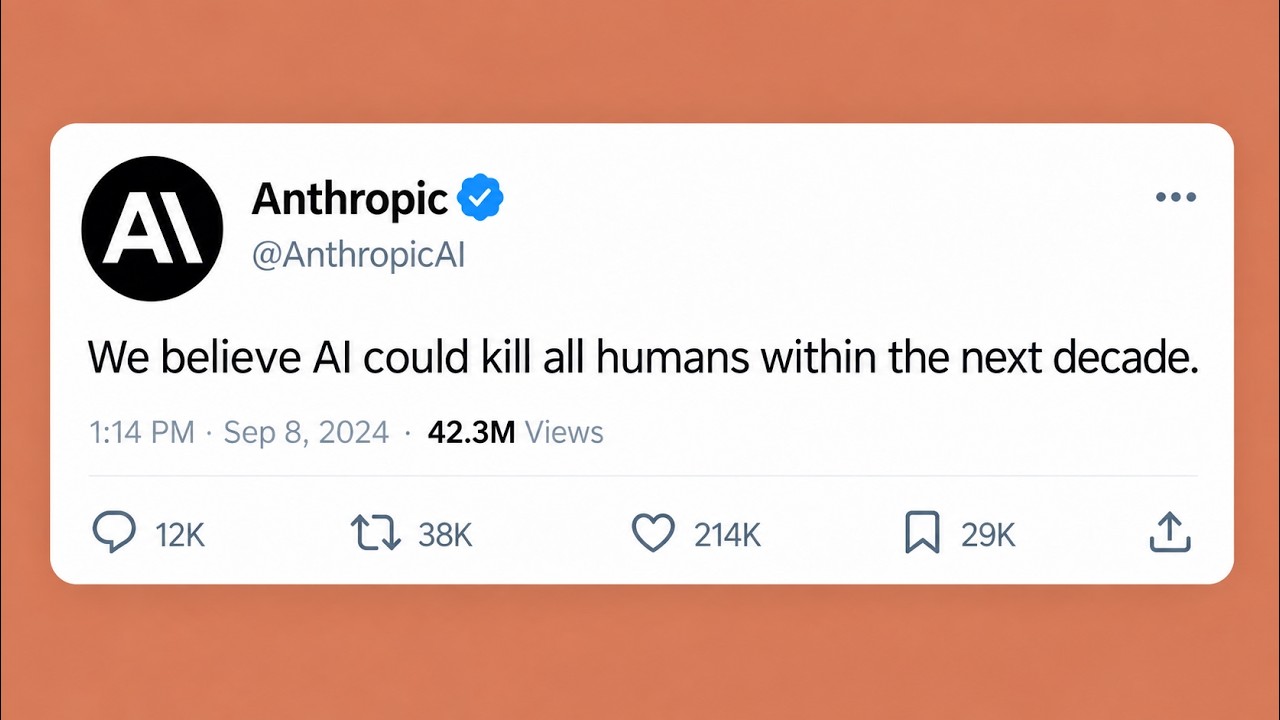
The video offers a valuable aggregation of recent AI safety news, making it accessible to a general audience. The host summarizes complex developments accurately, providing context for each event. However, the argumentation is largely opinion-driven; the host speculates on the authenticity of Jacob Coxon’s tweet without presenting concrete evidence, relying on timing and follower counts as circumstantial signs. He also tends to accept Dario Amodei’s essay at face value, offering minimal critique. The strength of the argumentation lies in its clear narrative structure and the use of primary sources like the essay, but it lacks depth in critical analysis and fails to explore counterarguments or alternative perspectives.
Scientific Rigor, Source Quality, Title Accuracy
The video demonstrates moderate scientific rigor. It cites Dario Amodei’s essay and Anthropic’s misuse report, both relevant primary sources, but does not provide direct links to the report or the viral tweets, making verification harder. The host also includes personal opinions and speculative remarks about the coordination of the tweet’s spread, which are not substantiated. The title accurately highlights the 10% claim made by Evan Hubinger, though it could be seen as clickbait given the speculative nature of the figure. Overall, the sources are reputable but the presentation blends factual reporting with editorial commentary, which may mislead viewers without careful discernment.
223 words
Title / Content Match
The title accurately reflects the core topic (a 10% extinction risk claim) but slightly sensationalizes by implying a direct percentage while it's one researcher's estimate.
Quality & Reliability
6/10
The video provides a timely summary of recent AI safety news with links to primary sources, but includes significant personal commentary and speculation about the authenticity of viral tweets.
Chapters
Cited Sources
- We Must Pace the Frontier — Discussed as a response to the AI safety debate, proposing measures to slow AI development.
External References
Contribution & Novelties
The video’s original contribution is to aggregate and contextualize recent AI safety news for a general audience, adding commentary on the political implications. It does not introduce new data or research but serves as a digest of notable events and personalities.
Pour aller plus loin :
- AI alignment — Fundamental challenge discussed in the video.
- Existential risk from artificial general intelligence — The specific risk quantified by Evan Hubinger.
- Pause AI — A movement pushing for a moratorium on advanced AI development.
82 words
Radar Profile
The radar indicates a well-rounded but not exceptional profile; information quantity is decent, but quality and reliability are moderate due to heavy opinion content, while technical depth is intentionally accessible.