Fabriquer des super-héros : jusqu’où peut-on augmenter nos performances humaines ?
Making superheroes: how far can we enhance our human performances?
Keywords
Summary
111 words
Critical Evaluation
Value of the Information & Strength of the Argument
The talk offers valuable insights by bridging fundamental neuroscience with sports performance. It clearly explains the dual contribution of neural and muscular factors to strength, using accessible diagrams and examples. The argumentation is solid, supported by experimental data from the speaker’s lab (e.g., the jump performance study after tDCS) and by reference to established literature. The speaker objectively discusses the mixed evidence for some techniques, which strengthens credibility. The value lies in demystifying human performance limits and presenting a realistic picture of what science can achieve, without overhyping unreal results.
Scientific Rigor, Source Quality, Title Accuracy
The scientific rigor is high: the speaker cites influential models (e.g., the 1980s strength gain model) and recent re-evaluations by an Australian team, and describes careful experimental protocols (placebo conditions, proper electrode placement). However, no formal citations or links are provided in the video or description, making it difficult to verify sources directly. The title is well-suited to the content, as it directly addresses the question of performance enhancement. The talk also warns about the gap between sophisticated lab tools and commercial devices, adding a critical perspective. Overall, the content is reliable for a public audience, but the lack of explicit references limits its use for deep verification.
213 words
Title / Content Match
The title accurately reflects the content, which explores the scientific feasibility of enhancing human performance through neural training, drawing parallels with fictional superheroes.
Quality & Reliability
8/10
The speaker is a neurophysiologist and the talk presents a balanced overview of neural training methods, including own laboratory results, while acknowledging limitations and unresolved questions.
Key Moments
Markers derived by PSI from the transcript: the creator did not define chapters.
- Introduction to the speaker and laboratory equipment used for measuring neural and muscular activity.
- Explanation of the strength gain model: force improvement results from both muscular and neural changes, with neural adaptations dominating early training.
- Presentation of voluntary activation levels and how electrical stimulation quantifies the true maximum force, showing typical deficits.
- Introduction to training methods targeting the nervous system, including top-down and bottom-up approaches.
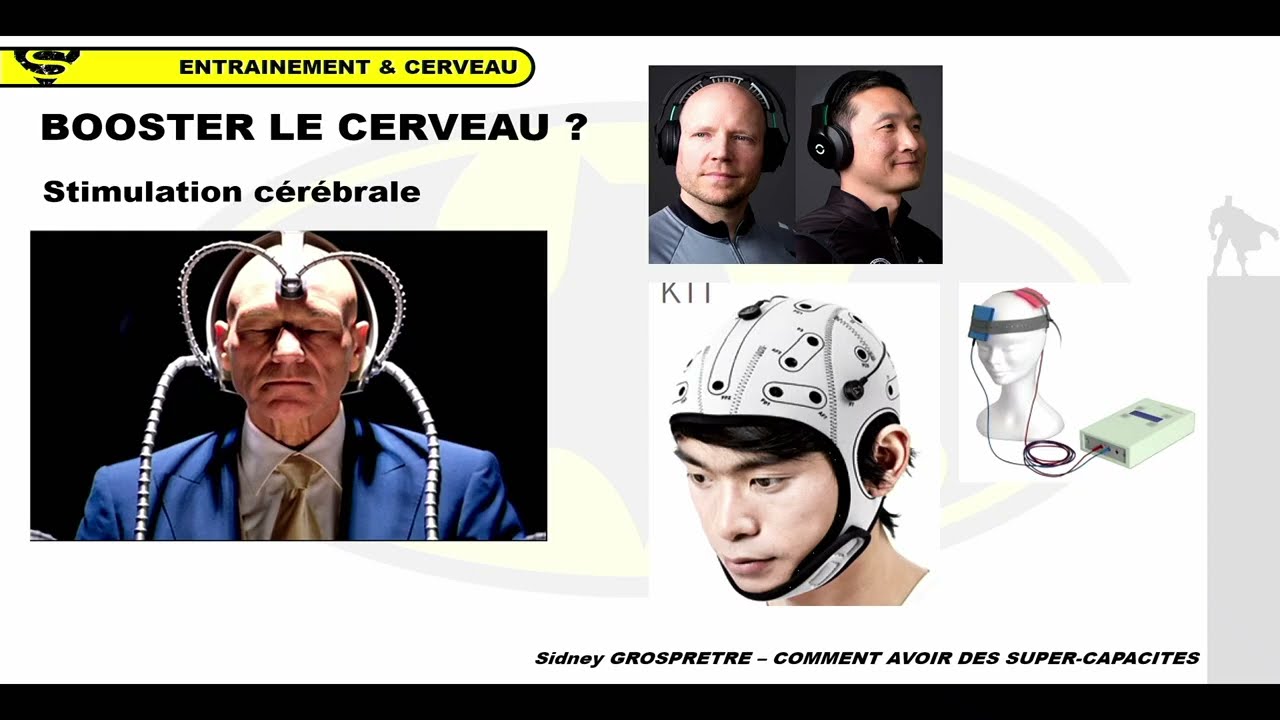
- Discussion of transcranial direct current stimulation (tDCS): background, protocol, and results from the speaker's study on parkour athletes showing improved jump performance.
- Segue into mental imagery and motor imagery, explaining how imagining movements activates similar brain regions as actual execution.
Contribution & Novelties
The talk provides an original overview by situating recent lab studies within the wider context of neural training methods. It highlights the importance of neural factors in strength development and presents concrete experimental evidence. The discussion also critically examines the transfer of research findings to consumer products.
Pour aller plus loin :
- Transcranial direct current stimulation — covers the technique used in the talk’s experiments.
- Motor imagery — foundational for the mental training section.
- Neural adaptation — explains the biological basis of long-term training-induced changes.
85 words
Radar Profile
The radar profile shows balanced scores with high quality and quantity of information, a moderate technical level, and strong overall reliability, indicating a well-structured and trustworthy presentation.