La liberté d’expression à l’épreuve du travail
Freedom of expression put to the test at work
Title history
- La liberté d’expression à l’épreuve du travail — observed on 20261117-0328 UTC (YouTube)
Keywords
Summary
175 words
Critical Evaluation
Value of the Information & Strength of the Argument
The lecture provides a clear and well-founded analysis of the legal evolution of freedom of expression in the workplace. The speaker demonstrates strong argumentation by tracing the historical context from public liberties to fundamental rights, using authoritative sources such as the Auroux report and legislative texts. The explanation of the two-dimensional nature of freedom (both recognized and restrictable) is nuanced, and the connection to contemporary judicial strategy (e.g., the impact of Macron ordinances) is insightful. The value lies in its synthesis of legal doctrine and practical implications for labor law.
Scientific Rigor, Source Quality, Title Accuracy
The speaker cites key legal documents including the 1789 Declaration, the law of 1881, the European Convention, and the Auroux report, showing careful reliance on primary sources. The presentation is rigorous, referencing specific statutes and reports. The title is highly adequate: it captures the core tension between individual expression and employment constraints. The content aligns with the title, exploring both theoretical foundations and practical legal developments.
171 words
Title / Content Match
The title accurately reflects the content, which examines the tension between employee freedom of expression and employment subordination.
Quality & Reliability
8/10
The lecture is delivered by a professor of private law, based on legal texts, historical reports, and case law. The content is well-structured and accurate, though it reflects the speaker's interpretative perspective.
Key Moments
Markers derived by PSI from the transcript: the creator did not define chapters.
- Introduction by the host and welcome to the conference.
- Definition of freedom of expression as a legal object and fundamental liberty.
- Discussion of the 1789 Declaration and the public liberty perspective.
- Analysis of the 1881 Press Law and its relevance.
- Evolution towards fundamental liberties, including the European Convention.
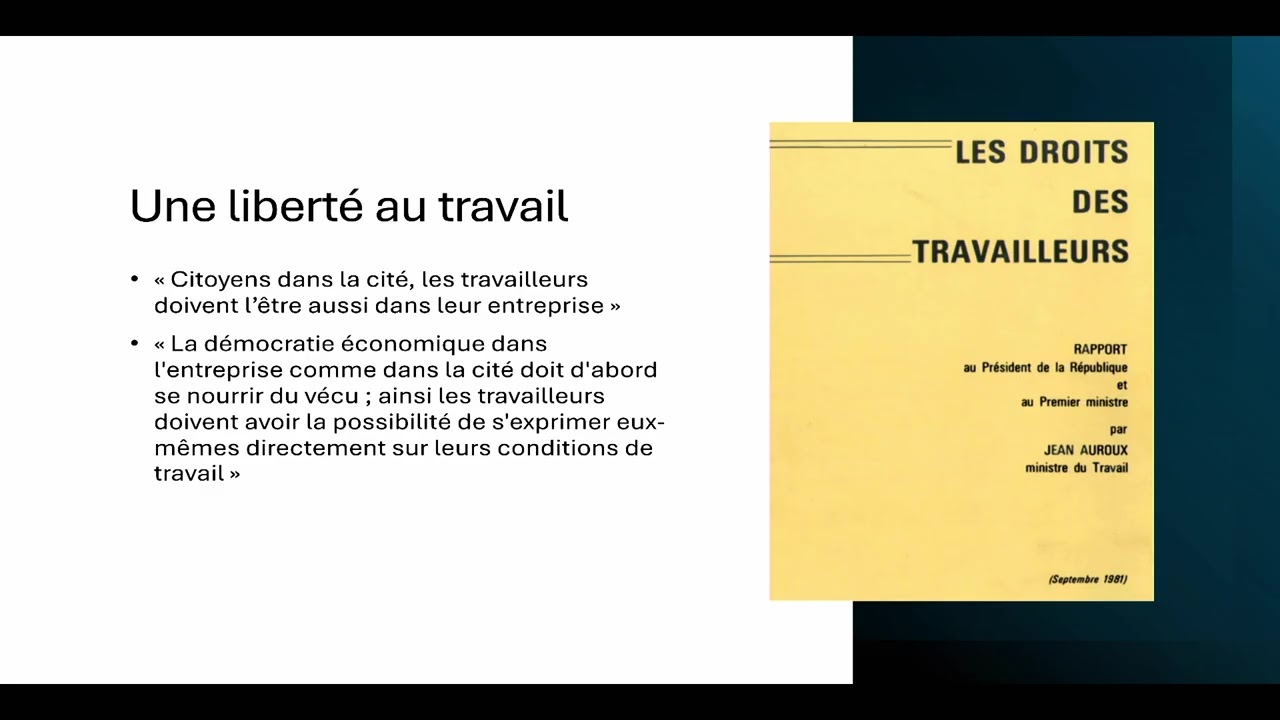
- Presentation of the Auroux report and the 1982 laws on workers' rights.
- Introduction of the right to direct expression and its initial failure.
- Revival of direct expression through quality-of-work plans.
- Explanation of juridicisation and judiciarisation trends.
- Impact of the 2017 Macron ordinances on litigation strategies.
Cited Sources
- The Auroux Report on Workers' Rights (1981) — Cited as a foundational document advocating for worker citizenship in enterprises.
- Law of 29 July 1881 on Freedom of the Press — Relevant to the legal framework of freedom of expression.
- Declaration of the Rights of Man and of the Citizen (1789), Article 11 — Basis for the constitutional protection of freedom of expression.
- European Convention on Human Rights (1950), Article 10 — International source for freedom of expression as a fundamental freedom.
- Auroux Laws (1982) — Introduced provisions for workers' rights and direct expression in the workplace.
Concurring Sources
- European Convention on Human Rights, Article 10 — International legal guarantee of freedom of expression, consistent with the lecture's emphasis on fundamental rights.
Contribution & Novelties
The lecture provides a comprehensive historical and jurisprudential overview of freedom of expression in the French labor context, focusing on the concept of proportionality and the evolving balance between employer power and employee rights. Its originality lies in connecting the legal evolution to broader social changes (e.g., individualization of HR) and practical litigation strategies post-2017.
Pour aller plus loin :
- Cour de cassation official website — For direct access to French case law, relevant to understanding judicial interpretation.
- Légifrance - French law database — For the texts of laws cited, including the 1881 law and the Labor Code.
- European Court of Human Rights - Freedom of expression — Jurisprudence on Article 10 ECHR, though the video focuses on French law, this provides European context.
124 words
Radar Profile
The profile shows a strong emphasis on quality of information and reliability, with slightly lower technical complexity, indicating a lecture that is accessible yet rigorous. The high scores in quantity and quality suggest a dense and well-argued presentation.