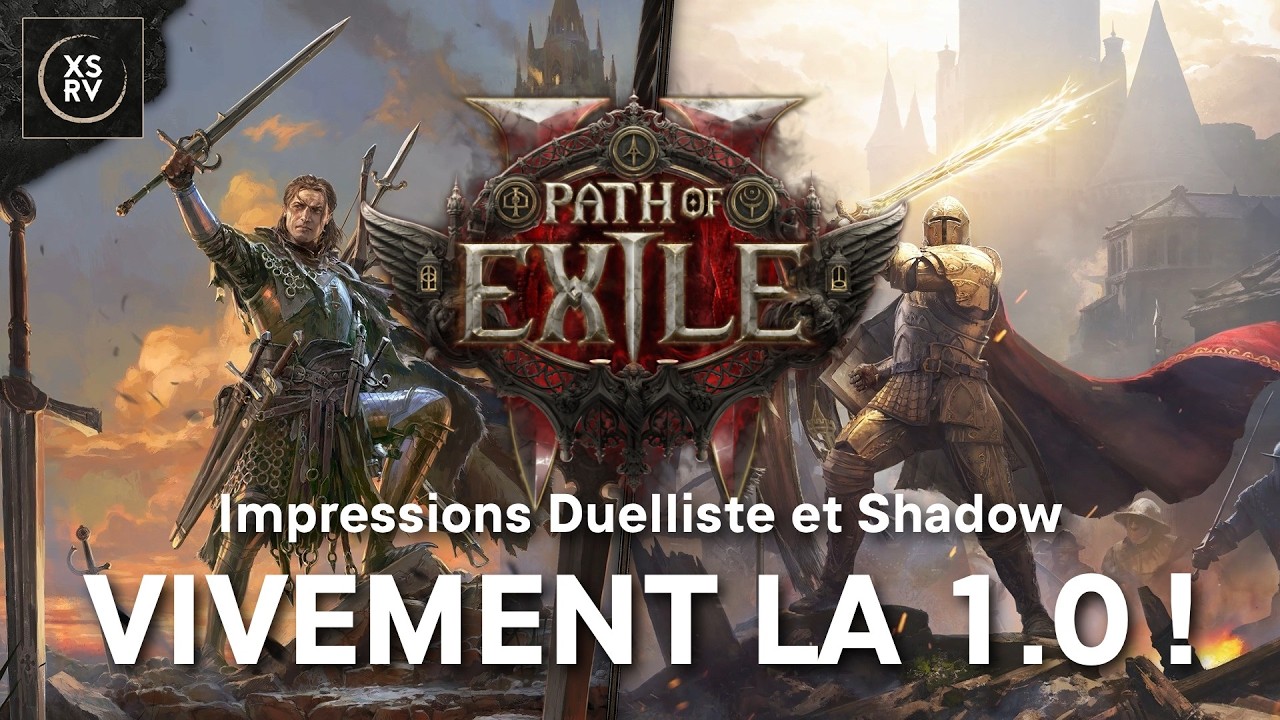
J'ai testé la version 1.0 de POE 2... que dire à part vivement 11 décembre !
I tested version 1.0 of POE 2... what can I say except roll on December 11!
Keywords
Summary
297 words
Critical Evaluation
Value of the Information & Strength of the Argument
The informational value lies in the density of concrete, experience-based detail rather than in any data. Over roughly seventeen minutes the author describes specific mechanics: the Shadow’s stealth/visibility toggle governing both dagger skills and trap detonation, the two trigger conditions for traps, the Duellist’s maintained attacks leading into a stance choice between blood and sand, the parry functioning as an endurance-gated posture that blocks everything except clearly telegraphed red boss attacks, and the vortex keyword letting Cyclone absorb ground surfaces and add them to damage. These are the kind of observations that only come from playing, and they are useful to anyone trying to anticipate how the classes feel. The argumentation, however, is associative and testimonial rather than demonstrative: each claim rests on the author’s sensations (‘I found this absolutely brilliant’, ‘it feels fluid’) and on a single session of about five hours with pre-built level-55 characters, which he acknowledges took thirty to sixty minutes just to understand. He consistently marks the limits of his own evidence, saying the build was far too powerful and will likely be nerfed, that he could be wrong about whether mixing the two stances is viable, that the endgame remains unseen, and that mixing a sword and a mace might open options he did not think to test. The comparative framework is his own long history with the first game, which lets him situate Cyclone, traps and the blood-and-sand concept against their earlier versions, but this remains a single expert’s impression, with no measurement, no controlled comparison and no counter-testimony from players who disagree. The practical advice given to newcomers is sound and appropriately modest, and the closure is honest about what the format could not show: ascendancies for the Shadow were absent and much of the content could not be captured.
Scientific Rigor, Source Quality, Title Accuracy
No external source is cited anywhere in the video: no patch notes, no developer interview quoted verbatim, no press release, no third-party analysis. The description’s links are commercial or community in nature (an affiliate-tracked link to the game, a partner store, a merchandise shop, a Patreon, a Discord invite, an illustration portfolio, the author’s publisher page and his own review playlist), so none of them constitutes a documentary source for the factual claims made. The claims about scope (six acts, 10 classes, 26 ascendancies, two classes still missing, a four-month content cycle, a league mechanic resembling Heroes of Might and Magic) are asserted from the author’s attendance and memory of the event rather than referenced. On the positive side, the conflict of interest is disclosed clearly and unprompted at the start, the author distinguishes what he played himself from footage supplied by other attending streamers, and he states plainly that the demo build is identical to the one shown weeks earlier in New Zealand and therefore not representative of the December 11 release. The title’s promise of a 1.0 test is thus slightly ahead of what was actually tested, though the gap is acknowledged inside the video. No viewer comments were supplied with this material, so no audience trend is assessed.
524 words
Title / Content Match
The title announces a test of the 1.0 version; the video delivers hands-on impressions of a preview build, explicitly identified as the same build shown earlier in New Zealand and not the final release. The match is honest, and the author warns that balance and features may change by December 11.
Quality & Reliability
5/10
First-hand hands-on impressions from a press preview event, delivered by a long-time player of the franchise (since 2013), which gives genuine domain familiarity. The author repeatedly flags uncertainty (unbalanced build, 'probably nerfed', 'I might be wrong'), distinguishes what he played from what he only saw, and discloses that the studio covered his train and hotel. However, the video contains no external sources, no figures, no comparison with documented data, and its claims rest on a few hours with pre-built level-55 characters on a demo restricted in what could be captured; several stated facts (10 classes, 26 ascendancies, six acts, four-month league cycle) are asserted without citation. Reliability is therefore that of informed but subjective testimony rather than verified reporting.
Key Moments
Markers derived by PSI from the transcript: the creator did not define chapters.
- Introduction: free-to-play launch on December 11, context of the Munich preview event and the two new classes.
- Transparency statement on who paid for travel and accommodation, and the announcement that no streams or guides will appear before January.
- Advice to newcomers: do not chase a meta build, pick a character whose fantasy appeals and aim to finish the campaign.
- Overview of 1.0 content: six-act campaign, 10 classes and 26 ascendancies, the new league mechanic with troop recruitment and castle battles, passive tree and support gem rework.
- Seamless switching between keyboard and controller on PC, including mouse navigation of controller menus.
- Act 5 in Oriath: staging, optional side content, boss design and the balance between Souls-like encounters and Diablo-like crowds.
- The Shadow: dagger-and-trap duality, stealth toggling, trap detonation conditions and concern about the intensity of the light flashes.
- The Duellist: arrival of swords, one- and two-handed options, stance and combo system, and the parry as posture rather than timing.
- Cyclone and the vortex keyword absorbing ground effects, plus mobility skills and the learning curve on a pre-built level-55 character.
- The Chevalier ascendancy: banners, glory resource and squire companion, then closing remarks and the Discord community.
Cited Sources
- Path of Exile 2 — official game page (affiliate-tracked link from the description) — Only direct pointer to the game itself provided by the author; used as the reference for release date and access.
- Ex Serv Discord server — Community space where the author says builds, crafting advice and playstyle tips will be shared from December 11.
- Ex Serv — full review and test playlist — The author's own body of previous game tests, referenced as background to his comparative judgements.
Concurring Sources
- Path of Exile 2 — official site — Publisher-side reference that would corroborate the announced content scope, class roster and league cycle described in the video.
- Path of Exile 2 on Wikipedia — Independent encyclopaedic summary consistent with the publicly known development timeline and release framing mentioned by the author.
External References
Contribution & Novelties
The value here is not novelty of knowledge but early, granular, first-hand description of two classes and one act that were not publicly playable before: how the Shadow’s stealth toggle actually governs both dagger skills and trap detonation, how the Duellist’s maintained attacks feed into a stance choice and a posture-based parry, how the vortex keyword on Cyclone converts enemy ground effects into damage, and how the Chevalier ascendancy layers an extra effect on top of banner effects while carrying a fully equippable squire. The author also reports the concrete, low-profile improvement of hot-swapping between keyboard and controller mid-session, with mouse navigation retained inside controller menus — a quality-of-life change promised for over a year. What the video does not provide is anything beyond one player’s impressions of a demo build: no endgame assessment, no mapping or economy analysis, no ascendancy detail for the Shadow, and no verification of the announced scope.
Pour aller plus loin :
- Path of Exile 2 — Encyclopaedic background on the game’s development history, its lengthy paid beta and its free-to-play transition, useful for situating the 1.0 claims.
- Grinding Gear Games — The New Zealand studio behind the franchise, relevant to the author’s account of the ExileCon announcement cycle and the global preview tour.
- Action role-playing game — Genre framework for the tension the author describes between Souls-like boss encounters and Diablo-like mass combat.
- Free-to-play — Economic model context for the December 11 shift and its expected influx of first-time players.
- Dark Souls — Reference point explicitly invoked by the author when discussing boss design and the deliberate rejection of Sekiro-style parry timing.
- Seasonal league model and content-wipe cycles in live-service ARPGs — directly relevant to the four-month renewal rhythm described, but cited by name only, as no stable reference address could be confirmed.
299 words
Radar Profile
The profile is that of a dense but testimonial piece: high on information quantity and moderate on technical depth, since mechanics are described precisely but without numbers or comparisons. Quality and reliability sit in the middle, held back by the absence of any citable source and by the acknowledged instability of the preview build, while the author's long familiarity with the franchise keeps the technical vocabulary accurate. Overall the radar describes a useful experiential report rather than a verifiable analysis.