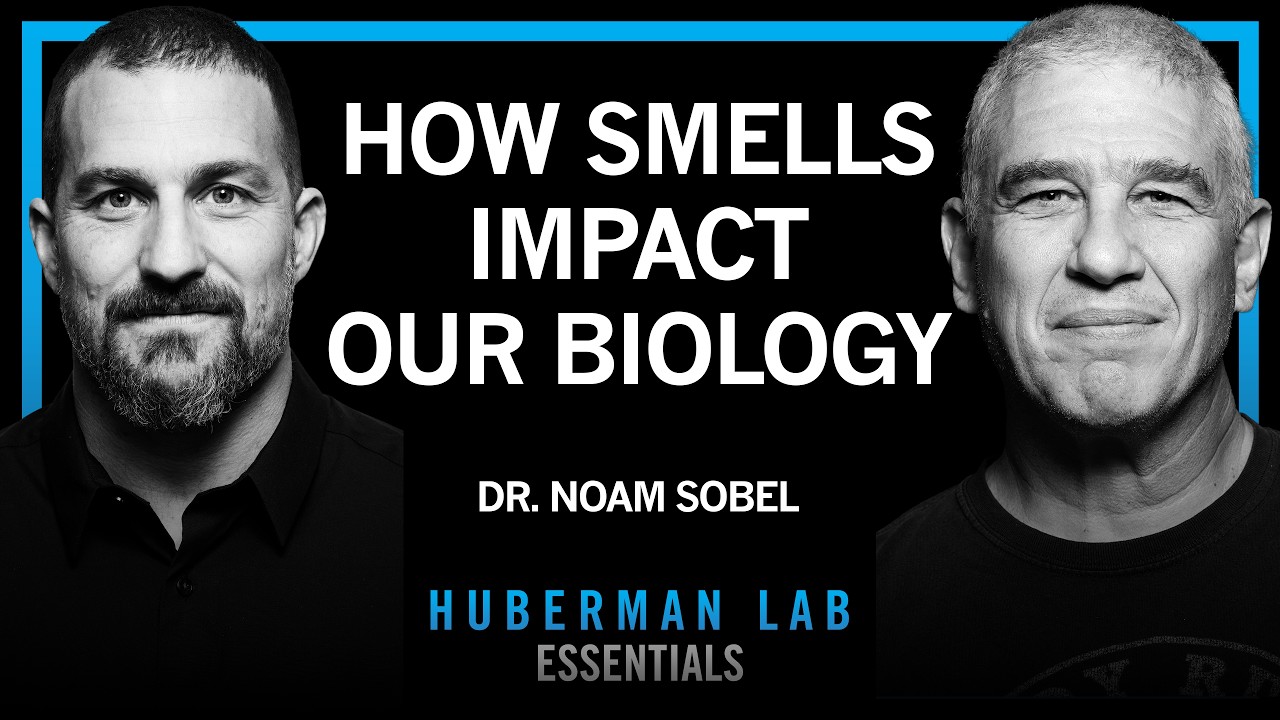
Essentials: How Smells Influence Our Hormones, Health & Behavior | Dr. Noam Sobel
Title history
- Essentials: How Smells Influence Our Hormones, Health & Behavior | Dr. Noam Sobel — observed on 20261029-1306 UTC (YouTube)
Keywords
Summary
162 words
Critical Evaluation
Value of the Information & Strength of the Argument
The video provides a rich, evidence-based overview of the human olfactory system and its impact on social and hormonal processes. Dr. Sobel clearly explains the scientific basis, often referencing specific studies from his lab and others, and highlights controls and replications. For instance, he describes the handshake experiment with measures of nasal airflow to confirm olfactory behavior, and the click friendship study using an electronic nose to predict friendship ratings. He also notes the independent replication of the testosterone-lowering effect of tears. The argumentation is strong, as he distinguishes between established findings and hypotheses, and avoids overclaiming. However, some topics like the exact neural coding beyond the olfactory bulb remain acknowledged as murky, showing intellectual honesty.
Scientific Rigor, Source Quality, Title Accuracy
The scientific rigor is high, as the content is based on peer-reviewed publications. Dr. Sobel provides detailed experimental procedures and notes replications. He mentions specific paradigms like the Taylor Aggression Paradigm and fMRI validation. The sources are not explicitly cited in the description, but the show notes link likely contains a list of references. The title is appropriate and accurately describes the scope of the discussion, which includes both basic olfaction biology and behavioral effects. The content adheres to scientific standards, with clear explanations of mechanisms and limitations.
219 words
Title / Content Match
The title accurately reflects the content, covering how smells influence hormones, health, and behavior.
Quality & Reliability
9/10
Content is based on peer-reviewed research, with detailed experimental descriptions, controls, and independent replications cited.
Chapters
- Noam Sobel
- Biology of Smell (Olfaction)
- Human Smell, Social Interaction, Handshaking
- Sponsor: LMNT
- Friendship, Body Odor
- Human Chemosignals, Smell of Fear & Contagion
- Aggression, Chemosignals, Men vs Women, Babies
- Sponsor: AG1
- Tears, “Chemical Blanket”, Testosterone
- Digitizing Smells
- Sponsor: Eight Sleep
- Creating Digital Odors; Future Medical Diagnostics
- Acknowledgments
Cited Sources
- Huberman Lab Episode Show Notes — This page provides links to scientific papers and additional resources discussed in the episode.
External References
Contribution & Novelties
This video synthesizes cutting-edge research on human chemosignaling, presenting novel findings such as the influence of hexadecanal on aggression in a sex-dependent manner, and the effect of emotional tears on testosterone. It also highlights technological advances in digitizing smells for potential medical diagnostics. The conversation brings together multiple studies from Dr. Sobel’s laboratory, offering a comprehensive perspective not typically available in a single source.
Pour aller plus loin :
- Olfactory system — Overview of the anatomy and function of the olfactory system.
- Olfactory receptor — Description of the receptors that bind odorants.
- Pheromone — Context on chemical signals and their role in behavior across species.
105 words
Radar Profile
The radar shows high scores for information quality and reliability, reflecting the expert-backed content, while technical level is moderate, suitable for a broad audience.