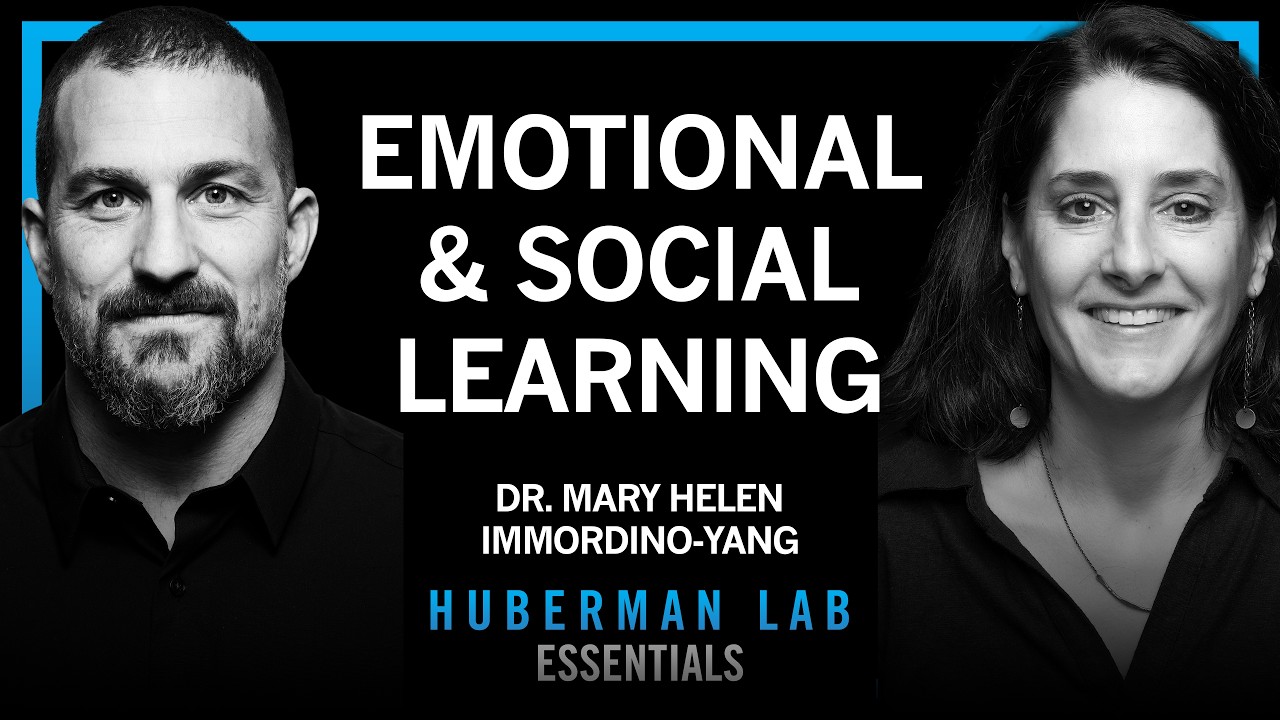
Essentials: How Emotions & Social Factors Impact Learning | Dr. Mary Helen Immordino-Yang
Title history
- Essentials: How Emotions & Social Factors Impact Learning | Dr. Mary Helen Immordino-Yang — observed on 20261112-1338 UTC (YouTube)
Keywords
Summary
139 words
Critical Evaluation
Value of the Information & Strength of the Argument
The information presented is highly valuable, offering a deep synthesis of affective neuroscience, developmental psychology, and education. Dr. Immordino-Yang grounds her arguments in empirical research and personal observations, providing a compelling account of how emotions drive learning and meaning-making. She integrates findings from Antonio Damasio’s somatic marker framework and cultural psychology, and uses concrete developmental examples to illustrate abstract concepts. Her argumentation is logically structured, moving from biological substrates to narrative construction and societal implications. She also addresses challenging topics like dehumanization and political divisiveness with scientific rigor and ethical nuance, emphasizing the need for dispositions that promote curiosity and self-questioning. The discussion is persuasive and well-supported, though some claims remain theoretical and would benefit from more systematic evidence.
Scientific Rigor, Source Quality, Title Accuracy
The episode demonstrates strong scientific rigor through the expertise of the guest and the careful framing of claims. Dr. Immordino-Yang references well-known researchers such as Antonio Damasio and Shinobu Kitayama, and her work is supported by publications accessible via Google Scholar and USC profile. The title accurately captures the core theme: the impact of emotions and social factors on learning, and the content stays on-topic throughout. The description provides show notes and disclaimers, maintaining transparency. No significant discrepancies between title and content were observed. The discussion includes practical tools, but these are clearly grounded in theoretical and empirical foundations. Overall, the sources cited are credible and the title faithfully represents the content.
246 words
Title / Content Match
The title accurately reflects the content: the video focuses on how emotions and social factors influence learning, with Dr. Immordino-Yang as the guest expert.
Quality & Reliability
9/10
The discussion features a leading researcher in affective neuroscience and education, Dr. Mary Helen Immordino-Yang, and is hosted by a Stanford professor. The content is grounded in peer-reviewed research and reputable academic work, with references to studies (e.g., by Shinobu Kitayama) and concepts from Antonio Damasio. The claims are presented with appropriate nuance and caution.
Chapters
- Mary Helen Immordino-Yang
- Inspiration, Awe & Story; Emotions & Survival Systems
- Brain-Body Dialogue, Social Interdependence & Sense of Self
- Sponsor: LMNT
- Early Emotional Experiences; Love, Development & Meaning
- Core Emotions, Life Stories & Development
- Culture, Perception & Imposing Expectations
- Narratives, Dehumanization & Empathy
- Tool: Question Assumptions & Engage Other Perspectives
- Social Media & Reinforcing Biases; Emotions & Mental Flexibility
- Sponsor: AG1
- Education System, Learning Outcomes; Project-Based Learning
- Curiosity, Preschool vs. Traditional Schooling
- Emotions & Learning, Ideas vs. Performance
- Tool: Engage Students' Interests & Curiosity
- Adolescence, Meaning-Making & School Constraints
- Tool: Deconstruct Beliefs, Sit with Uncertainty
- Education & Development of the Person
- Acknowledgements
Cited Sources
- USC Faculty Profile - Mary Helen Immordino-Yang — Profile of the guest expert, providing her academic credentials and research focus.
- Google Scholar - Mary Helen Immordino-Yang — List of publications by Dr. Immordino-Yang, offering access to her peer-reviewed work.
- Huberman Lab Podcast Episode Page — Official show notes and additional resources for this episode.
- Huberman Lab Website — Main website for Andrew Huberman's content, including episodes and supplementary materials.
- Huberman Lab Disclaimer — Legal disclaimer regarding the informational content of the podcast.
- Huberman Lab Newsletter — Subscription for updates and supplementary science-based content.
- Andrew Huberman LinkedIn — Professional profile of the podcast host.
- Mary Helen Immordino-Yang LinkedIn — Professional profile of the guest, highlighting her academic positions.
- Huberman Lab Threads — Social media channel for updates and community engagement.
External References
Contribution & Novelties
This episode provides a nuanced integration of affective neuroscience and education, emphasizing that emotions are not just peripheral but central to learning. The original contribution lies in framing the brain-body dialogue as the foundation for narrative construction, and in connecting basic physiological processes to cultural and societal issues like dehumanization and educational reform. Dr. Immordino-Yang offers practical tools, such as questioning assumptions and engaging with other perspectives, based on her research. The episode adds value by bridging neuroscience and pedagogy in an accessible yet rigorous manner.
Pour aller plus loin :
- Somatic marker hypothesis — Addresses Antonio Damasio’s theory linking body states to decision-making and emotional reasoning.
- Cultural psychology — Explores how culture shapes perception, cognition, and emotion, relevant to Kitayama’s work.
- Project-based learning — An educational approach that aligns with the episode’s advocacy for curiosity-driven, in-depth learning.
138 words
Radar Profile
The radar reveals a high-quality, well-rounded discussion with strong scores in information quality and reliability, moderate technical depth, and slightly lower but still good quantity of information. The broad shape suggests a scientifically sound episode that balances expertise with accessibility.