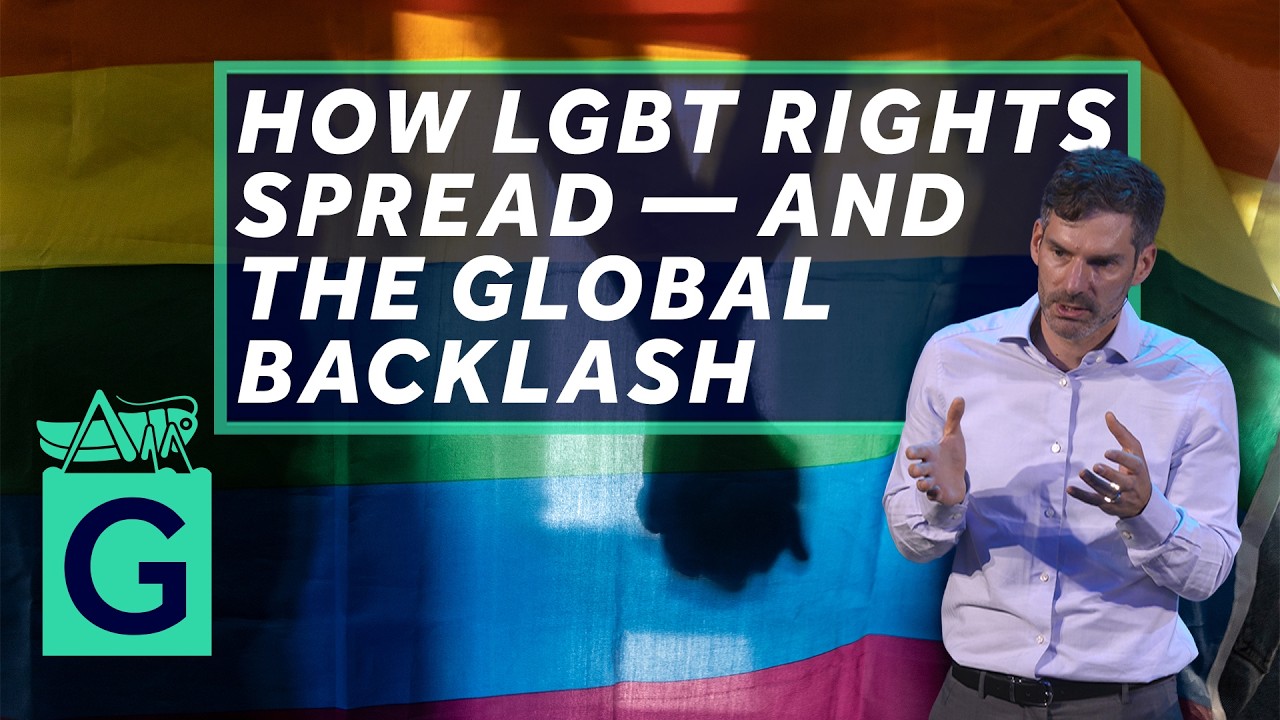
The Global Fight Against LGBTI Rights - Phillip Ayoub
Keywords
Summary
273 words
Critical Evaluation
Value of the Information & Strength of the Argument
The lecture’s main value is conceptual synthesis. It connects several literatures and research projects into a clear account of how international and domestic factors interact in the expansion and contestation of LGBTI rights. The three-channel model of visibility is useful because it moves beyond a simple domestic-readiness explanation and identifies mechanisms: media and images, membership in international organisations, and activist ties across borders. The argument is strongest where it uses paired cases and concrete episodes to show how international signals become locally salient, as with Ireland’s referendum, Malta’s policy profile, the Merkel cartoon, the Coman and Hamilton case and the Obama effect in New Zealand. The later argument about a ‘double helix’ of rival advocacy networks is original and policy-relevant: it treats anti-LGBTI actors not as purely domestic reactionaries but as transnational entrepreneurs who learn, network and borrow tactics. The argument is less developed in the transcript excerpt, where the double helix metaphor is introduced near the end and not fully specified. Causation is also illustrative rather than demonstrated: the lecture identifies plausible mechanisms and sequences but does not present systematic tests, counterfactuals or alternative explanations. Some concepts, such as ‘visibility’ and ’norm diffusion’, are broad enough to accommodate many cases, which increases descriptive reach but weakens causal precision. The framing of LGBTI rights as a site of fluidity versus fixed conservative worldviews is analytically useful, though it risks simplifying the motives of opponents and the internal diversity of both camps. Overall, the argument is coherent, well organised and intellectually valuable as a synthesis, but it should be read as an expert interpretive account rather than a definitive causal demonstration.
Scientific Rigor, Source Quality, Title Accuracy
The lecture is delivered by a recognised specialist and draws on published books, co-authored research and extended fieldwork, which gives the content a solid scholarly basis. However, the transcript does not include a formal reference list, footnotes or systematic discussion of evidence quality. The sources invoked are mostly the speaker’s own work, comparative cases and organisational examples such as ILGA and the World Congress of Families, with legal and political illustrations including the Coman and Hamilton case and EU anti-discrimination requirements. The description provides links to the Gresham College lecture page and a separate Q&A session, but not to a bibliography. This limits independent verification of specific claims from the talk alone. The title is reasonably aligned with the content, though ‘The Global Fight Against LGBTI Rights’ suggests a focus on opposition, whereas the lecture gives substantial space to advances, diffusion mechanisms and activist adaptation. The empirical coverage is also uneven: Europe dominates, with Zimbabwe as the main non-European case, so the global scope is asserted more than fully demonstrated. These are limitations of format and scope rather than signs of unreliable expertise.
468 words
Title / Content Match
The title broadly fits the lecture's focus on transnational contestation over LGBTI rights, but 'global fight against' emphasizes opposition more than the lecture does overall, since it also documents legal advances and activist strategies. The empirical coverage is mostly European, with one extended Zimbabwe case, so 'global' is somewhat expansive.
Quality & Reliability
7/10
Gresham College public lecture by a UCL professor of international relations, drawing on long-term research and comparative cases. The content is expert-led and conceptually coherent, but it remains a lecture synthesis rather than a peer-reviewed article: no formal bibliography is presented in the transcript, causal claims are illustrated rather than systematically tested, and examples are selective.
Chapters
- Introducing Professor Phillip Ayoub
- Welcome and lecture roadmap
- The central question: has progress on LGBT rights kept pace?
- Research origins: two decades of change
- Netherlands and the first wave of marriage equality
- Surprising adopters: Ireland and Malta
- Three channels of LGBT rights visibility
- Transnational activist networks
- Case study: Germany, Ireland and Merkel
- Spiral models and international courts
- The Obama effect and policy diffusion
- Backlash begins: the Warsaw rainbow arch
- Framing LGBT rights as a threat
- Anti-LGBTQ movements adopt transnational tactics
- World Congress of Families: Tbilisi and Nicosia
- Anti-propaganda and "foreign agent" laws
- The "double helix" of rival advocacy networks
- Key anti-LGBTQ organizations and their reach
- Decoding "gender ideology" and recent policy examples
- How LGBT movements are adapting their frames
- Case study: Zimbabwe and rooting rights in history
- Closing remarks and Q&A
Cited Sources
- Gresham College lecture page: The Global Fight Against LGBTI Rights — Official lecture page listed in the video description, with transcript and downloadable versions.
- Q&A session for the lecture — Separate Q&A video linked in the description.
- When States Come Out: Europe's Sexual Minorities and the Politics of Visibility — Book by Phillip Ayoub, Cambridge University Press, 2016, cited in the introduction and used as background for the visibility argument.
- Co-authored research with Kristina Stöckl on backlash and rival transnational advocacy networks — Research project explicitly cited as the basis for the lecture's argument about anti-LGBTI transnational organizing and the 'double helix' model.
External References
Contribution & Novelties
The original contribution is the application of transnational advocacy and norm-diffusion models to anti-LGBTI actors. Ayoub argues that conservative and anti-gender networks use many of the same tools as LGBTI movements: international meetings, cross-border organizing, legal venues, shared frames and pressure on states. The ‘double helix’ metaphor captures the idea that rival networks now develop in relation to one another, each responding to the other’s presence and borrowing tactics. This reframes backlash not as a purely domestic residue but as a transnational political phenomenon. The lecture also highlights how LGBTI movements adapt their framing in response, for example by reclaiming ‘family’ language or rooting rights claims in local and indigenous history, as in the Zimbabwe case. These points are valuable for international relations theory because they challenge the assumption that transnational human-rights diffusion is mainly progressive and that nationalism necessarily prevents cross-border conservative cooperation.
Further reading:
- Spiral model and boomerang model of human-rights norm diffusion — conceptual background used to explain how international pressure and activist networks can push states to adopt rights.
- ‘Double helix’ model of rival transnational advocacy networks — Ayoub and Stöckl’s metaphor for reciprocal LGBTI and anti-LGBTI transnational mobilization; the lecture introduces it but does not fully elaborate it in the transcript.
- Coman and Hamilton v. Romania — European Union legal case discussed as an example of free movement and marriage-recognition pressure on a member state.
- World Congress of Families — transnational conservative network cited as an example of cross-border anti-LGBTI organizing; the lecture discusses its Tbilisi meeting and related events.
- Gresham College lecture page — official page for the lecture, transcript and downloadable materials.
269 words
Radar Profile
The profile is high on information quantity and quality, moderate on technical depth, and solid but not maximal on reliability. This fits a synthetic international-relations lecture: conceptually rich and empirically illustrated, but not a formal systematic review or a primary data study.