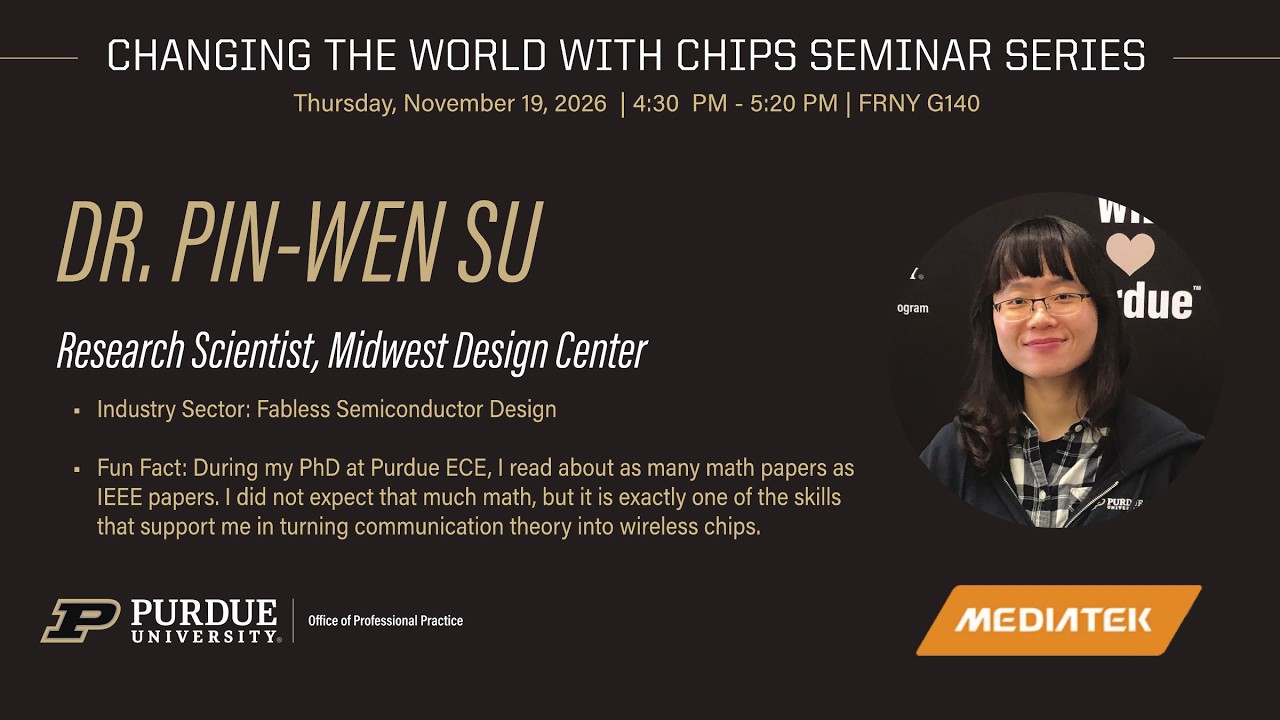
From Math to Silicon: Inside a Wireless Chip (Pin-Wen Su, MediaTek Technology USA Inc.)
Keywords
Summary
149 words
Critical Evaluation
Value of the Information & Strength of the Argument
The presentation provides valuable insight into the industrial application of communication theory, demystifying the role of a system engineer. The argumentation is coherent: it logically flows from company overview to specific research topics, then dives into the technical workflow and design tradeoffs. Concrete examples (repetition code, LDPC) help illustrate abstract concepts. The speaker acknowledges uncertainties (e.g., space data centers being nascent) and stresses the importance of collaboration between algorithm and hardware teams. The main value lies in bridging academia and industry, giving students a realistic view of chip design challenges and career paths.
Scientific Rigor, Source Quality, Title Accuracy
The speaker is qualified, and the information is consistent with industry knowledge. Sources are not explicitly cited, but the content reflects the speaker’s professional experience and company data. The title is apt, though the talk also covers career advice and company promotion. The video appears to have no comments provided; therefore, no public reception analysis is included. The lack of explicit references limits verifiability, but the technical explanations are sound and align with established communication theory and semiconductor industry practices.
188 words
Title / Content Match
The title accurately captures the presentation's core theme—translating mathematical communication theory into silicon chip design. It matches the content well.
Quality & Reliability
8/10
The speaker is a research scientist with a PhD from Purdue, presenting technical content from a leading fabless semiconductor company. The information is credible, grounded in practical engineering experience, and includes concrete examples (LDPC codes, satellite communication challenges). Some claims (e.g., revenue figures, product placements) are company-specific but presented as factual.
Key Moments
Markers derived by PSI from the transcript: the creator did not define chapters.
- Introduction and personal background, including studies at Taiwan, Germany, and Purdue.
- Overview of MediaTek: fifth-largest fabless company, products, and global reach.
- Focus on West Lafayette office: mission, research areas (energy-efficient circuits, GaN, heterogeneous integration, AI-assisted design).
- Research topic: satellite communications, challenges (Doppler effect, signal attenuation, handover).
- On-device AI: benefits (privacy, speed, offline) and challenges (memory, energy, quantization).
- Space data centers: concept, heat dissipation, communication bottlenecks, open questions.
- System engineer's role: from theory to algorithm to hardware; example of channel coding with LDPC.
- Takeaways: chips are hardware plus ideas, wireless is hard, engineering is tradeoffs; hiring pitch.
Cited Sources
- Changing the World with Chips - Introduction to Semiconductors course description — Course description mentions the seminar series and MediaTek's participation.
Concurring Sources
- MediaTek official website — Confirms company size, revenue, and product lines as mentioned.
Contribution & Novelties
The talk offers a rare industry perspective on how communication theory is translated into wireless chip design, emphasizing the role of a system engineer and the tradeoffs in chip design. It also highlights emerging research areas like satellite communications and on-device AI, providing a glimpse into future challenges and opportunities.
Pour aller plus loin :
- Low-density parity-check code — LDPC codes are mentioned as a smarter coding technique; this page explains the concept.
- Satellite communication — Context for the challenges discussed, including Doppler effect and latency.
- On-device AI — Further reading on running AI locally on devices, addressing the mentioned benefits and challenges.
- Fabless semiconductor company — Clarifies the business model described in the talk.
115 words
Radar Profile
The radar profile is balanced with high scores in information quality and reliability, reflecting the speaker's expertise and clear presentation. Quantitative information is slightly lower due to limited depth, but the technical level is appropriate for the audience. Overall, the video is a solid educational resource for students interested in semiconductor engineering.