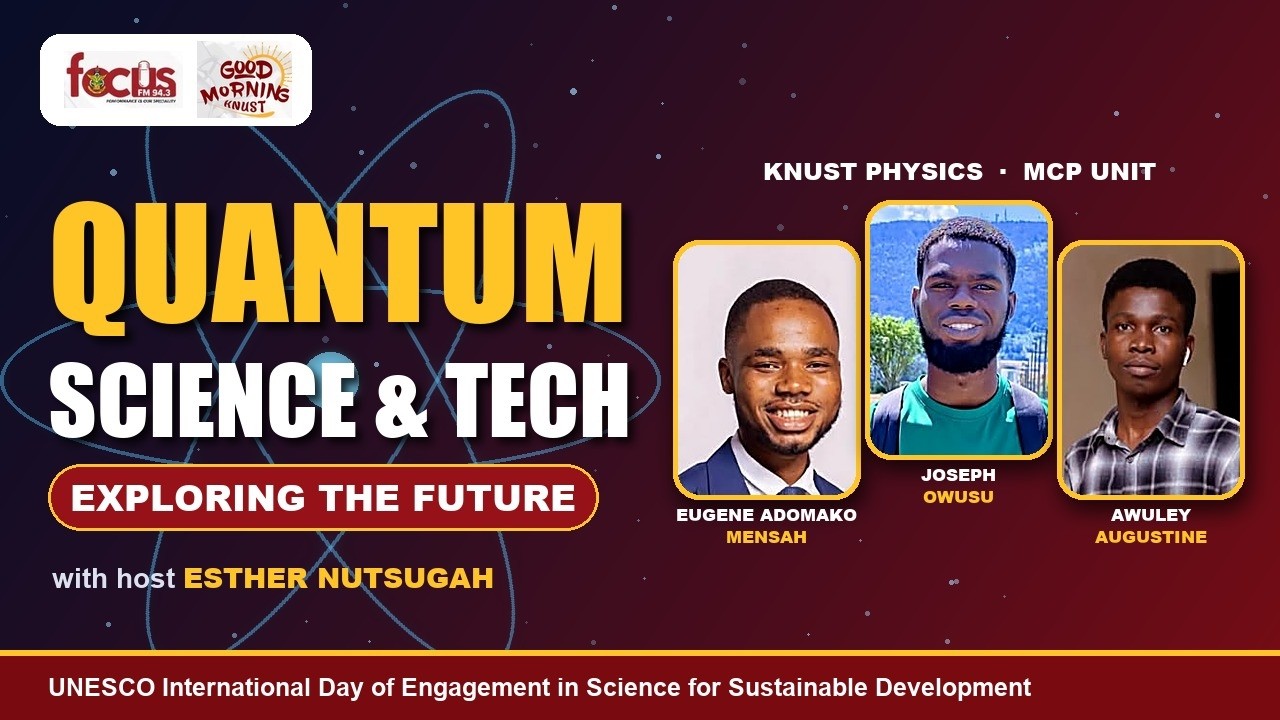
Quantum Science for Sustainable Development | UNESCO Science Day | Focus FM KNUST
Keywords
Summary
348 words
Critical Evaluation
Value of the Information & Strength of the Argument
The informational value lies less in the physics, which is standard textbook material delivered at an introductory level, than in the concrete picture it gives of what a small, well-organised African research unit is actually doing with quantum methods. The four-pillar framing — computing, communication, sensing, materials — is a serviceable map of the field, and each pillar is attached to a use case rather than left abstract: drug behaviour prediction, quantum key distribution for banking and government traffic, detection of chemicals and tumours at their earliest stage, and MOF design for water treatment. The strongest passage is the presentation of the three students’ own projects, because it exposes the actual methodological chain: heavy-metal contamination motivates a materials problem, the materials problem is recast as an electronic-structure problem, the electronic-structure problem is transformed from a fermionic into a qubit Hamiltonian, and the variational quantum eigensolver is used to rank binding energies so that a filter can be designed. The same concreteness appears in Eugene’s account of why machine learning enters quantum optimal control — unstable qubits, expensive and slow conventional optimisation, therefore a cheap surrogate model — which is a genuinely informative statement about method rather than about promise. The explicit refusal to overclaim, when he says he cannot yet assert that the surrogate is more accurate because the work is unfinished, is a notable point of intellectual honesty.
The argumentation, however, is almost entirely by analogy and assertion. Nearly every concept is introduced through a comparison — paper that is really granular, dice that are entangled, a light that is on and off at once, a microscopic magnet for mercury — and analogies of this kind buy intelligibility at the cost of precision; the entangled-dice image in particular transmits a misleading picture of pre-agreed outcomes. No order of magnitude, benchmark, timescale or error rate is given anywhere: quantum advantage is evoked through the contrast between classical and quantum computers without any statement of where the boundary currently lies, and Shor’s algorithm is presented as a recent solved problem rather than as an algorithm whose experimental demonstration remains confined to small numbers. The sustainable-development thread, which the title promises, is argued rather than demonstrated: illegal mining, water pollution and food security are named as motivations, but no quantitative link is drawn between the quantum work described and an environmental outcome, and the leap from ’these problems are complex’ to ‘quantum methods will help’ is made without intermediate steps. The closing passages on careers and on quantum computers complementing rather than replacing classical machines are sensible and better grounded, since they rest on the speakers’ own experience of training and of computational constraints. Overall the segment is informative about intentions, research directions and local capacity, and thin on evidence, measurement or verification.
Scientific Rigor, Source Quality, Title Accuracy
No bibliographic source is invoked at any point: there is no paper, no review, no dataset, no institutional report and no numerical result. The references that do appear are of three kinds. The first is institutional and legitimate — UNESCO and its newly proclaimed international day, and the Department of Physics at KNUST — and is used correctly to frame the broadcast. The second is a named commercial actor, a UK company said to be predicting drug behaviour with quantum simulation, cited without a study, a product name beyond the company, or any performance figure, which makes it unverifiable from the listener’s position. The third is algorithmic, with Shor’s algorithm and the variational quantum eigensolver named as techniques; the second is described correctly enough as an algorithm for obtaining energies, while the first is attached to a claim about prime factorisation having been ‘recently solved’ that conflates a theoretical breakthrough with an achieved computational result. Terms such as fermionic and qubit Hamiltonians, superposition, entanglement and tunnelling are used in acceptable general senses, though with the simplifications one expects in spoken outreach. There is no engagement with the open scientific controversies of the field — error correction, decoherence budgets, the practical reach of near-term devices — and no attempt to distinguish established technology (MRI, atomic clocks, both correctly flagged as first-generation quantum technology) from speculative or laboratory-stage work. The factual base is therefore sound but uncited, and the listener has no route from the broadcast to a primary source.
On the relation between title and content, the fit is good: the segment is announced as a UNESCO science-day conversation on quantum science and sustainable development, and it delivers exactly that, including the local research component the description advertises. The mismatch is minor and concerns emphasis rather than subject — ‘sustainable development’ occupies a modest share of the airtime compared with the general exposition of quantum concepts, and the connection is carried mainly by the water-treatment projects. No promotional insert was identified in the transcript.
809 words
Title / Content Match
The title is faithful: the segment is explicitly framed around UNESCO's first International Day of Engagement in Science for Sustainable Development and delivers a broad tour of quantum science and its applications. Only the 'sustainable development' half is treated somewhat loosely, mainly through water-pollution research.
Quality & Reliability
5/10
Radio outreach segment delivered by postgraduate researchers from a recognised physics department, with a coherent and largely accurate conceptual overview of quantum technologies. However, no source, paper, dataset or figure is cited on air, several statements are imprecise (Shor's algorithm described as having 'solved' prime factorisation, entanglement reduced to a pair of dice always showing the same number, 'electrons nowhere and everywhere'), and forward-looking claims about impact are asserted rather than quantified. Reliable as an introduction and as a window on local research activity, not as a technical reference.
Key Moments
Markers derived by PSI from the transcript: the creator did not define chapters.
- Eugene introduces UNESCO and explains why the organisation proclaimed the International Day of Engagement in Science for Sustainable Development: bridging laboratory and published science with society, using illegal mining water pollution and food security as examples.
- Presentation of the Mathematical and Computational Physics Unit: its purpose (mathematical and computational treatment of systems too complex or too costly to realise experimentally) and its four research strands, including quantum science and technology.
- Joseph's conceptual introduction to quantum science: matter at microscopic scale, the breakdown of classical intuition for electrons, and the granular nature of apparently continuous objects.
- Explanation of superposition and of the bit/qubit distinction, followed by the entangled-dice analogy for quantum entanglement.
- Augustine lays out the four technology families — quantum computing, communication, sensing and materials — and introduces tunnelling and the use of quantum simulation to predict drug behaviour.
- Eugene on why quantum technologies matter: complexity of current problems, Shor's algorithm for prime factorisation, and the first-generation legacy of MRI and caesium atomic clocks.
- Quantum key distribution for protecting banking and government communications, and quantum sensing for detecting chemicals and tumours at their earliest stage.
- Joseph describes his research on metal-organic frameworks for capturing heavy metals such as lead and mercury while leaving beneficial calcium and magnesium ions in the water.
- Eugene presents quantum optimal control with deep learning surrogate models for qubit manipulation, and his quantum-sensing project aimed at detecting mercury at microscopic scale.
- Augustine explains the fermionic-to-qubit Hamiltonian transformation and the variational quantum eigensolver used to compute binding energies that inform MOF design; closing remarks cover careers, quantum engineering and limited access to high-performance computing.
Cited Sources
- UNESCO — International Day of Engagement in Science for Sustainable Development — Invoked at the opening as the institutional frame of the broadcast, with an account of UNESCO's mandate in education, science and culture and of the day's goal of connecting research to the public.
- Shor's algorithm — Presented by Eugene as the prime-factorisation breakthrough that demonstrated the potential of quantum computers and changed perceptions of the field.
- Mion Solutions (UK company, drug behaviour prediction) — Cited by Augustine as an example of a firm using quantum simulation to predict how drug molecules behave in the body and thereby to limit side effects; no study or technical detail is provided.
- Variational Quantum Eigensolver (VQE) — Described by Augustine as the algorithm he uses to compute the energies of a qubit Hamiltonian and identify the binding energy of heavy metals captured by a metal-organic framework.
Concurring Sources
- Quantum computing — Wikipedia — Corroborates the description of qubits, the gate-based model, and the current state of quantum advantage, which the segment presents in simplified form.
- Quantum superposition — Wikipedia — Confirms the principle underlying the segment's explanation of a qubit existing in a combination of 0 and 1.
- Quantum key distribution — Wikipedia — Supports Augustine's account of eavesdropper detection based on superposition and entanglement for protecting sensitive communications.
- Quantum tunnelling — Wikipedia — Matches the description of a particle passing through a barrier that classical physics would treat as impenetrable.
Dissenting Sources
- Shor's algorithm — Wikipedia — The segment presents prime factorisation as a recently solved problem and a breakthrough for quantum computers. In practice Shor's algorithm is a theoretical result whose experimental demonstrations have been limited to very small numbers, and factoring cryptographically relevant keys remains far beyond current hardware without large-scale error correction.
- Quantum entanglement — Wikipedia — The entangled-dice analogy, in which both dice always show the same number, suggests pre-agreed or classically correlated outcomes. Entanglement is stronger than classical correlation and cannot be reproduced by shared hidden variables, yet it also cannot be used to transmit information, a point the analogy obscures.
Contribution & Novelties
The segment’s originality is geographic and institutional rather than scientific: it gives a public, first-person account of quantum research being carried out in Ghana, by named postgraduate students in a specific unit, on problems that are locally salient — heavy-metal and mercury contamination of water bodies linked to illegal mining, and the design of porous metal-organic frameworks to treat it. The methodological thread it exposes is the useful part: the translation of an environmental contamination problem into an electronic-structure problem, then into a qubit Hamiltonian, then into an energy computed with the variational quantum eigensolver, with the results fed back into materials design. Equally concrete is the account of quantum optimal control as a resource-allocation problem — unstable qubits, costly conventional optimisation, hence surrogate models trained on simulation — and the honest statement that the surrogate’s accuracy has not yet been demonstrated. The framing of first-generation quantum technology (MRI, atomic clocks) against second-generation devices is a clarifying distinction rarely made in popular treatments. What the segment does not provide is any new result, figure or comparison; its novelty lies in visibility and in the local anchoring of a global research agenda.
Further reading:
- Quantum computing — Background for the bit/qubit distinction, the four technology pillars and the current limits of quantum advantage discussed in the segment.
- Quantum superposition — Formal statement of the principle Joseph illustrates with the paper, the electron and the on/off light.
- Quantum entanglement — Corrective reading for the entangled-dice analogy, including why correlation cannot be used to signal.
- Quantum key distribution — Technical basis of the eavesdropping detection described for banking and government traffic.
- Variational quantum eigensolver — The hybrid algorithm Augustine applies to heavy-metal binding energies.
- Quantum optimal control and GRAPE-type pulse engineering — The research area Eugene describes, where learned surrogate models replace expensive iterative optimisation of control fields.
- Metal-organic frameworks for heavy-metal sequestration — The materials class at the centre of Joseph’s and Augustine’s projects; accessible introductions exist in chemistry reviews and in environmental-engineering literature.
332 words
Radar Profile
The profile is that of an accessible outreach conversation: high on informational breadth and on the diversity of applications covered, low on technical depth and on evidentiary support. Technical level and reliability scores sit close together because the physics is broadly correct but simplified and entirely uncited. Quantity of information is the strongest axis, reflecting the density of topics packed into thirty-five minutes.