Prof. Jan Krajicek | Facets of the logical foundations of complexity theory
Title history
- Prof. Jan Krajicek | Facets of the logical foundations of complexity theory — observed on 20261101-0213 UTC (YouTube)
Keywords
Summary
166 words
Critical Evaluation
Value of the Information & Strength of the Argument
The talk provides valuable insights by identifying three under-explored logical problems in complexity theory, emphasizing the need to understand logical facets rather than just adding technical results. The argumentation is solid, drawing on known theorems and recent work, and is presented with clear reasoning. The speaker critically examines common assumptions, such as the differential treatment of hypotheses E and H, and argues for more rigorous criteria for ‘plausibility’. The technical part, while detailled, illustrates a concrete construction that connects to the broader questions, but the main value lies in the conceptual framing and the open problems highlighted.
Scientific Rigor, Source Quality, Title Accuracy
The lecture demonstrates high scientific rigor, with references to specific results, such as the formalization of CSP in bounded arithmetic and consistency results from Kudlak and others. The speaker carefully defines concepts and uses standard formalisms. Sources are implicitly referenced but not explicitly cited with URLs; the only external links provided in the description are to the Newton Institute and the specific seminar page, which serve as institutional references. The title is perfectly aligned with the content, which indeed explores facets of logical foundations. No comment data were available for analysis.
203 words
Title / Content Match
The title accurately reflects the presentation, which explores logical foundations of complexity theory, covering both informal problems and a technical construction.
Quality & Reliability
9/10
High-quality lecture by a leading expert, based on established results and careful reasoning, with rigorous formalizations and clear exposition.
Key Moments
Markers derived by PSI from the transcript: the creator did not define chapters.
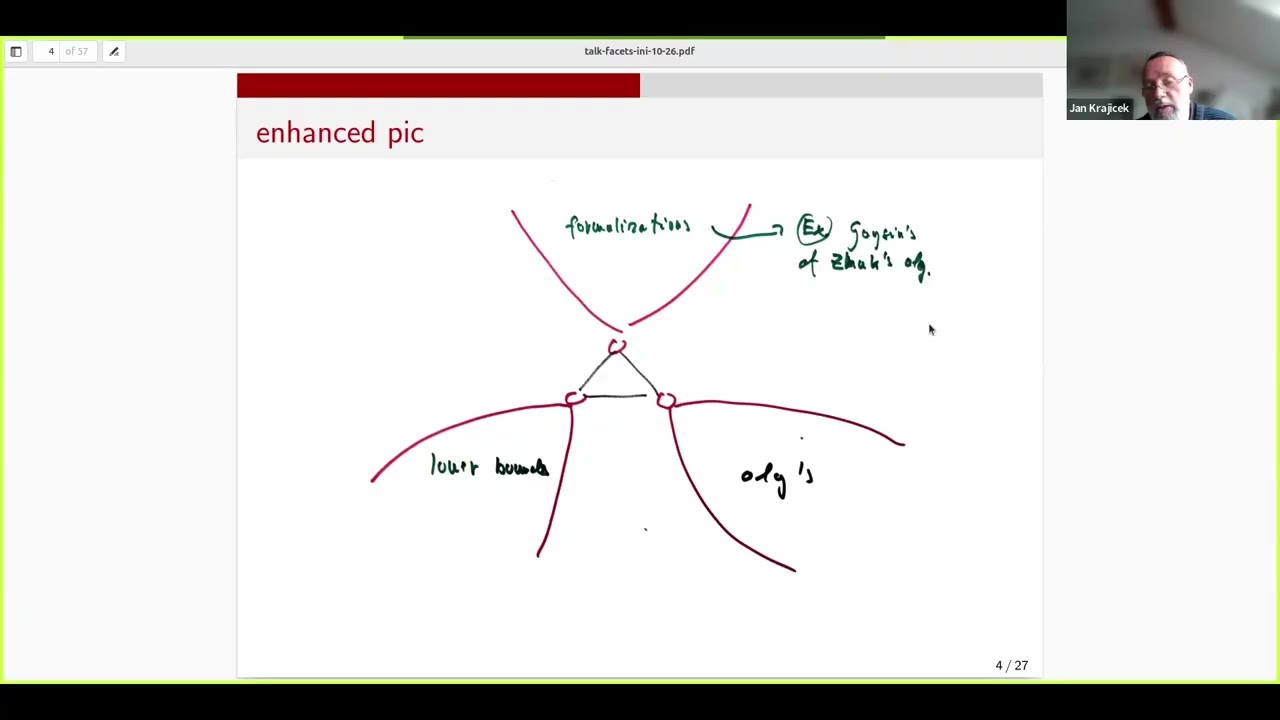
- Introduction and overview of the talk's structure, presenting the basic triangle of theories, proof systems, and computational classes.
- Discussion of the first informal problem: consistency of key computational complexity hypotheses with weak arithmetic theories, mentioning results on EF and PV.
- Second informal problem: the meaning of 'plausibility' for hypotheses such as E and H, questioning the justification of common beliefs.
- Third informal problem: does the theory in which soundness of algorithms is proved matter? Examples about P vs NP and provability of lower bounds.
- Technical construction (second part of talk) relating to soundness and simulation among proof systems, with implications for optimality.
Cited Sources
- Newton Institute Website — Institutional page providing background on the Isaac Newton Institute.
- Seminar Page on Logical Foundations of Complexity Theory — Event page for the seminar where this talk was presented.
Contribution & Novelties
The talk offers a unique perspective by systematically identifying logical foundations issues beyond mere formalization, such as the notion of plausibility and the significance of the proving theory. It also brings attention to a lesser-known formalization of CSP algorithms in bounded arithmetic. The presentation encourages a re-examination of core complexity hypotheses through a logical lens.
Pour aller plus loin :
- Proof complexity — Overview of the field connecting propositional proof systems and complexity classes.
- Bounded arithmetic — Theories formalizing feasible computational reasoning, central to the talk.
- Isaac Newton Institute seminar — Direct link to the event and related resources.
- Extended Frege systems (no URL available) — Key proof system discussed, with polynomial-size proofs relating to PV.
116 words
Radar Profile
The radar profile is dominated by very high technical level and high information quantity, with slightly lower but still strong scores on quality and fiability, reflecting a dense, expert-level presentation with solid rigor but limited accessibility to non-specialists.