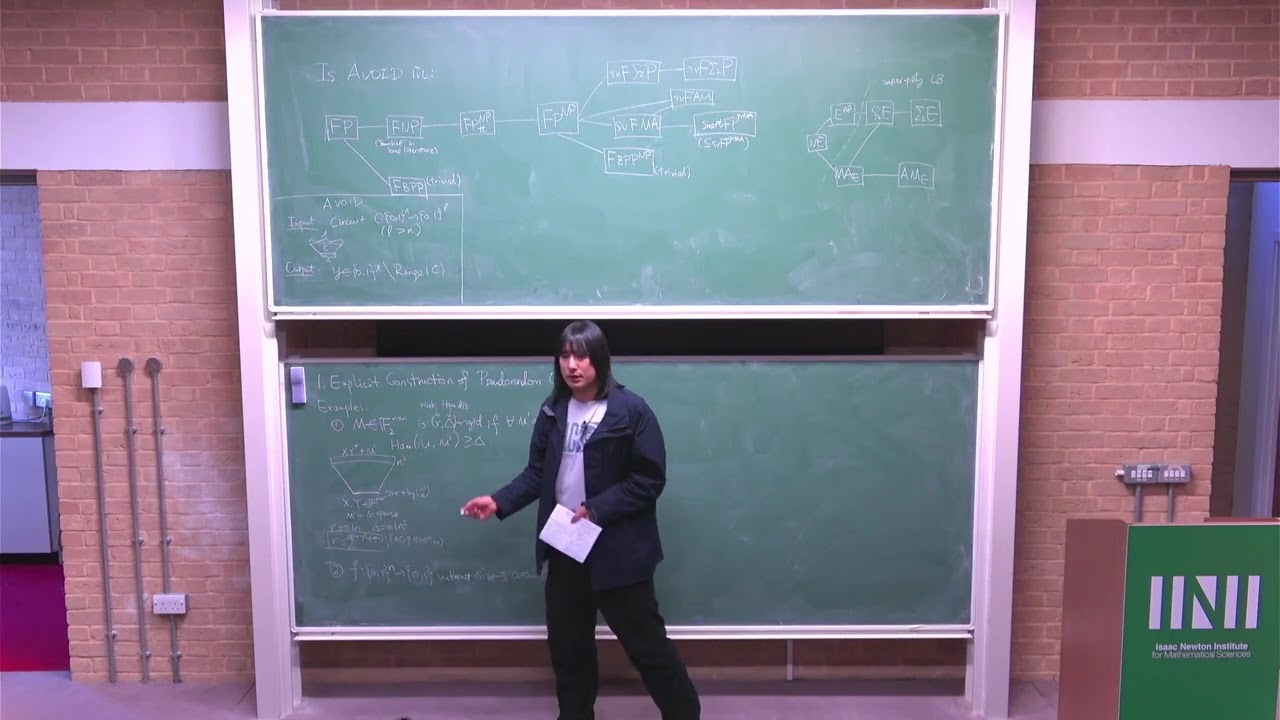
Dr. Hanlin Ren | The complexity of Range Avoidance (and why you should care)
Keywords
Summary
271 words
Critical Evaluation
Value of the Information & Strength of the Argument
The informational value is high for anyone working in complexity theory: the talk does not merely report results, it organises an entire research area around a single question and makes explicit the reduction machinery linking them. Three families of explicit constructions — rigid matrices, hard truth tables or circuit lower bounds, and pseudorandom objects more generally — are each shown to reduce to range avoidance in a parameter regime where the reduction is essentially a re-encoding of the search space (a non-rigid matrix described by two rectangular factors plus sparse noise, a truth table described by a small circuit). The proofs sketched are short and checkable, which is what makes the argument persuasive rather than rhetorical. The speaker is also careful with epistemic status: he marks the boundary between trivial, known, conjectural and open cases, distinguishes the regimes where parameters matter, and repeatedly concedes ignorance (‘I haven’t fully understood the EXP part’, ‘I’m not super familiar with these algorithms’, ‘I forgot’). That candour is a strength of the argumentation, since it prevents over-claim from spreading to the surrounding claims. The argumentative structure is cumulative and modular: each complexity class is a separate case examined in turn, and the conditional statements are stated with their consequences so that a reader can price each hypothesis independently. The weaker point is the density of the delivery: several definitions are introduced verbally with parameters left implicit, and the audience questions periodically interrupt the thread, so the chain of implications has to be reconstructed. A few claims — notably the ACC0 result and its reliance on rectangular PCPs — are asserted and deferred rather than argued in the room, which leaves the listener dependent on the speaker’s authority for that part.
Scientific Rigor, Source Quality, Title Accuracy
Scientifically, the content is rigorous in the sense that matters for a seminar: definitions are stated formally (stretch, non-output, R-delta rigidity with Hamming distance, NC0 fan-in, gap satisfying pairs), reductions are given in outline, and parameter regimes are specified where they matter. Theorems are attributed to their authors rather than presented as free-floating facts, which is the correct norm in this community. The weakness is bibliographic: references are given orally and from memory, several are approximate or garbled by transcription, one is explicitly ‘some paper, I forgot’, and no full citation or preprint link is offered during the talk. The description’s links point only to the seminar event page and the institute website, not to any of the papers discussed, so the cited works cannot be followed up from the video itself. The admissibility of the results is therefore high in mathematical substance and low in traceability. On the title: it fits the content closely, and the ‘why you should care’ promise is honoured with concrete, argued motivations rather than a slogan.
473 words
Title / Content Match
The title is accurate: the talk defines the range avoidance problem and then systematically examines, class by class, why its complexity matters, exactly as announced. The 'why you should care' part is genuinely delivered through the connections to explicit constructions and circuit lower bounds.
Quality & Reliability
7/10
Research-level seminar delivered by an active specialist presenting his own results and a coherent survey of the state of the art. The mathematical content is dense and internally consistent, definitions are given explicitly, and the speaker openly flags what he does not know or has not worked through. However, bibliographic references are given orally and from memory, several author names and paper labels are imprecise or garbled, no formal citation apparatus or slides with full references are provided, and the key unconditional result is stated without proof details. Reliable as an expert overview, weaker as a citable source.
Key Moments
Markers derived by PSI from the transcript: the creator did not define chapters.
- Formal definition of range avoidance: given a circuit stretching n input bits to L output bits, output a string of length L outside its range; the problem is a search problem, hence functional classes FP, FNP, FP^NP.
- Trivial bounds: a random string is a solution with high probability, but verification seems to need an NP oracle, giving an errorless randomised algorithm with an NP oracle — and the caveat that the exact definition of functional BPP matters.
- First motivation: rigid matrices (Valiant). A random matrix is rigid with high probability; finding one reduces to range avoidance, since a non-rigid matrix is encoded by two rectangular factors plus sparse noise.
- Second motivation: explicitly constructing a hard truth table, i.e. proving circuit lower bounds. A deterministic polynomial-time range avoidance algorithm would yield polynomial-time constructions matching the probabilistic method.
- Restriction to NC0 circuits: the tight stretch regime (L = n+1, fan-in 4) would give strong formula lower bounds; fan-in 2 is tractable, and the picture connects to refuting random k-SAT and static data-structure lower bounds.
- Three reasons to care about FP^NP rather than FP: dynamisation of the existing algorithm, Ryan Williams' algorithmic method, and Cottom's 'hardest explicit construction'.
- Statement of Williams' algorithmic method: a non-trivial derandomisation algorithm for a well-behaved circuit class yields circuit lower bounds; the speaker recasts it as producing FP^NP range avoidance algorithms.
- Definition of the gap satisfying-pairs problem — distinguishing all-zero from half-ones over a family of circuits and inputs in subquadratic time — and the theorem that such an algorithm implies range avoidance in FP^NP for restricted circuit classes.
- Unconditional result: ACC0 range avoidance is in FP^NP when the output length exceeds a quasi-polynomial in the circuit size, with the quasi-polynomial depending on depth and modulus.
- The new ingredient required: rectangular PCPs, introduced in a follow-up work, and the closing point that Williams' algorithmic method solves whole families of range avoidance instances, not only lower bounds.
Cited Sources
- INI seminar page — 'The complexity of Range Avoidance (and why you should care)', LFC programme — Event page linked in the description, giving speaker, date and host programme (Logical foundations of complexity theory).
- Isaac Newton Institute for Mathematical Sciences — Host institution, linked in the description; context for the seminar series in which the talk was given.
- Valiant — work introducing rigid matrices and showing random matrices are rigid — Cited from memory by the speaker as the origin of the rigidity notion, roughly fifty years ago; no URL verified.
- Chen and Ren — polynomial-time construction of rigid matrices with an NP oracle (and follow-up work referred to as 'BHP') — Referenced as the state of the art the speaker builds on; author names and label partially garbled in the transcript, no URL verified.
- Williams — algorithmic method and non-uniform ACC0 lower bounds — The 'algorithmic method' that structures the second half of the talk; the speaker also notes he reformulates the result for EXP^NP rather than EXP.
- Cottom — 'the hardest explicit construction' — Cited as the third motivation for studying FP^NP rather than FP.
- Speaker's papers with Rahul (and follow-up) on range avoidance over restricted circuits — Source of the gap satisfying-pairs notion and of the ACC0 range avoidance result reported in the last third of the talk.
Concurring Sources
- Computational complexity theory — overview of complexity classes and search problems — General reference consistent with the talk's use of FP, FNP, FP^NP and the distinction between decision and search problems.
- Circuit complexity — circuit classes and lower bounds — Confirms the standard framing of hard-truth-table constructions and restricted circuit classes used in the talk.
- P versus NP problem — Consistent with the claim that verifying a candidate non-output appears to require an NP oracle.
Contribution & Novelties
The talk’s distinctive contribution is organisational as much as technical: it takes a single search problem and uses it as a lens through which a large part of complexity theory becomes legible, with a case-by-case table of what happens to explicit constructions, to derandomisation and to lower bounds if range avoidance lands in this class or that one. Two moves are genuinely novel relative to a standard survey. First, the argument that the right target is FP^NP rather than FP, supported by three independent reasons (dynamisation, Williams’ method, Cottom’s hardest explicit construction). Second, the generalisation of the algorithmic method from a lower-bound technique into a solver for families of range avoidance instances, via the gap satisfying-pairs problem, culminating in an unconditional FP^NP algorithm for ACC0 range avoidance in a quasi-polynomial stretch regime. The observation that this proof requires rectangular PCPs — an ingredient that did not exist in the original method — is the kind of detail that only surfaces in a live research report.
Pour aller plus loin :
- Computational complexity theory — Background on complexity classes and the FP/FNP/FP^NP notation used throughout.
- P versus NP problem — Context for why NP oracles appear naturally in the verification step of range avoidance.
- Circuit complexity — Frames the hard-truth-table motivation and the restricted circuit classes (AC0, ACC0, NC0) discussed.
- AC0 — Reference for the constant-depth circuit classes underlying the NC0 and ACC0 sections.
- Pseudorandom generator — Entry point to the family of explicit constructions of pseudorandom objects that the problem is meant to capture.
- Rigid matrix (Valiant) — concept central to the first reduction; cited by name only, no URL given here.
- Gap satisfying pairs, rectangular PCPs, and the ‘hardest explicit construction’ — technical notions introduced or used in the talk; cited by name, no stable public URL verified.
299 words
Radar Profile
The profile is sharply skewed: maximal technical level, very high information density, and solid information quality, offset by a moderate reliability score that reflects oral, memory-based citations rather than any doubt about the mathematics. The gap between technical level and reliability is exactly what one expects from a live research seminar that is authoritative in substance but not designed to be quotable.