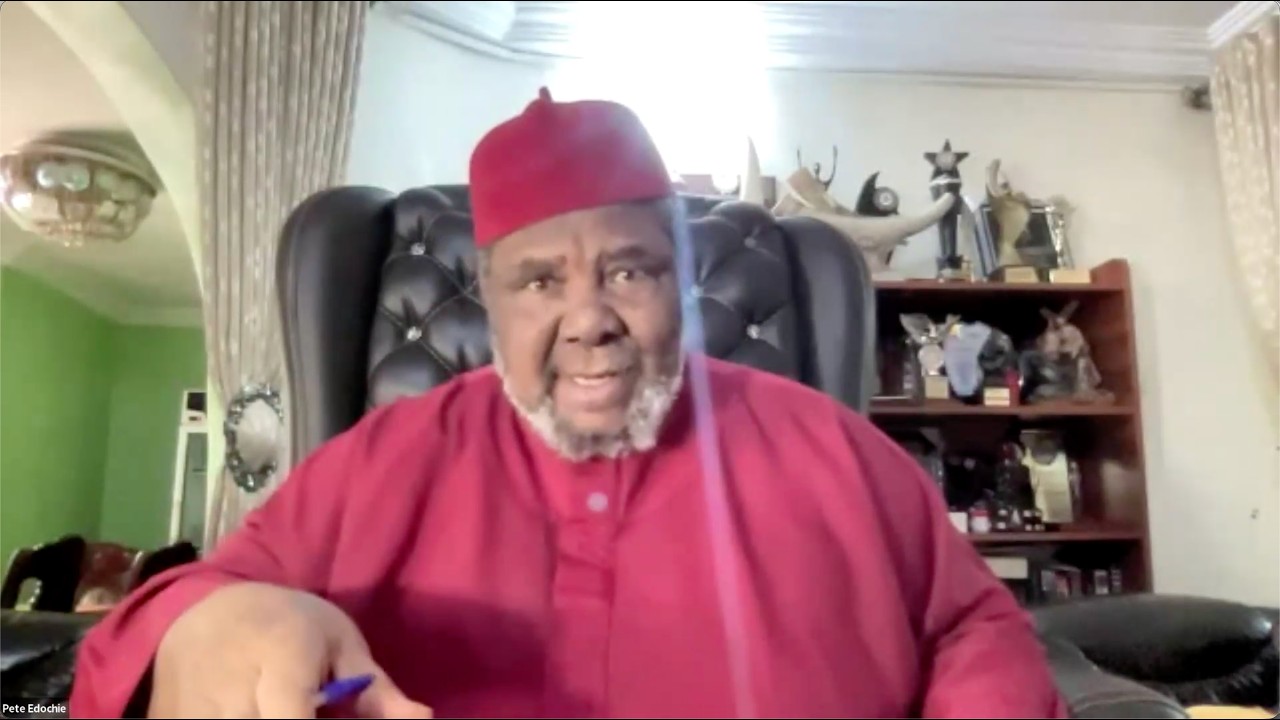
Africana Studies Global Virtual Forum - Pete Edochie
Keywords
Summary
230 words
Critical Evaluation
Value of the Information & Strength of the Argument
The main value of the video lies in its primary-testimony character. Pete Edochie gives a long, situated account of Nigerian broadcasting and film history from the inside, including details about recruitment, training, programme presentation and the transition from broadcasting to Nollywood. The forum also preserves his personal framing of cultural politics: the critique of Western representations of Africa, the defence of African storytelling, and the proposal to film the Igbo Landing story. These are valuable as records of an actor’s self-understanding and of a broader cultural moment. The argumentation, however, is conversational and authority-based rather than demonstrative. Edochie moves between personal recollection, literary quotation, moral judgement and broad historical narrative, with little calibration of certainty. Some claims are presented as vivid anecdote rather than documented fact, and causal explanations are often simplified. The clips from Things Fall Apart add illustrative force, but they do not function as evidence for the historical claims. The session is therefore strongest as oral history and cultural commentary, and weaker as a verifiable argument about film history or historical causation.
Scientific Rigor, Source Quality, Title Accuracy
The session does not follow a formal scholarly protocol: there is no bibliography, no footnoting and no systematic checking of dates or attributions. The sources invoked are literary and cinematic works, such as Chinua Achebe’s Things Fall Apart, Edgar Allan Poe’s ‘The Tell-Tale Heart’, James Baldwin, Alex Haley’s Roots, Sanders of the River, Living in Bondage and Igodo, rather than archival documents or peer-reviewed studies. Several claims are plausible but unverified, and at least one is clearly inaccurate: Edochie says Orlando Martins appeared alongside Ronald Reagan in Sanders of the River, whereas the 1935 film is associated with Paul Robeson. The title is nevertheless accurate and not misleading: it names the forum and the guest, and the content is indeed a long Africana Studies forum conversation with Pete Edochie, including film clips and discussion.
324 words
Title / Content Match
The title accurately identifies the Africana Studies Global Virtual Forum and its guest, Pete Edochie. The available content matches that framing: a long interview-conversation with biographical, film-historical and cultural discussion, plus clips.
Quality & Reliability
5/10
The video is a first-person oral-history forum with a major Nigerian actor and broadcaster, which gives it real documentary value. However, the claims are largely anecdotal, not footnoted, and at least one film-historical assertion appears inaccurate; the session is therefore reliable as testimony but only moderately reliable as factual reference.
Key Moments
Markers derived by PSI from the transcript: the creator did not define chapters.
- Approximate location: welcome and introduction of Chief Pete Edochie by the Africana Studies forum host.
- Approximate location: Edochie recounts his birth in 1947, his parents' backgrounds and his early schooling in northern Nigeria.
- Approximate location: he describes entering broadcasting through a reading test on Poe's 'The Tell-Tale Heart' and his rapid promotion to presenting and newsreading.
- Approximate location: advice to young broadcasters and actors, centred on wide reading and listening to original-language broadcasters such as the BBC.
- Approximate location: Edochie narrates a history of Nigerian film from Orlando Martins through travelling theatre and Ola Balogun to the 1992 breakthrough of Living in Bondage.
- Approximate location: discussion of Western misrepresentation of Africa and Edochie's call for African filmmakers to undertake a 'retaliatory civilizing mission'.
- Approximate location: screening and discussion of three scenes from Things Fall Apart, focused on Okonkwo, Ikemefuna and the colonial confrontation.
- Approximate location: transition to the 1999 film Igodo, The Land of the Living Dead.
Cited Sources
- Things Fall Apart (Chinua Achebe, 1958) — The novel is discussed and adapted in the film clips screened during the forum.
- Living in Bondage (1992) — Edochie identifies it as the film that signalled the arrival of Nollywood.
- Sanders of the River (1935) — Edochie cites Orlando Martins's appearance in this film as an early landmark in Nigerian acting.
- Igodo, The Land of the Living Dead (1999) — The forum moves to this film at the end of the available transcript.
- The Tell-Tale Heart (Edgar Allan Poe) — Edochie recounts being tested on this story during his broadcasting interview.
- Roots (Alex Haley) — Mentioned among the books Edochie urges young broadcasters to read.
- Igbo Landing / Dunbar Creek — Edochie proposes a collaborative film about the 1803 mass drowning and resistance of Igbo captives.
- Orlando Martins — Named by Edochie as Nigeria's first known actor.
Concurring Sources
- Things Fall Apart — Wikipedia — Confirms the 1958 publication and the novel's role in depicting pre-colonial Igbo society, as discussed in the forum.
- Nollywood — Wikipedia — Supports the broad outline of Nollywood's emergence and the significance of Living in Bondage (1992).
- Igbo Landing — Wikipedia — Corroborates the Igbo Landing resistance story that Edochie proposes as a collaborative film subject.
- Pete Edochie — Wikipedia — Provides biographical background consistent with Edochie's account of his broadcasting and acting career.
Dissenting Sources
- Sanders of the River — Wikipedia — Edochie says Orlando Martins appeared alongside Ronald Reagan in Sanders of the River; the 1935 film is associated with Paul Robeson, not Ronald Reagan, so the claim appears inaccurate.
- Living in Bondage — Wikipedia — Edochie attributes the film to 'Kelly Nebwe'; standard accounts identify Kenneth Nnebue as producer and Chris Obi Rapu as director, so the attribution is imprecise.
Contribution & Novelties
The forum’s main original contribution is a long first-person oral history from Pete Edochie, linking Nigerian broadcasting, pre-Nollywood film experiments, the 1992 breakthrough of Living in Bondage, and the cultural politics of African self-representation. It also preserves his account of the Igbo Landing story as a proposed collaborative film project. Its novelty lies less in new archival findings than in the witness testimony and in the framing of Nollywood as a response to colonial representation.
For further reading:
- Things Fall Apart — Wikipedia — Background on Achebe’s novel and its adaptations.
- Nollywood — Wikipedia — Overview of the industry whose early history Edochie narrates.
- Igbo Landing — Wikipedia — Context for the 1803 resistance story Edochie proposes to film.
- Sanders of the River — Wikipedia — Background on the colonial-era film Edochie discusses, useful for checking his claim.
138 words
Radar Profile
The profile is broad rather than deep: a high information volume and a long runtime are offset by low technical density and only moderate reliability. The content is strongest on cultural memory, biography and industry history, and weaker on verifiable factual precision. The radar therefore suggests a valuable oral-history document rather than a technical or evidence-heavy analysis.